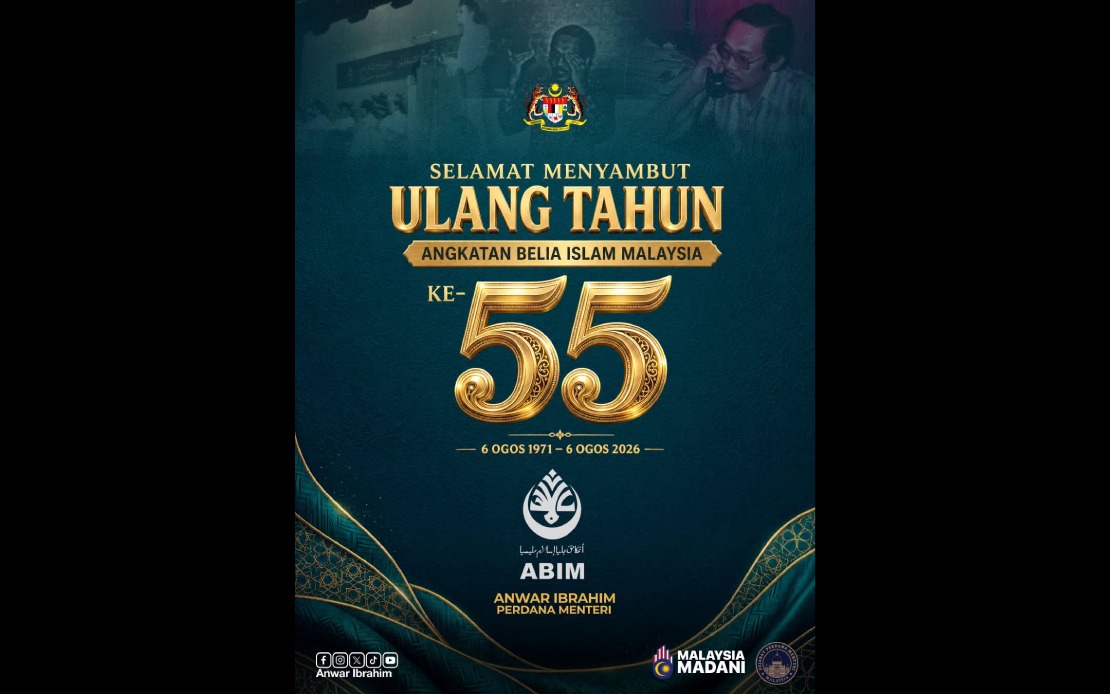
Prime Minister Datuk Seri Anwar Ibrahim has paid tribute to the Muslim Youth Movement of Malaysia (ABIM) as the organisation marks five and a half decades of sustained commitment to student activism and Islamic engagement. In remarks posted on social media, Anwar emphasised that ABIM's milestone anniversary represented far more than a chronological marker—it embodied a legacy constructed on principles of sacrifice, integrity, compassion and unwavering faith in serving Malaysia's Muslim community.
ABIM was formally established on August 6, 1971, making this year's celebration particularly significant as the movement reflects on 55 years of operations spanning generational change, political transitions, and evolving social challenges. The organisation has maintained a distinctive position within Malaysia's Islamic civil society landscape, functioning simultaneously as a youth mobilisation platform, an educational institution, and a voice for community advocacy. Its historical trajectory intersects with Malaysia's own development as a nation, having weathered economic cycles, political shifts, and demographic transitions while preserving its foundational mission.
Anwar's personal connection to ABIM adds particular resonance to his commendation. As a former president of the movement, he represents a direct link between ABIM's institutional memory and contemporary national leadership. This continuity underscores how the organisation has served as an incubator for figures who subsequently assume prominent roles in Malaysian public life, suggesting its influence extends beyond immediate membership to shape broader political and social discourse. The acknowledgment from the sitting Prime Minister reflects official recognition of ABIM's legitimacy as an important stakeholder in Malaysia's Islamic and civic spheres.
The Prime Minister characterised ABIM's mission as transcending narrow religious instruction, instead encompassing a holistic approach to community development and social welfare. According to his assessment, the organisation has actively strengthened Muslim communities across Malaysia, provided material and moral support to marginalised populations, facilitated educational opportunities for successive generations, preserved respect for human dignity as a non-negotiable principle, and maintained hope among constituencies facing confusion during periods of uncertainty. This multidimensional description portrays ABIM not merely as a religious organisation but as a comprehensive social actor engaged in nation-building.
The emphasis on supporting marginalised communities highlights ABIM's welfare-oriented activities, which have historically included educational scholarships, livelihood programmes, and advocacy for vulnerable populations. In Malaysia's context, where income inequality and unequal access to educational resources remain persistent challenges, such work addresses demonstrable social needs. The organisation's educational mission has been particularly significant, offering alternative pathways for knowledge acquisition and spiritual development among youth populations who might otherwise lack such opportunities. This dimension distinguishes ABIM from purely devotional organisations and situates it within broader frameworks of social development.
Anwar's metaphor of ABIM as a tree with deep roots and widespread branches carries symbolic weight in Malaysian discourse, evoking stability, protection, and interconnectedness. The image of roots remaining firm in turbulent conditions speaks to organisational resilience, suggesting that principled adherence to foundational values enables institutions to survive and adapt through different historical periods. The branches offering shelter to the community emphasise ABIM's protective and nurturing function, positioning it as a refuge for those seeking guidance, fellowship, or practical assistance. This arboreal imagery, common in Islamic and Malaysian cultural rhetoric, resonates with audiences accustomed to such metaphorical language in formal address.
The 55th anniversary also provides an opportune moment to consider ABIM's evolving role in contemporary Malaysia. The organisation operates within a domestic landscape increasingly characterised by plural Islamic movements with varying theological orientations, competing visions of Islamic governance, and debates over Islam's relationship to democratic institutions and minority rights. ABIM's historical positioning as a modernist, relatively progressive Islamic movement—emphasizing education, social welfare, and engagement with secular institutions—distinguishes it from more literalist or political approaches that have emerged in recent decades. Understanding how the organisation navigates these ideological currents is essential for analysing contemporary Islamic civil society in Malaysia.
Regionally, ABIM's significance extends beyond Malaysia's borders. The Muslim Youth Movement has engaged in international Islamic networking and student exchanges, positioning Malaysia as a participant in broader conversations about Islamic revivalism, youth engagement, and faith-based approaches to development. Its activities have influenced and been influenced by Islamic movements across Southeast Asia and globally, making its institutional trajectory relevant to understanding how Islamic civil society organisations adapt to globalisation and transnational ideological flows. ABIM's emphasis on grounding Islamic principles in practical community service offers a model that resonates with Muslim-majority societies grappling with similar questions about Islam's contemporary relevance.
The Prime Minister's public commendation serves multiple functions simultaneously. It validates ABIM's contributions to Malaysian society at an official governmental level, potentially enhancing its legitimacy among constituencies skeptical of civil society organisations. It also signals the government's recognition of religious civil society as a legitimate partner in national development, rather than viewing such organisations with suspicion or seeking to subordinate them entirely to state control. This approach reflects a particular vision of church-state relations adapted to the Malaysian context, where Islam maintains constitutional status but civil society organisations retain meaningful autonomous space.
Looking forward, ABIM faces both opportunities and challenges in sustaining its relevance across generational lines. Younger Malaysians navigate digital environments, economic precarity, and climate concerns that earlier cohorts experienced differently, requiring the organisation to articulate how Islamic principles address contemporary anxieties. Simultaneously, ABIM must maintain institutional coherence while accommodating legitimate diversity of opinion among members and supporters. The Prime Minister's emphasis on ABIM's roots in established values suggests confidence that the organisation possesses sufficient foundational stability to accommodate necessary evolution without abandonment of core commitments.
As Malaysia continues navigating complex questions about national identity, religious pluralism, and social inclusion, organisations like ABIM occupy important intermediary positions, translating Islamic principles into community-relevant programming while maintaining engagement with governmental structures and secular institutions. The 55th anniversary celebration thus represents not merely backward-looking commemoration but an occasion to consider how faith-based civil society contributes to Malaysia's ongoing development and democratic health. The Prime Minister's remarks, by recognising ABIM's historical contributions while implicitly encouraging future engagement, position the movement as a valued partner in the nation's continuing evolution.

