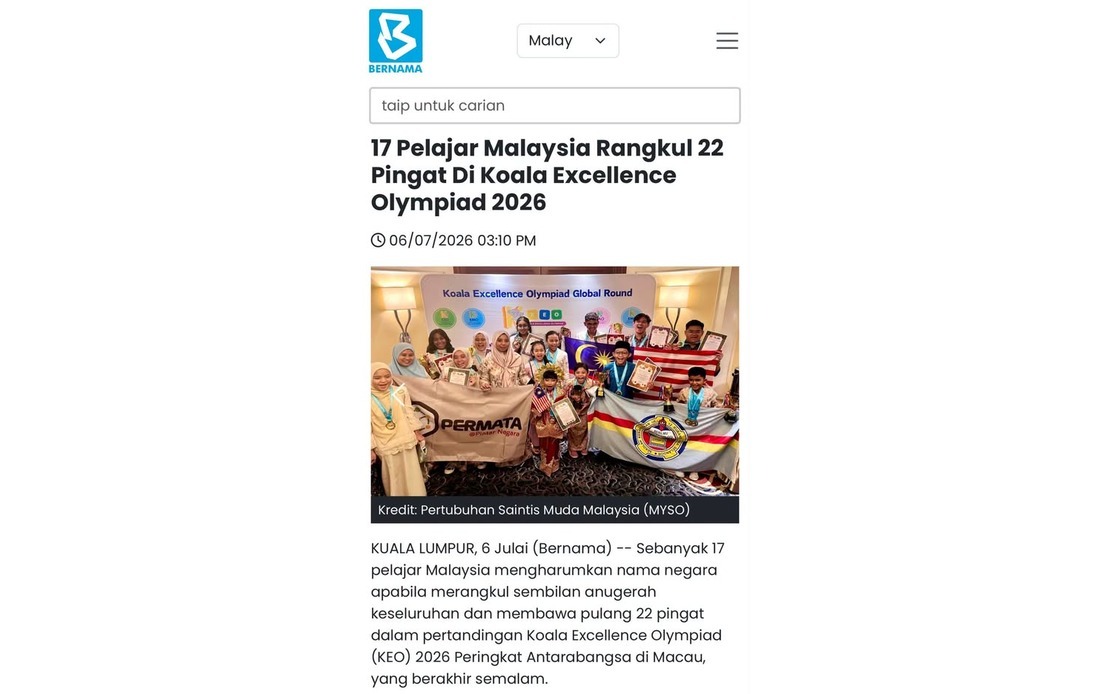
Prime Minister Datuk Seri Anwar Ibrahim has extended his congratulations to a group of 17 Malaysian students following their impressive medal haul at the 2016 Koala Excellence Olympiad (KEO) Global Finals in Macau, which drew to a close recently. The young achievers collectively captured nine overall awards alongside 22 individual medals, demonstrating the calibre of Malaysia's youth talent in competitive academic disciplines.
In his statement posted on social media platform X, the Prime Minister urged the victorious contingent to maintain their drive for excellence and pursued even more ambitious goals in their academic pursuits. His remarks underscored the government's commitment to recognising and encouraging high-achieving students who represent Malaysia on the international stage, reflecting broader national priorities around educational advancement and youth development.
According to Aidah Misran, who served as coordinator of the Malaysia Young Scientists Organisation (MYSO) and led the Malaysian delegation to Macau, the team's medal breakdown comprised five gold medals, six silver medals, and 11 bronze medals. This distribution across multiple medal categories demonstrates consistent strength across various competitive categories rather than concentration in a single discipline, suggesting a well-rounded approach to academic excellence among the Malaysian participants.
The Koala Excellence Olympiad represents a significant international academic platform that welcomes student competitors from numerous countries to test their capabilities across four core subject areas. The competition evaluates proficiency in English, Mathematics, Science, and Arts, providing a comprehensive assessment of student knowledge and problem-solving abilities across these foundational disciplines. This multi-disciplinary framework reflects contemporary educational priorities that emphasise breadth alongside depth of learning.
The KEO competition itself was conceived and developed by a team of Australian educational specialists and university graduates who sought to create a rigorous yet accessible international academic platform. By structuring the competition around these four essential subjects, KEO provides students with opportunities to demonstrate expertise in areas that form the backbone of most secondary and tertiary educational curricula worldwide. The inclusion of Arts alongside traditional STEM subjects represents a conscious effort to value creative and humanities-based learning.
In Malaysia, the coordination and management of KEO participation falls to the Malaysia Young Scientists Organisation (MYSO), working alongside international partners including KEO and the Miss Man International Group. This collaborative approach ensures that Malaysian students receive appropriate preparation and support while maintaining alignment with international competition standards and expectations. MYSO's involvement specifically reflects the organisation's mission to nurture and develop young scientific talent within the Malaysian context.
The success of Malaysian participants at the KEO 2026 Global Finals carries particular significance for Southeast Asia, where educational excellence and international academic recognition serve as markers of national competitiveness. For Malaysia specifically, strong performances by students in international olympiads and competitions contribute to the nation's reputation as a centre of educational quality within the region. Such achievements also serve to inspire younger cohorts of students to engage seriously with academic pursuits and consider participation in similar international forums.
The breadth of Malaysia's representation across multiple medal positions suggests that the contingent benefited from systematic preparation and coaching prior to travelling to Macau. National olympiad programmes typically involve rigorous selection processes and intensive training regimens designed to optimise student performance against international competition. The success of the 17 Malaysian participants reflects not only their individual intellectual capabilities but also the investment and support systems established to facilitate their development.
For Malaysian educators and policymakers, results such as these provide concrete data regarding the effectiveness of current educational approaches and student preparation methods. They also serve as a benchmark for evaluating how Malaysian pedagogical methods compare against international standards and best practices. Recognition from the Prime Minister signals that the government views such academic achievements as expressions of national pride and indicators of educational system health.
The timing and significance of recognising these students through official channels also carries broader messaging value. By publicly congratulating the cohort through formal statements, leadership demonstrates commitment to valuing intellectual achievement and encouraging other students to aspire towards similar excellence. This recognition helps establish a cultural narrative within Malaysia that positions academic achievement, particularly in international forums, as a valued and celebrated dimension of national identity.

