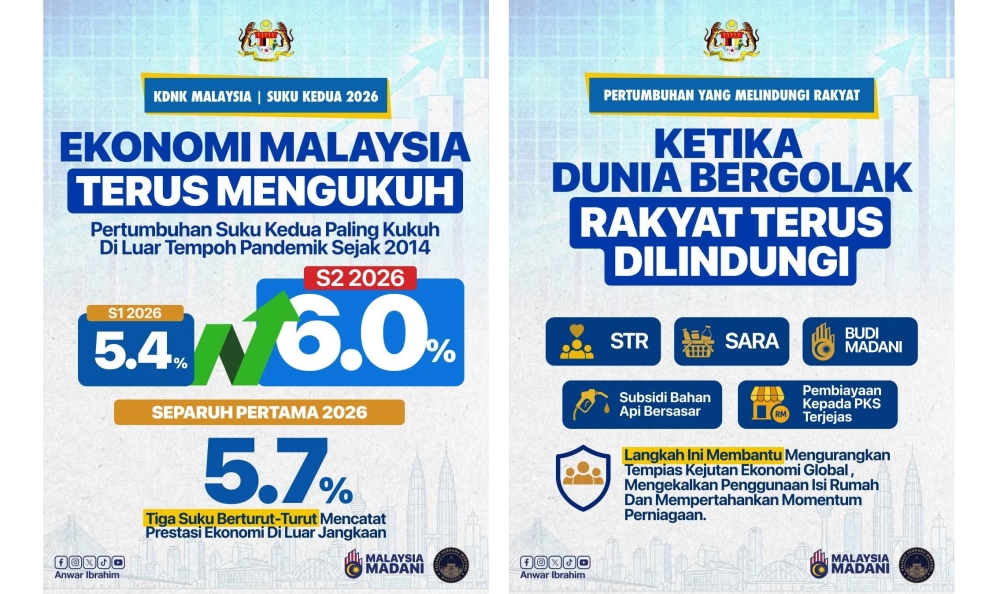
Prime Minister Datuk Seri Anwar Ibrahim threw his weight behind Malaysia's economic trajectory on Wednesday, commending the country's outperformance in the second quarter and underscoring the administration's deliberate efforts to shield Malaysian families from the ripple effects of worldwide price surges.
The government's strategy to mitigate inflation's impact on household budgets has become increasingly central to Anwar's economic narrative, particularly as developing economies across the region grapple with imported commodity costs and currency volatility. By positioning Malaysia's economic resilience as a direct consequence of cabinet-level interventions, the Prime Minister sought to reinforce public confidence in the administration's stewardship during a period of global economic uncertainty.
Malaysia's expansion outpaced analyst expectations during the April-to-June period, signalling continued momentum despite headwinds facing major trading partners. This outperformance carries particular significance for a nation whose growth is substantially dependent on external demand for manufactured goods and services. The result suggests that domestic consumption and investment activity have helped offset softer global conditions, a development that typically reflects both structural strengths and successful policy calibration.
The broader context of Malaysia's economic management involves a delicate balancing act between maintaining growth momentum and preventing household purchasing power from eroding under inflationary pressure. Several Southeast Asian governments have deployed targeted subsidies, price controls on essential goods, and monetary policy adjustments to achieve this balance. Anwar's emphasis on protecting families from inflation costs indicates this remains a political priority even as economic growth rebounds.
Government measures cited by officials typically include fuel and food subsidies, targeted cash assistance programmes, and coordination with the central bank on monetary policy settings. These interventions represent a conscious trade-off between near-term fiscal expenditure and longer-term price stability objectives. For Malaysian policymakers, the calculation has hinged on whether domestic inflation expectations could be anchored through direct protection measures whilst allowing growth drivers to remain active.
The timing of the Prime Minister's remarks reflects awareness that economic messaging carries electoral dimensions. With macroeconomic indicators trending positively, the government has sought to consolidate public perception around its management competence. This framing becomes particularly relevant in Malaysia's political context, where economic performance frequently influences voting behaviour and coalition dynamics.
Regionally, Malaysia's economic performance holds significance for ASEAN's broader trajectory. The bloc has faced divergent growth patterns following pandemic disruptions, with some economies recovering faster than others. Malaysia's ability to combine reasonable expansion with inflation containment provides both a counterpoint to less successful regional performers and a template potentially worth emulating by neighbours facing similar pressures.
However, questions persist regarding the sustainability of Malaysia's approach. Generous subsidies, whilst protecting household welfare in the near term, create fiscal constraints that could limit future policy flexibility. Economists and analysts have increasingly flagged concerns about subsidy burdens and their eventual necessity for rebalancing. The government's success in delivering second-quarter growth must therefore be weighed against longer-term fiscal sustainability challenges.
International observers have noted that Malaysia's inflation trajectory has remained comparatively moderate relative to other ASEAN members, partly reflecting policy choices and partly reflecting commodity price dynamics favourable to the country's export position. This relative advantage provides some breathing room for continued implementation of protective measures, though the underlying global environment remains fluid and dependent on factors beyond Malaysian control.
Looking forward, the government faces the challenge of gradually normalising support measures whilst maintaining growth momentum and managing inflation expectations. The political economy of subsidy removal typically generates public resistance, making the transition technically and politically complex. Anwar's continued emphasis on household protection signals that this normalisation process may proceed cautiously rather than through abrupt policy shifts.
For Malaysian households and businesses, the government's inflation-shielding approach has provided predictability and reduced purchasing power erosion during a volatile global period. Small and medium enterprises, in particular, have benefited from stable domestic demand supported by maintained household consumption. Whether this stability can be preserved as global conditions inevitably shift remains a central question for medium-term economic planning.
The Prime Minister's comments represent an attempt to anchor Malaysia's economic narrative around successful technocratic management and pro-household policymaking. As the nation moves through the remainder of 2024, the effectiveness of this narrative—and the actual sustainability of the underlying policies—will shape both economic outcomes and political dynamics in the months ahead.

