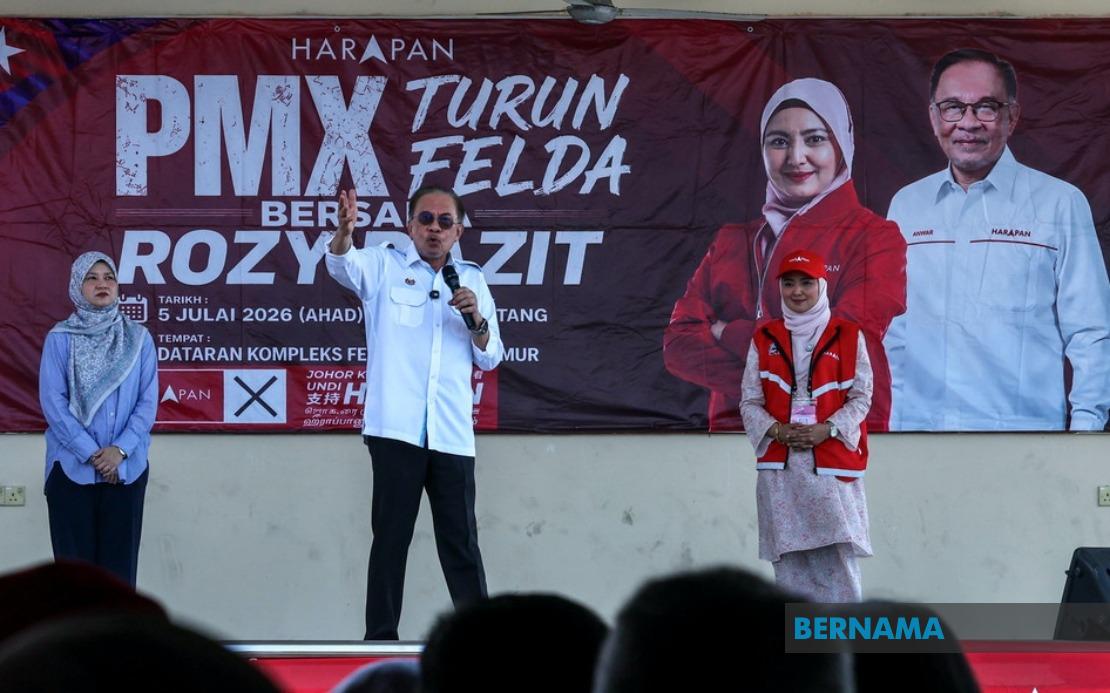
Prime Minister Datuk Seri Anwar Ibrahim has made a firm commitment to address one of rural Malaysia's most persistent challenges: the shortage of housing sites for children of original FELDA settlers. Speaking at a public engagement in Segamat, the premier outlined his determination to tackle an issue that has festered for decades without resolution, framing it as a priority that cannot wait beyond his tenure in office.
The FELDA scheme, established to resettle landless rural communities, created a social contract whereby participating families received land and housing. However, as the original settler generation aged, their children faced an acute shortage of allocated land and housing, creating tension within these long-established agricultural communities. This generational divide has become increasingly visible across FELDA settlements nationwide, where younger residents struggle to secure their own plots despite family heritage within the scheme.
Anwar's remarks, delivered during a meet-the-people session at Dataran Putra FELDA Palong Timur in the Buloh Kasap state constituency, reflected a hands-on approach to a demographic crisis that statistics suggest affects tens of thousands of households. The Prime Minister acknowledged the urgency of the matter, signalling that his administration views this not merely as an administrative task but as a fundamental fairness issue affecting rural Malaysian families who have contributed to national agricultural productivity.
Crucially, Anwar tempered expectations by underscoring a constitutional reality that often complicates federal rural development initiatives. Land matters and the provision of basic infrastructure remain the purview of state governments under Malaysia's federal system, meaning that any comprehensive solution requires genuine partnership between the federal government and all thirteen state administrations. This structural constraint has historically hampered quick resolution of such nationwide problems, as coordination across multiple state governments with differing political alignments and priorities proves logistically complex.
The Prime Minister's statement that he wants "the issues affecting the second generation, which have remained unresolved for decades, to be settled while I am Prime Minister" signals both urgency and awareness of political capital. By anchoring the commitment to his personal tenure, Anwar has essentially made this a signature issue, raising the political cost of failure and signalling to FELDA communities that resolution is non-negotiable within his administration's timeline.
The delegation accompanying Anwar underscored the multi-level governance approach deemed necessary. Selangor Menteri Besar Datuk Seri Amirudin Shari's attendance was particularly significant, representing the largest FELDA-dependent state and signalling state-level buy-in for collaborative efforts. Education Minister Fadhlina Sidek's presence, while ostensibly protocol-based, may also indicate that education and youth development aspects of FELDA second-generation welfare are being considered holistically rather than as isolated land issues.
For Malaysian readers in FELDA areas, the pledge carries both promise and cautionary notes. FELDA settlements span multiple states—including Pahang, Johor, Perak, and Selangor—meaning any solution must be standardized yet flexible enough to accommodate different state circumstances. Land availability varies dramatically across regions, with some states facing genuine scarcity while others may have underutilized FELDA land that could theoretically be reallocated.
The second-generation housing crisis also intersects with broader rural-urban migration patterns. Young FELDA residents, facing limited economic opportunities and housing prospects in their settlements, have increasingly relocated to cities for employment and education. Addressing the housing shortage could theoretically reverse this brain drain, revitalizing FELDA communities with educated, entrepreneurial residents. However, this requires complementary policies addressing rural income generation and economic diversification beyond traditional palm oil and rubber cultivation.
Previous governments have attempted piecemeal solutions, including limited land allocation schemes and housing subsidies, but these have proven insufficient given the scale of unmet demand. Anwar's framing suggests a more comprehensive, policy-driven approach rather than ad hoc interventions. The appointment of a specific minister responsible for FELDA affairs, whom Anwar indicated would work alongside him on this issue, signals institutional commitment to sustained focus.
From a Southeast Asian perspective, Malaysia's handling of this agricultural-settlement modernization challenge offers lessons for neighboring countries wrestling with similar land-distribution legacies. Indonesia, Thailand, and the Philippines all operate settlement schemes with comparable second-generation complications. How Malaysia navigates this issue may inform regional approaches to intergenerational equity in rural development.
The political dimensions cannot be overlooked. FELDA settlers and their descendants represent a substantial voting bloc, particularly in marginal parliamentary constituencies. Rural constituencies remain crucial to Malaysia's electoral calculus, and FELDA communities' frustrations have historically influenced electoral outcomes. By visibly addressing this grievance, Anwar's administration simultaneously pursues good governance and electoral strategy.
Moving forward, success will depend on Anwar's ability to translate his commitment into concrete action. This requires drafting implementable policies, securing state government cooperation, identifying and surveying land, planning infrastructure investments, and establishing transparent allocation mechanisms. Each step presents bureaucratic and political obstacles that have deterred previous administrations from decisive action.

