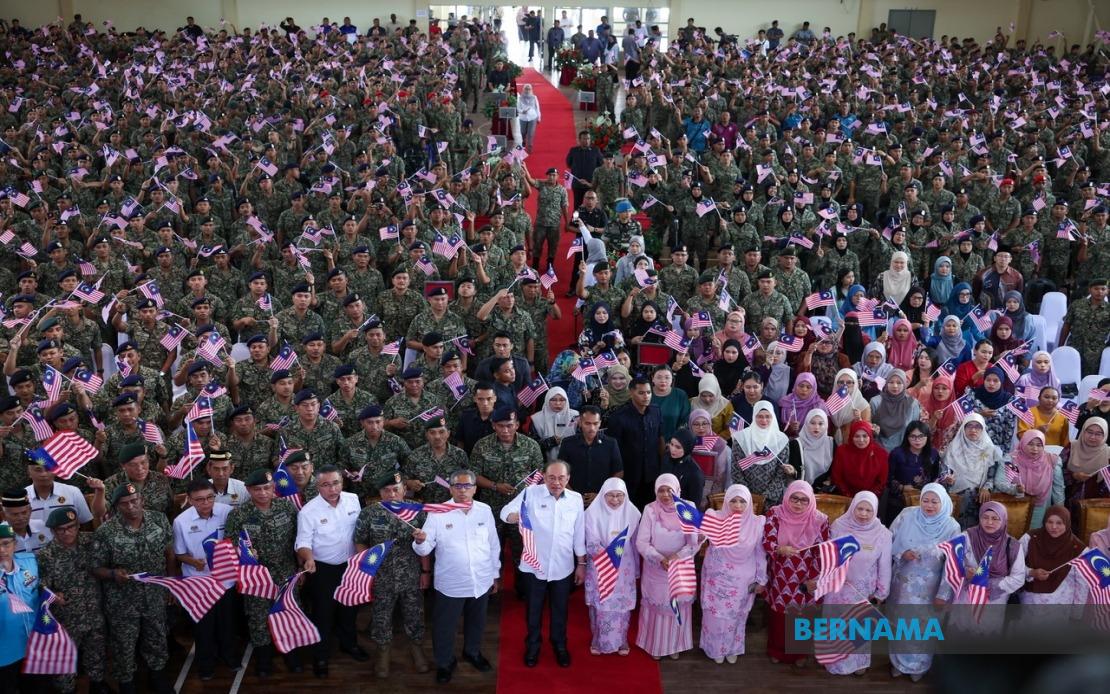
Prime Minister Datuk Seri Anwar Ibrahim has forcefully pushed back against suggestions that his administration has deprioritised the interests of the Bumiputera community, particularly Malays, by highlighting a landmark initiative to create new Malay reserve land within Kuala Lumpur. Speaking in Tampin on July 27, the Prime Minister presented the move as tangible proof of the government's dedication to protecting and advancing Bumiputera economic rights in an increasingly competitive urban landscape.
The centerpiece of Anwar's defence is the reclamation and subsequent allocation of land from the Bandar Malaysia development site, a 480-acre expanse that had previously been under the control of Chinese and private commercial interests. According to the Prime Minister, this acquisition in 2023 was necessitated by violations of existing regulations governing the property, making intervention imperative. The recovery of this strategically positioned asset represents a reversal of decades-long trends in the capital, where Malay reserve land holdings have steadily diminished through sales and transfers to non-Malay entities.
Since Malaysia's independence in 1957, Kuala Lumpur had witnessed no creation of new Malay reserve land, a deficit the Anwar administration has characterised as a critical governance failure requiring immediate redress. Instead of preserving Malay landholdings, successive administrations had permitted the erosion of such holdings through market transactions, fundamentally altering the demographic and economic composition of the capital city's property landscape. This historical pattern forms the backdrop against which the government now positions its Bandar Malaysia initiative as a corrective intervention of constitutional significance.
From the reclaimed Bandar Malaysia site, the government has designated 50 acres—equivalent to 20 hectares—as Malay reserve land, a portion comprising some of the most commercially valuable real estate within the capital. The placement of these reserve lands under the stewardship of Petronas and Khazanah Nasional underscores a strategy of leveraging government-linked companies with substantial Malay ownership and control to ensure the holdings serve broader community interests rather than narrowly defined private gain. This approach reflects a deliberate architectural choice to integrate reserve land preservation with state-directed economic development objectives.
For Malaysian observers tracking debates over Bumiputera policy and inter-ethnic economic relations, the government's move carries symbolic and practical weight. Urban Malay communities in particular have faced mounting pressures from property market dynamics that have historically privileged capital accumulation over communal landholding frameworks. The creation of 50 acres of new reserve land in Kuala Lumpur—the nation's economic and political nucleus—signals an attempt to counterbalance these structural headwinds through executive action rooted in constitutional protections for Bumiputera interests.
The initiative also reveals something about the political dynamics within the current ruling coalition, particularly the relationship between Pakatan Harapan's dominant component, Anwar's PKR, and the Democratic Action Party (DAP), a primarily Chinese-supported party within the coalition. The Prime Minister's account suggests that when the Bandar Malaysia allocation was presented to Cabinet, DAP secretary-general Anthony Loke raised questions seeking clarification rather than lodging formal objections. This procedural narrative appears designed to demonstrate that even coalition partners representing non-Malay constituencies have accepted the government's rationale for privileging Malay reserve land in the capital.
Anwar's framing of Loke's response—that the DAP leader merely requested an explanation and subsequently agreed once provided with the government's justification—represents an attempt to neutralise potential criticism that the measure represents discriminatory policy-making within a multi-racial coalition framework. By presenting the decision as technically justified and politically consensual, the government seeks to position Bumiputera protection not as zero-sum competition but as a reasonable stewardship of constitutional obligations that coalition partners themselves accept.
The broader context for understanding this initiative involves ongoing tensions within Malaysian politics regarding the interpretation and implementation of Article 153 of the Federal Constitution, which enshrines special rights for Bumiputeras. Progressive and opposition-aligned voices have occasionally argued that Bumiputera provisions require modernisation and market-driven reform, while more conservative constituencies have warned against erosion of traditional protections. The Anwar government's approach appears to occupy middle ground—reaffirming constitutional commitments through concrete land allocations while simultaneously operating through market-sensitive mechanisms like Petronas and Khazanah rather than purely administrative controls.
For Southeast Asian observers, Malaysia's approach to managing Bumiputera interests within rapidly urbanising metropolitan areas presents a case study in navigating affirmative action frameworks amid economic transformation. Many regional economies face comparable challenges: how to preserve historical protections for indigenous or historically disadvantaged communities without impeding broader economic dynamism and inter-ethnic cooperation. The Bandar Malaysia initiative suggests the Malaysian government believes targeted, visible interventions in high-value urban property markets can serve both objectives simultaneously.
Looking ahead, the success of this initiative will depend partly on how effectively the 50 acres are developed and whether resulting economic benefits reach intended Malay communities beyond elite circles. Property-based affirmative action can easily become a mechanism for enriching well-connected individuals rather than broadly advancing Bumiputera interests. The government's choice to vest management in Petronas and Khazanah rather than allocating land to individual Malay owners reflects awareness of these risks, suggesting a preference for corporate-mediated stewardship over direct individual holdings.
The Prime Minister's robust defence of his government's Bumiputera credentials through the Bandar Malaysia example also serves immediate political purposes. As questions periodically surface about the coherence and commitment of a coalition government spanning ideologically diverse parties, Anwar's ability to point to tangible measures addressing core Malay-Muslim constituency concerns reinforces his political base. The absence of Cabinet-level objections from DAP and other non-Malay coalition partners, as emphasised in his account, further strengthens this narrative of inclusive governance that simultaneously prioritises constitutional obligations.
Moving forward, Malaysian policymakers will face ongoing questions about replicating this model in other urban centres where Malay reserve land has similarly diminished, and about whether property-based interventions represent the most effective long-term strategy for advancing Bumiputera economic interests in increasingly financialised real estate markets. The Bandar Malaysia precedent may thus prove influential in shaping not only the government's future land policy but also broader perceptions of how the MADANI administration reconciles constitutional commitments with coalition governance and economic modernisation.

