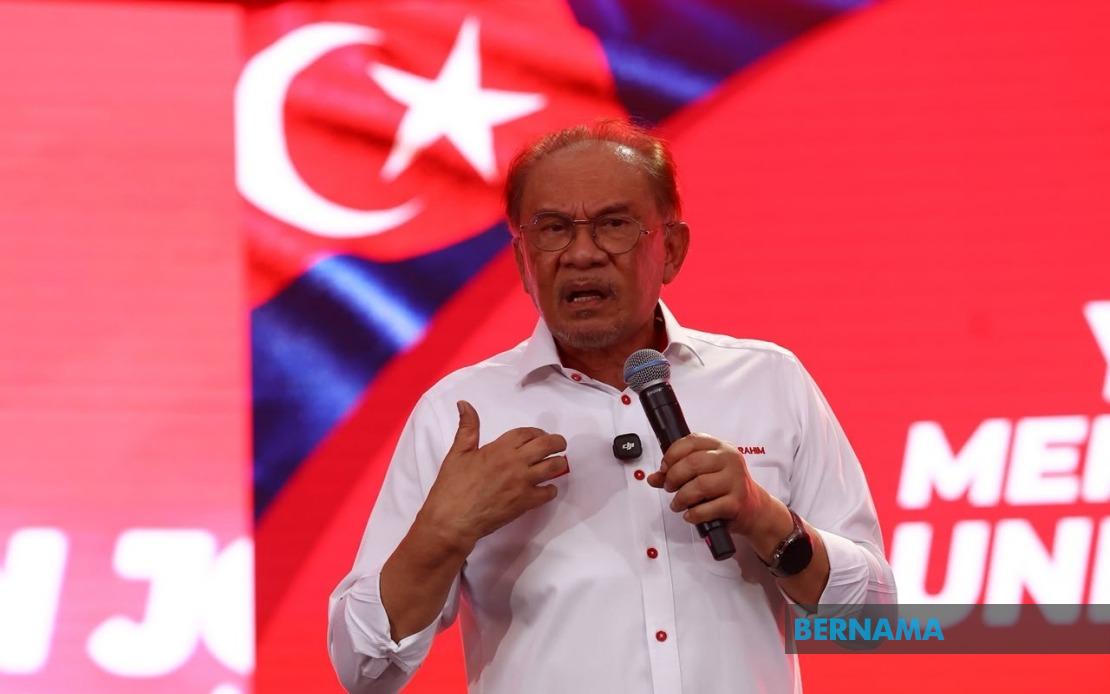
Prime Minister Datuk Seri Anwar Ibrahim moved swiftly to counter viral accusations on social media that he had acquired a new BMW for his own use, characterizing the narrative as deliberate misinformation during a campaign stop in Batu Pahat on Wednesday. Speaking at a Pakatan Harapan rally in Senggarang coinciding with canvassing for the 16th Johor state election, Anwar rejected the allegation directly, asserting that not only had he not purchased the vehicle but that it was actually a pre-existing asset rather than a recent acquisition. His direct dismissal of the claim underscores the sensitivity surrounding the use of official vehicles by high-ranking government officials in Malaysia, where such matters frequently become fodder for political criticism and public scrutiny.
The Prime Minister went further in his remarks by distinguishing between the BMW in question and the Mercedes-Benz vehicle he currently operates, providing details about the acquisition and registration of the latter to clarify his personal conduct. Anwar emphasized that the Mercedes-Benz was a gift bestowed by His Majesty Sultan Ibrahim, King of Malaysia, and that he deliberately chose not to register it under his name but rather transferred ownership to the Prime Minister's Department to maintain transparency. This decision, as he framed it, reflects a commitment to ensuring that assets connected to his office remain public property rather than becoming personal possessions, a stance he contrasted implicitly with what he perceived as corrupt practices by other officials who he accused of misappropriating state resources.
The controversy appears to have been triggered by discussions circulating on social media platforms regarding the ownership and status of the BMW vehicle that has been used in connection with the prime ministerial office. To provide official clarity, the Prime Minister's Department and the Ceremonial and International Conference Secretariat Division issued a joint statement on Monday addressing the matter directly. The statement categorically confirmed that the BMW in question is an established government asset that predates recent months and has not been newly procured for official use. Furthermore, the agencies clarified that the vehicle falls under the management purview of the Ceremonial and International Conference Secretariat Division and has been allocated for the logistical requirements of official state functions.
This clarification represents a standard institutional response designed to separate fact from speculation by relying on official government records and documentation regarding vehicle ownership and procurement. The timing of the statement, issued before Anwar's public remarks, suggests that the Prime Minister's office detected the spreading narrative and moved preemptively to contain the story before it gained additional momentum during an active election campaign period. In the Malaysian political context, where election campaigns in individual states can become increasingly contentious as polling day approaches, early rebuttal of such allegations becomes strategically important to maintain campaign momentum and public credibility.
Anwar's characterization of the claim as a deliberate falsehood reflects the broader pattern of misinformation that has become increasingly prevalent in Malaysian politics during election periods. By labeling the accusation as a lie intended to undermine his message about economic support for lower-income Malaysians, the Prime Minister attempted to frame the narrative as part of coordinated opposition efforts to distract voters from substantive policy discussions. The juxtaposition of his poverty-alleviation advocacy with allegations of extravagant spending creates a particularly sharp political contrast, which explains why such claims gain traction on social media despite official denials.
The Johor state election context provides important background for understanding the urgency of the Prime Minister's response. The 16th Johor state election, scheduled for polling day on Saturday, represents a significant test of Pakatan Harapan's electoral standing in a state that has traditionally been a stronghold of opposition parties. The coalition is contesting all 56 state seats, signaling an aggressive campaign strategy aimed at maximizing representation in the state assembly. With campaign intensity reaching peak levels in the days immediately preceding the election, controlling the narrative becomes increasingly critical for all political actors involved.
Joining Anwar at the Senggarang rally were senior party officials and state-level candidates, reflecting the coordinated nature of Pakatan Harapan's campaign structure. Communications Minister Datuk Fahmi Fadzil, who also serves as the coalition's communications director, was present alongside three candidates contesting seats in the immediate vicinity: Onn Abu Bakar in Senggarang, Mohd Khuzzan Abu Bakar in Semerah, and Felicia Poh Rui Ling in Penggaram. This combination of national leadership visibility and local candidate presence typifies campaign strategy designed to generate momentum and media attention for coalition-backed candidates in hotly contested electoral areas.
The vehicle controversy itself touches on broader governance issues that resonate with Malaysian voters across the political spectrum. Questions about the appropriate use of government assets, the distinction between official and personal property, and accountability mechanisms for high-ranking officials remain perpetually contentious subjects in Malaysian public discourse. By proactively addressing these concerns and providing documentary evidence of official asset management, the Prime Minister's office sought to preempt suggestions of impropriety that might otherwise influence voter decision-making during the election campaign.
The incident also illustrates how rapidly unverified claims can circulate through social media platforms before official institutions have opportunity to respond with authoritative information. In the contemporary Malaysian political environment, where digital engagement forms an increasingly important component of electoral campaigns, the ability to rapidly debunk misinformation and provide counter-narratives has become a critical capability for political actors seeking to maintain public confidence and electoral support. The coordination between Anwar's public statements and the official departmental clarification demonstrates an attempt at strategic message alignment during a period of heightened political activity.

