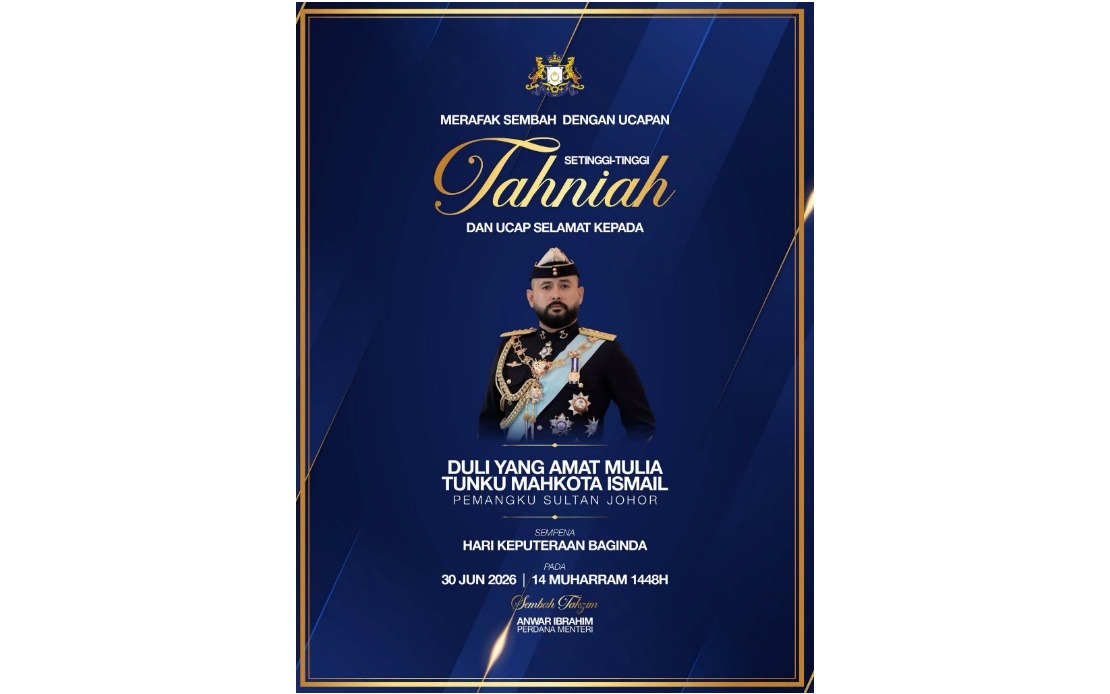
Prime Minister Datuk Seri Anwar Ibrahim and Deputy Prime Minister Datuk Seri Dr Ahmad Zahid Hamidi have offered their birthday greetings to Tunku Mahkota Ismail, the Regent of Johor, in messages of goodwill that underscore the strong protocol-based respect between Malaysia's federal leadership and the state's royalty.
Anwar conveyed his congratulations through a Facebook post on June 30, marking the occasion of His Royal Highness's birthday. Beyond the formal acknowledgment, the Prime Minister expressed his hope that the Johor Regent would enjoy enduring good health and continued prosperity, reflecting the customary blessings extended to senior members of the royal households across Malaysia's federal and state structures.
The gesture from Anwar carries particular significance given the complex dynamics between the federal government and Johor's state administration. Malaysia's constitutional monarchy system reserves substantial autonomy for individual state rulers, who serve as ceremonial heads while maintaining traditional authority over religious and customary matters within their territories. The Prime Minister's public recognition of the Regent's birthday through social media demonstrates the continued diplomatic importance of maintaining cordiality with regional power centres, especially in Johor, the nation's southernmost peninsula state and a significant economic and political hub.
Ahmad Zahid Hamidi similarly offered his prayers on the same occasion through a Facebook post, invoking divine blessings upon Tunku Mahkota Ismail. The Deputy Prime Minister's message carried a notably substantive dimension, extending wishes not merely for personal health but for the continued wisdom necessary to lead Johor Darul Ta'zim and serve Bangsa Johor—the people of Johor. This formulation suggests recognition of the Regent's broader responsibilities beyond ceremonial functions, encompassing the welfare and governance of the state's population.
In the Malaysian context, such public exchanges between federal leaders and state royalty serve multiple purposes beyond simple courtesy. They reinforce the hierarchical respect that characterizes Malaysia's constitutional framework, where the Yang di-Pertuan Agong holds supreme position while state rulers maintain their own dignified status. Johor holds particular weight in this equation: as the home state of the current Yang di-Pertuan Agong, Sultan Ibrahim Ismail, the Johor royal household occupies an elevated position in the national consciousness. Tunku Mahkota Ismail, as the Regent, functions as the state's administrative head in the immediate term and represents the future continuity of the institution.
The birthday greetings also reflect the pragmatic requirements of coalition politics in contemporary Malaysia. The federal government, under Anwar's leadership, operates through a complex alliance of various political parties, and maintaining positive relationships with state governments—whether they are controlled by the same coalition or by opposition parties—remains essential for legislative and administrative cooperation. Johor's state government, currently under Barisan Nasional control, operates within a framework that requires periodic demonstration of unity and respect for the institution of monarchy that transcends partisan divides.
Public declarations of support for the royal household through social media platforms have become a standard practice in modern Malaysian political communication. These posts reach wide audiences and contribute to the broader narrative about the government's reverence for constitutional institutions. For Prime Minister Anwar in particular, such gestures help solidify his standing as a leader who respects the established order and works within Malaysia's constitutional parameters, an important positioning given his previous detention and reform-oriented political history.
The Johor Regent's role as administrator during the Sultan's occupancy of the federal throne represents a significant responsibility, encompassing state-level decisions affecting millions of residents. The federal leadership's public recognition of this role through birthday greetings acknowledges both the individual holding the position and the institution itself, signalling that Johor's governance remains a matter of federal concern and respect.
These courtesy exchanges, while seemingly ceremonial on the surface, actually serve to maintain the delicate balance required in Malaysia's system of shared power between federal and state authorities. They demonstrate that despite the inevitable political tensions and policy differences that arise between different levels of government, a baseline of institutional respect and personal civility persists. For Malaysian observers and the broader Southeast Asian region watching Malaysia's political stability, such visible markers of constitutional propriety and respect for tradition provide reassurance about the resilience of Malaysia's democratic and monarchical institutions.

