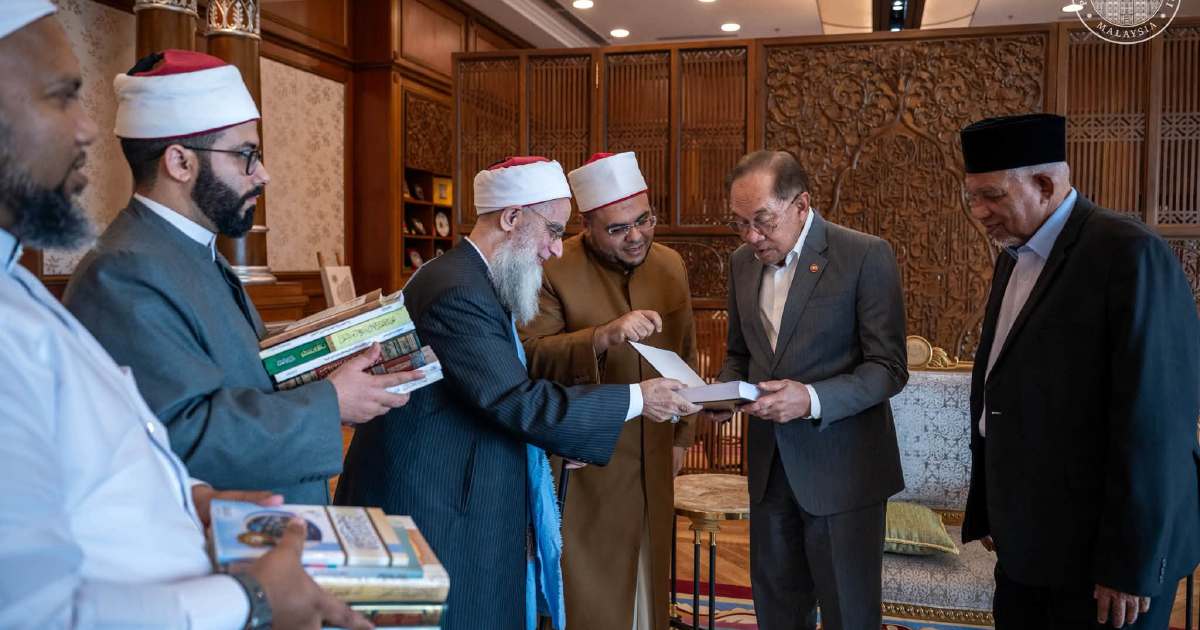
Prime Minister Datuk Seri Anwar Ibrahim held a bilateral meeting with Sheikh Dr Mustafa An-Nadwi Al-Hasani Mansurah, one of Egypt's most respected Islamic scholars, at his official residence in Putrajaya. The visit underscores Malaysia's continued engagement with influential Muslim intellectual circles across the Arab world, a relationship that extends beyond conventional diplomatic channels to encompass religious and scholarly discourse.
Sheikh Dr Mustafa An-Nadwi carries substantial credentials within Islamic academia and thought leadership. His standing as a scholar of recognised prominence positions him as a bridge between Egypt's rich Islamic intellectual tradition and the broader Muslim world. For Malaysia, which has positioned itself as a moderate Islamic nation and a hub for interfaith dialogue, such encounters carry symbolic weight. They demonstrate the country's openness to engaging with diverse interpretations and voices within Islamic scholarship.
The timing of this visit reflects the Malaysian government's broader approach to international relations, particularly with key Muslim-majority nations. Egypt, as the Arab world's most populous nation and custodian of Al-Azhar University—one of Islam's most prestigious theological institutions—holds considerable influence in shaping Islamic discourse globally. High-level exchanges between Malaysian and Egyptian figures, whether governmental or scholarly, strengthen bilateral understanding and create platforms for collaborative initiatives.
Anwar Ibrahim's personal interest in such meetings aligns with his established reputation as an intellectual leader within Islamic circles. His background as an activist and scholar before entering higher political office has consistently informed his approach to governance and international engagement. The Premier's willingness to receive prominent foreign scholars suggests a deliberate strategy of elevating Malaysia's profile as a destination for intellectual exchange and a voice in contemporary Islamic thought.
The scholar's visit may touch upon several substantive issues of mutual concern. Islamic education, the role of religious institutions in modern governance, interfaith understanding, and the intellectual foundations of moderate Islam are likely discussion points. Malaysia has invested considerable effort in positioning itself as a model of Muslim-majority democracy where diverse religious and secular perspectives coexist within a constitutional framework. Such dialogues provide opportunities to share experiences and lessons with other Muslim-majority nations grappling with similar challenges of balancing religious identity with pluralistic governance.
For Malaysian readers, this engagement carries implications beyond ceremonial diplomacy. The Malaysian Islamic Development Department (JAKIM) and the country's broader institutional apparatus have long promoted what officials describe as "Islam Hadhari"—a concept emphasising Islamic teachings' compatibility with modernity, science, and inclusive governance. When Prime Ministers receive international scholars, these instances validate Malaysia's own intellectual positioning and create networks that may eventually influence religious policy and educational curricula domestically.
Egyptian-Malaysian relations have historically benefited from shared religious heritage and post-colonial trajectories. Both nations have navigated the challenge of building modern nation-states with majority Muslim populations while managing religious pluralism and secular governance. Egypt's experience with Al-Azhar's evolution—from a purely theological institution to one engaging with contemporary issues—offers lessons for Malaysia's own religious institutional development. Conversely, Malaysia's relative success in maintaining religious harmony within a constitutionally diverse framework presents perspectives that may interest Egyptian interlocutors.
The visit also contextualises Malaysia within regional and global Muslim networks. Southeast Asia, despite its Islamic majority and rich Islamic heritage, sometimes receives less attention in discussions of Islamic thought than the Arab world. By hosting prominent Arab scholars and intellectuals, Malaysia asserts its relevance in broader Islamic conversations and positions itself as a serious participant in shaping contemporary Muslim discourse rather than merely a peripheral audience.
Moving forward, the substantive outcomes of such meetings often materialise gradually through institutional channels. Joint research initiatives, educational exchanges, and collaborative publications between Malaysian and Egyptian scholars may emerge from this engagement. Religious organisations and think tanks in both countries may formalise partnerships. These downstream effects, though less immediately visible than the high-level meeting itself, ultimately determine the visit's enduring significance for bilateral relations and Malaysia's intellectual standing.
The reception extended to Sheikh Dr Mustafa An-Nadwi reflects a deliberate Malaysian strategy of engagement with global Islamic intellectual leadership. Whether the meeting addresses specific diplomatic matters or remains primarily an exchange of ideas, it reinforces perceptions of Malaysia as a nation where Islamic scholarship and governance intersect meaningfully, and where serious intellectual engagement from abroad is welcomed at the highest levels.

