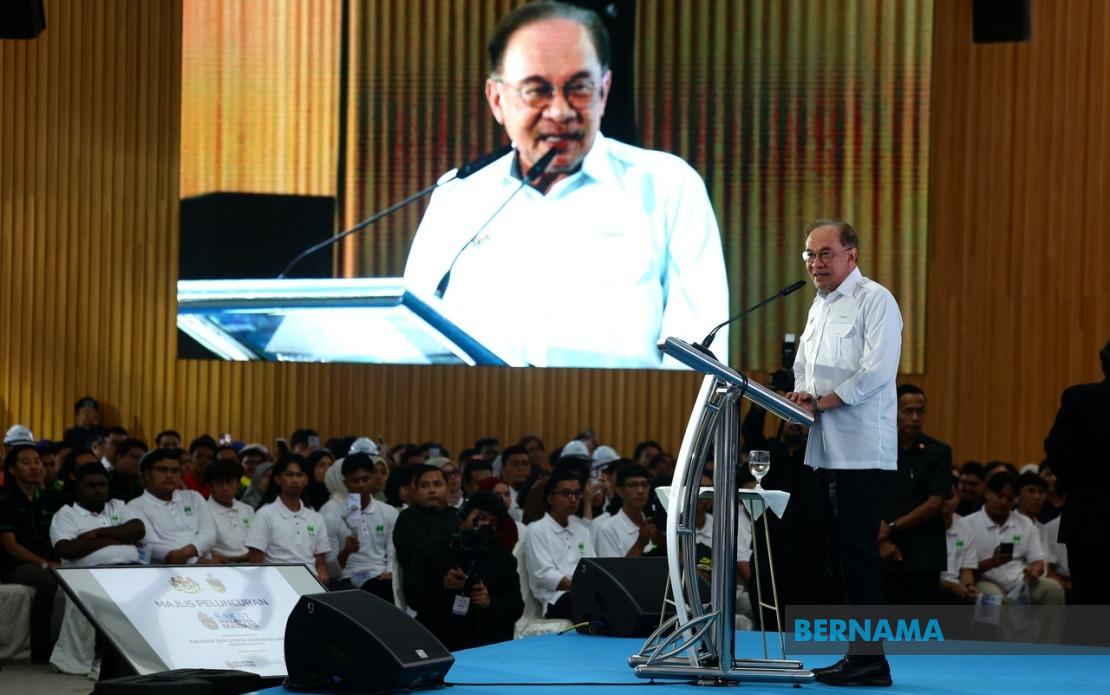
Prime Minister Datuk Seri Anwar Ibrahim has unveiled a sweeping new initiative aimed at cultivating Malaysia's talent pool and strengthening the nation's workforce across high-growth sectors. The Bakat MADANI programme, officially launched in Seremban on June 29, is poised to extend training and employment opportunities to approximately 25,000 individuals through a coordinated effort involving government-linked investment companies, government-linked corporations, and Petronas. The initiative represents a strategic shift towards building human capital as a cornerstone of economic competitiveness and social advancement.
The programme's scope encompasses three interconnected pillars: enhancing employability prospects and career advancement within the ecosystem of major government-linked entities; broadening job placement pathways across critical strategic industries; and strengthening technical and vocational training institutions to meet evolving market demands. This multi-pronged approach reflects recognition that talent development cannot rely on isolated interventions but requires coordinated action across multiple stakeholders and sectors. Finance Minister II Datuk Seri Amir Hamzah Azizan emphasised that the overarching objective is fundamentally about matching skilled individuals with genuine economic opportunities, thereby addressing both unemployment concerns and skills shortages simultaneously.
The initiative identifies several sectors as priority areas for talent cultivation and employment growth. Semiconductors, renewable energy, the digital economy, and advanced manufacturing have been designated as focus industries due to their expansive growth trajectories and strategic importance to Malaysia's economic diversification goals. These sectors represent the frontier of Malaysia's economic transformation and increasingly compete for skilled workers regionally and globally. By channelling developmental resources towards these domains, Bakat MADANI seeks to ensure that Malaysian talent remains competitive and that domestic workers can access career pathways in tomorrow's high-value industries rather than being displaced by international competition.
A significant innovation embedded within Bakat MADANI involves fiscal incentives designed to encourage corporate participation in skills development. The government will introduce targeted tax benefits for companies establishing and operating training programmes under the initiative's framework. These incentives extend beyond previous employability schemes by broadening eligibility to include TVET graduates whilst simultaneously increasing minimum allowances for trainees and apprentices. This financial architecture acknowledges that sustainable talent development depends on industry buy-in; without meaningful private sector engagement and investment, government initiatives risk remaining disconnected from genuine labour market needs and hiring practices.
The programme incorporates substantial enhancements to existing talent development pathways. Petronas is spearheading the transformation of VISTA into Vista i-Plus, executed in partnership with Malaysian Petroleum Resources Corporation and the Malaysian Oil, Gas & Energy Services Council. This evolution creates an integrated vocational training framework drawing together resources from MARA Skills Institutes, National Youth Skills Institutes, Advanced Technology Training Centres, and the Malaysian Construction Academy. Such consolidation aims to eliminate fragmentation in technical education whilst ensuring curricula remain responsive to industry standards and operational requirements.
Parallel initiatives are unfolding within the broader government-linked company ecosystem. Khazanah Nasional Berhad has established partnerships with 23 higher education institutions, encompassing Universiti Teknologi MARA, Universiti Teknikal Malaysia Melaka, and Universiti Malaysia Sabah, among others. These collaborations blend academic rigour with practical workforce preparation through industrial attachment programmes, technical certification pathways, and immersive exposure to real-world industry operating environments. This university-industry bridge model recognises that fresh graduates often face a disconnect between classroom learning and workplace expectations, a gap that structured exposure can substantially narrow.
Anwar Ibrahim stressed during the launch ceremony that successful implementation depends critically on the commitment and capability of participating organisations. The Prime Minister's remarks underscored an important accountability principle: corporate entities providing financing and operational support bear responsibility for programme quality and delivery standards. This framing shifts expectations from viewing Bakat MADANI as primarily a government responsibility to recognising it as a collaborative undertaking where multiple actors must fulfil defined roles competently. Young participants, in turn, were encouraged to recognise and appreciate the business contributions underpinning their developmental opportunities.
The initiative arrives at a moment of heightened attention to unemployment and skills mismatches in Malaysia's labour market. Youth unemployment remains a persistent concern, whilst employers simultaneously report difficulties filling vacancies in technical and specialised roles. This paradox reflects structural gaps between available skills and market demand, a challenge that educational institutions and government agencies alone cannot resolve. By engineering direct connections between trainers, employers, and learners, Bakat MADANI attempts to address this coordination problem through institutional redesign rather than through generic policy announcements.
Regionally, Malaysia's commitment to large-scale talent development programming carries strategic implications. As Southeast Asian economies intensify competition for skilled workers and investment in high-tech sectors, workforce quality increasingly determines competitive positioning. Countries investing in systematic talent cultivation and skills alignment gain advantages in attracting corporate investment and retaining innovative enterprises. Bakat MADANI positions Malaysia as a nation consciously building human capital depth, signalling to multinational corporations and regional investors that the domestic workforce receives sustained developmental support.
The programme's emphasis on quality employment rather than mere job creation warrants particular attention. Bakat MADANI explicitly prioritises meaningful career pathways and sustainable livelihood opportunities, reflecting understanding that temporary placements or low-wage positions fail to achieve genuine social mobility or economic advancement. By coupling skills training with placement guarantees within reputable organisations and high-growth sectors, the initiative seeks to create trajectories where initial entry-level positions become springboards for career progression rather than dead-ends.
Implementation challenges nonetheless remain. Coordinating action across numerous government agencies, corporations, and educational institutions presents logistical complexity. Ensuring curriculum responsiveness to rapidly evolving sectoral demands requires continuous feedback mechanisms between trainers and employers. Maintaining consistent quality standards across diverse TVET institutions demands robust oversight. Success ultimately hinges on whether participating organisations execute their commitments systematically and whether emerging workers can effectively transition from training into sustained employment within their chosen sectors.

