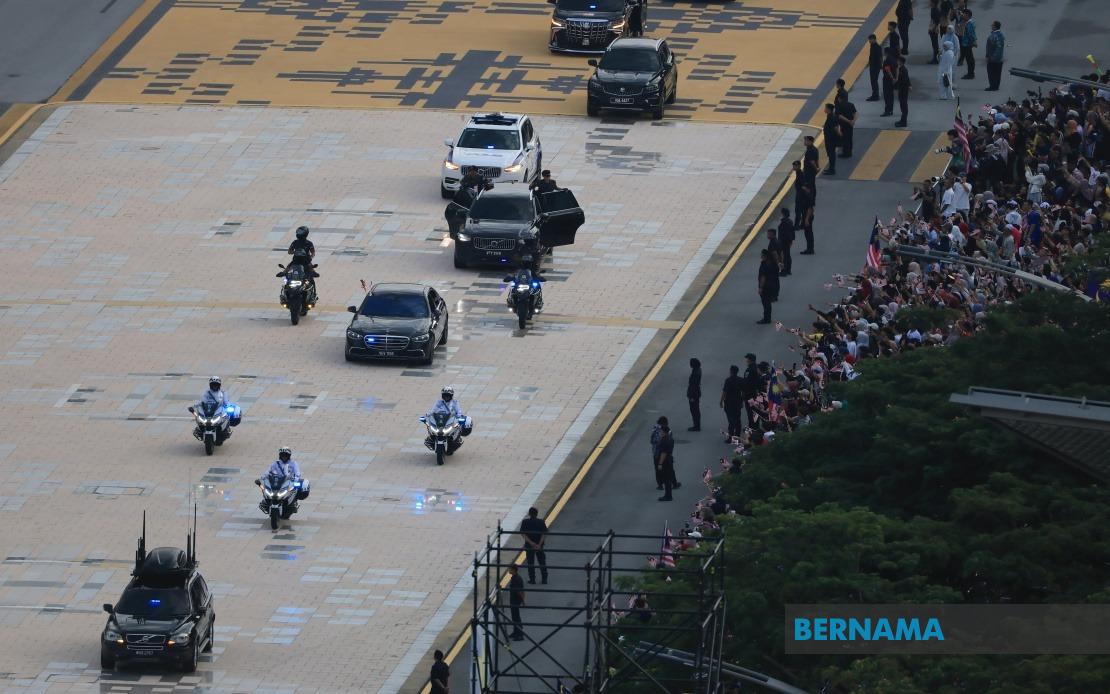
Prime Minister Datuk Seri Anwar Ibrahim led national festivities at Dataran Putrajaya on August 31st as Malaysia commemorated its 69th National Day, with the event drawing thousands of citizens and top government officials to the symbolic heart of the nation's administrative centre. Accompanied by his wife Datuk Seri Dr Wan Azizah Wan Ismail, the Premier arrived at the royal enclosure at 7.53 am, marking the formal commencement of proceedings as the traditional Hormat Perdana song resonated through the venue. The attendance of Malaysia's highest-ranking political figures underscored the significance the government places on National Day as both a patriotic milestone and an opportunity to reaffirm national unity and values.
Deputy Prime Minister Datuk Seri Dr Ahmad Zahid Hamidi had preceded the Prime Minister, arriving at the sprawling public square just minutes earlier at 7.45 am, while a constellation of Cabinet personnel assembled to witness the ceremonial proceedings. Communications Minister Datuk Seri Fahmi Fadzil, who simultaneously chairs the main organising committee responsible for the 2026 National Day and Malaysia Day commemorations, stood prominently among the gathering. Home Minister Datuk Seri Saifuddin Nasution Ismail and Defence Minister Datuk Seri Mohamed Khaled Nordin were equally present, alongside numerous other Cabinet-level office holders whose portfolios span the entire breadth of government operations.
The event's official theme, "Malaysia MADANI: Kesejahteraan Dinikmati" (Malaysia MADANI: Shared Prosperity Enjoyed), crystallised the government's developmental philosophy and social contract narrative currently underpinning Putrajaya's governance agenda. The MADANI framework, introduced by the Anwar administration, emphasises inclusive economic advancement and collective wellbeing as central organising principles, messaging that resonates particularly in an era where income inequality and social cohesion remain pressing national concerns for policymakers and citizens alike.
The scale of the 69th National Day commemoration reflected considerable logistical coordination and resource allocation. Organisers marshalled more than 10,800 participants drawn from 76 distinct contingents representing various government agencies, military units, youth organisations, and community groups across the nation. The pageantry incorporated 22 marching bands that transformed the square into a kaleidoscope of music, colour and disciplined movement, while 11 elaborately decorated vehicles added visual spectacle to the proceedings, each reflecting aspects of national heritage, culture or governmental priorities.
Military and civilian assets featured prominently throughout the celebration's choreography. A combined total of 328 land, sea and air assets demonstrated Malaysia's defence and security apparatus capabilities, ranging from ground vehicles and naval vessels to aircraft executing coordinated aerial displays. The inclusion of 112 working animals, traditionally representing Malaysia's diverse fauna and cultural heritage, alongside 22 electric vehicles showcased the nation's commitment to environmental sustainability and technological modernisation as simultaneous priorities within national development frameworks.
The representation at the Putrajaya gathering extended beyond Malaysian political and military hierarchies. Deputy ministers, various state and federal dignitaries, and foreign diplomatic delegations attended the festivities, facilitating both domestic national reflection and international engagement. Such diplomatic attendance carries significance within ASEAN and broader Indo-Pacific contexts, where Malaysia frequently positions itself as a regional bridge-builder and voice for developing nations navigating great power competition and geopolitical realignment.
National Day celebrations in Malaysia carry particular weight given the nation's multi-ethnic, multi-religious demographic composition. August 31st commemorates the date in 1957 when the Federation of Malaya achieved independence from British colonial rule, establishing the constitutional foundations upon which modern Malaysia emerged following subsequent regional integration in 1963. For contemporary governance, these annual ceremonies serve instrumental functions beyond ceremonial formality: they provide opportunity for political leadership to reaffirm national narratives, project governmental competence and legitimacy, and reinforce shared civic identity amid periodic communal tensions or political polarisation.
For regional observers and Southeast Asian watchers, Malaysia's National Day operations signal broader continuities in Malaysian governance, particularly regarding institutional stability and democratic participation despite periodic turbulence within the political system. The attendance of both executive leadership and foreign representatives at Dataran Putrajaya reaffirms Malaysia's commitment to constitutional governance frameworks and regular ceremonial observance of founding national moments, characteristics that distinguish Malaysia within the ASEAN institutional landscape where democratic practice remains contested terrain in several member states.
Looking forward, the Communications Ministry's chairmanship of preparations for the 2026 commemorations suggests early consideration of significant upcoming anniversaries, potentially including expanded regional or international dimensions reflecting Malaysia's aspirations within global and ASEAN forums. The current year's emphasis on MADANI principles and inclusive prosperity provides thematic continuity that government messaging will likely amplify through approaching electoral cycles and policy announcements, utilising National Day's symbolic weight to reinforce administration narratives regarding economic performance and social cohesion.
The gathering at Putrajaya ultimately embodied Malaysia's approach to navigating contemporary challenges while maintaining institutional and ceremonial traditions rooted in the nation's independence struggle. By assembling government apparatus, military personnel, representative civic organisations, and international observers around explicitly stated commitments to shared prosperity and national unity, the administration signalled both aspirational governance objectives and practical determination to sustain the constitutional frameworks established nearly seven decades prior when Malaysia first claimed sovereignty within the international community.

