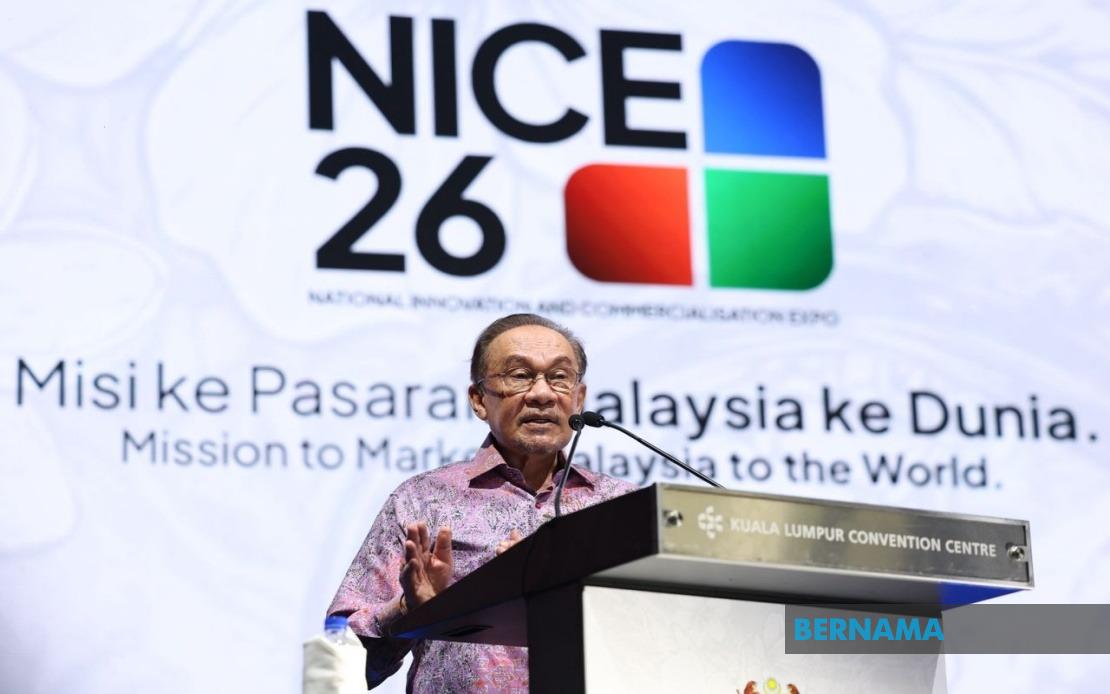
Prime Minister Datuk Seri Anwar Ibrahim has issued a forceful call for Malaysia to dismantle entrenched bureaucratic processes that are impeding the nation's capacity to innovate and commercialise new technologies at competitive speeds. Speaking at the National Innovation and Commercialisation Expo (NICE) 2026 at the Kuala Lumpur Convention Centre, Anwar stressed that the country risks falling behind in the global innovation landscape if it continues to cling to administrative procedures designed for an earlier era.
The Prime Minister's remarks reflect a growing frustration with institutional inertia within Malaysia's higher education and research ecosystems. Traditional approval mechanisms, rooted in hierarchical governance structures and multiple layers of review, have become substantial bottlenecks in an age where technological disruption moves at unprecedented velocity. Anwar's intervention signals that the federal government views this disconnect between institutional pace and market reality as a strategic vulnerability that demands immediate correction.
Central to Anwar's case for reform is the demonstrable success of accelerated timelines at Malaysian universities. The establishment of Artificial Intelligence faculties at several local institutions was accomplished in just three months—a figure that stands in stark contrast to the standard trajectory of approximately twelve months under conventional procedures. This achievement illustrates that when administrative constraints are relaxed and decision-making authority is delegated or streamlined, universities can respond with remarkable agility to emerging skills demands and technological imperatives.
The traditional university model requires approval through sequential senate and council meetings, each introducing delays as various stakeholders deliberate, raise concerns, and seek consensus. While such consultative processes serve important governance functions, they were architected for stability and incremental change rather than the dynamic adaptation required in technology-driven sectors. In fields such as artificial intelligence, biotechnology, and advanced manufacturing, delays of even months can mean the difference between leading curriculum development globally and playing catch-up with international competitors.
Anwar's appeal to the Ministry of Science, Technology and Innovation (MOSTI) and allied agencies represents a call for systemic recalibration. Rather than viewing speed as antithetical to rigorous standards, the Prime Minister is framing flexibility as essential to maintaining academic quality and relevance. Institutions that fail to adapt swiftly to emerging fields risk becoming repositories of outdated knowledge, unable to attract top talent or secure meaningful engagement with industry partners who demand contemporary expertise.
The innovation and commercialisation sector presents particular urgency for Malaysia. The nation aspires to transition from middle-income status to a high-income economy, a trajectory that depends fundamentally on knowledge-intensive industries and technological advancement. If Malaysian universities cannot establish programmes in cutting-edge fields at internationally competitive speeds, they will struggle to cultivate domestic talent pipelines for emerging industries. Foreign investors and multinational corporations evaluating Malaysia as a regional hub for research and development will factor in the country's capacity to supply appropriately trained graduates.
The commercialisation dimension adds another layer of complexity. Academic innovations—whether in materials science, software engineering, or medical technology—require pathways from laboratory to market. Excessive bureaucratic friction at the university stage compounds delays throughout the entire innovation-to-commercialisation pipeline. When a researcher must navigate protracted approval processes merely to establish a research cluster or spin-off entity, the momentum generated by initial discovery dissipates, and talent may migrate to jurisdictions offering less friction.
Southeast Asia more broadly faces intensifying competition for innovation investment and talent. Countries such as Singapore have built competitive advantages partly through streamlined governance and regulatory frameworks that facilitate rapid commercialisation. Vietnam and Thailand are equally aggressive in courting technology-focused investment. If Malaysia's institutions remain hampered by administrative sluggishness, the region's most ambitious entrepreneurs and researchers will gravitate toward more responsive ecosystems, representing both a direct loss of talent and a diminishment of Malaysia's regional influence in knowledge economy development.
Anwar's intervention carries implications beyond immediate administrative reform. His willingness to publicly critique bureaucratic practices suggests a priority shift within government toward outcomes-oriented governance rather than process compliance. This reframing could encourage other agencies—from economic development bodies to regulatory authorities—to audit their own procedures for unnecessary friction. The cumulative effect of such reassessments, if systematically pursued, could substantially enhance Malaysia's operational competitiveness across multiple sectors.
The challenge now lies in translating executive intent into institutional practice. Eliminating bureaucratic friction requires not merely ministerial directives but sustained engagement with university administrations, faculty senates, and regulatory bodies to build consensus around new approval frameworks. It demands clarity about which safeguards remain essential—academic standards, financial accountability, and regulatory compliance cannot be entirely abandoned—and which represent legacy impediments. It also requires training administrators in agile decision-making and empowering them to exercise discretion within clear parameters.
The success of AI faculty establishment demonstrates that change is achievable. However, scaling such acceleration across diverse programmes and institutions will require systematic support and model-building. MOSTI and the Ministry of Higher Education may need to develop pilot frameworks for rapid approval in designated priority areas, document lessons learned, and subsequently refine processes for broader application. International benchmarking against leading innovation ecosystems can identify specific bottlenecks and comparative best practices.
For Malaysian businesses and researchers, Anwar's remarks offer a signal that government recognises the competitive stakes. Yet sustained momentum requires follow-through. The private sector, particularly in technology and research-intensive fields, should monitor whether promised reforms materialise into concrete changes in approval timelines and regulatory responsiveness. The outcome will significantly shape Malaysia's trajectory in the global knowledge economy over the coming decade.

