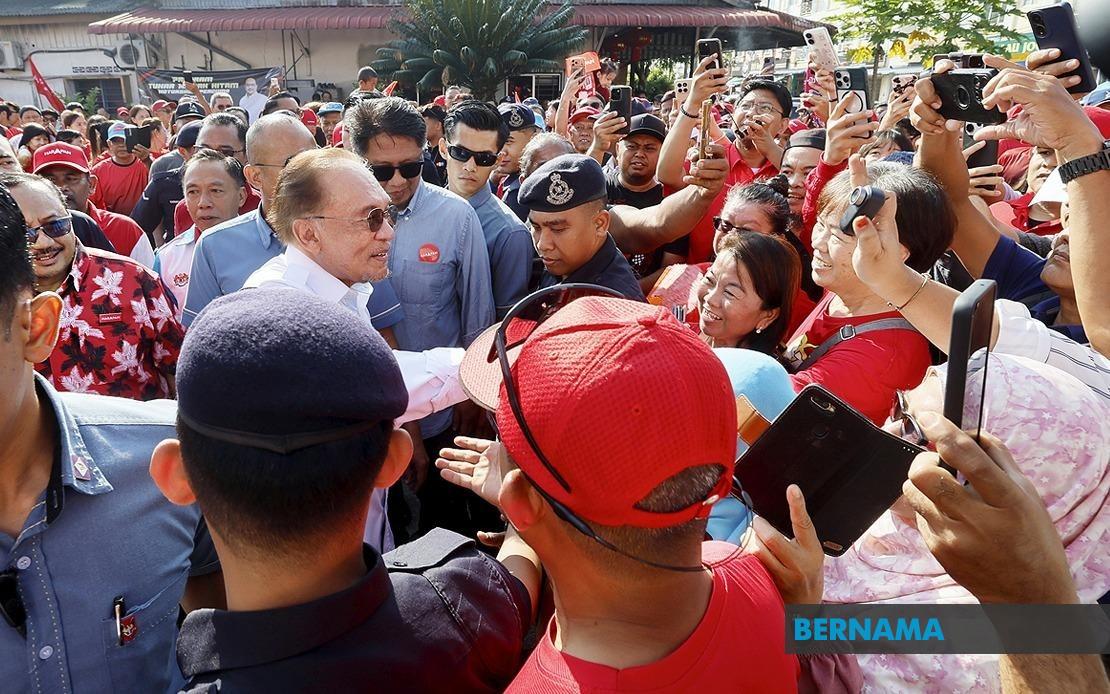
Prime Minister Datuk Seri Anwar Ibrahim made time during a campaign stop in Batu Pahat to personally greet an elderly couple whose determination to meet him had touched the hearts of Malaysians nationwide. Abdul Razak Pelangga, 86, and his wife Jamilah Samsudin, 64, were reunited with the Prime Minister at a "Yok! Meriahkan Johor! Undi Harapan" programme held in Senggarang on Tuesday, just days before Johor voters head to the polls.
The couple's story had captured widespread public affection the previous week when Abdul Razak pedalled his trishaw nearly one kilometre through the streets so that his wife could fulfil her wish of encountering the Prime Minister. What began as a quiet act of devotion by the octogenarian widened into a symbol of grassroots political engagement, with social media users sharing and celebrating the couple's modest but meaningful gesture. The image of an 86-year-old man powering a trishaw with such purpose resonated across Malaysia, transcending the usual partisan divisions that often characterise political discourse.
During their encounter at the Senggarang event, the Prime Minister engaged Abdul Razak in lighthearted banter, playfully remarking on the elderly man's impressive physical capability in pedalling the trishaw. Beyond the joviality, Anwar took the opportunity to express gratitude to the couple for their unwavering support. The warm exchange underscored a dimension of Malaysian politics often overshadowed by campaign rhetoric and policy debates—the personal human connections that motivate citizens to participate in the democratic process.
The reunion arrived at a strategically significant moment for Pakatan Harapan. With the 16th Johor State Election scheduled for Saturday, every visible show of public affection and grassroots enthusiasm carries weight in the final days of campaigning. The Prime Minister's willingness to step away from his official schedule to acknowledge Abdul Razak and Jamilah signalled to voters the coalition's commitment to recognising ordinary citizens' contributions to political life. Such moments often prove more memorable and shareable than formal policy announcements in the social media age.
Pakatan Harapan's deployment of its political machinery for the Johor campaign reflects the coalition's understanding that state elections serve as crucial barometers of public sentiment. The presence of senior leadership figures like Communications Minister Datuk Fahmi Fadzil at the Senggarang event, alongside candidates contesting the Senggarang, Semerah, and Penggaram state seats, demonstrated a coordinated effort to maintain electoral momentum in a state where opposition parties have traditionally held substantial ground. Onn Abu Bakar, Mohd Khuzzan Abu Bakar, and Felicia Poh Rui Ling represented the coalition's candidates at the gathering.
The trishaw couple's narrative also illuminates broader demographic patterns in Malaysian electoral politics. As the nation's population ages, the participation and enthusiasm of elderly voters increasingly shapes electoral outcomes. Abdul Razak and Jamilah's willingness to undertake a physically demanding journey to express political support suggests that engagement among senior citizens extends beyond passive voting to active demonstration of commitment. Their story challenges stereotypes about elderly citizens' political participation and their capacity to contribute meaningfully to democratic processes.
Johor's electoral significance cannot be overstated in Malaysian politics. As the nation's second-largest state by population and a traditional stronghold of UMNO-led coalitions, any gains by Pakatan Harapan represent substantial shifts in the political landscape. The state has historically served as a barometer for national political trends, with state-level results often presaging developments in federal elections. Anwar's visible campaigning in Johor, including these personal interactions with voters, forms part of a broader strategy to consolidate support and demonstrate the coalition's accessibility to ordinary Malaysians.
The timing of the reunion also carried symbolic resonance. Early voting had taken place the previous Tuesday, allowing the election machinery to gauge preliminary turnout figures. With Saturday's main polling day approaching, the coalition's campaign narrative shifted toward emphasising human connections and popular support rather than abstract policy positions. The trishaw couple's story provided authentic, relatable content that resonated far more powerfully than scripted campaign messaging.
From a regional perspective, the incident reflects Malaysia's ongoing democratic engagement despite perennial concerns about political polarisation and institutional challenges. That an elderly couple's simple act of devotion captured national attention and prompted personal acknowledgement from the Prime Minister suggests that Malaysia's political culture, while contested, remains receptive to grassroots participation and human-centred narratives. For Southeast Asian observers watching Malaysia's democratic evolution, such moments demonstrate the persistence of citizen agency within electoral processes.
As voters in Johor prepared to cast their ballots, the image of Abdul Razak pedalling his trishaw and Anwar's warm reception of the couple lingered in public consciousness. Whether such personal gestures influence voting behaviour remains subject to debate, but their capacity to generate positive sentiment and reinforce narratives of political accessibility appears undeniable. The reunion exemplified how modern Malaysian politics, despite its complexity and competitive intensity, can still accommodate moments of genuine human connection that transcend the usual calculations of electoral strategy.

