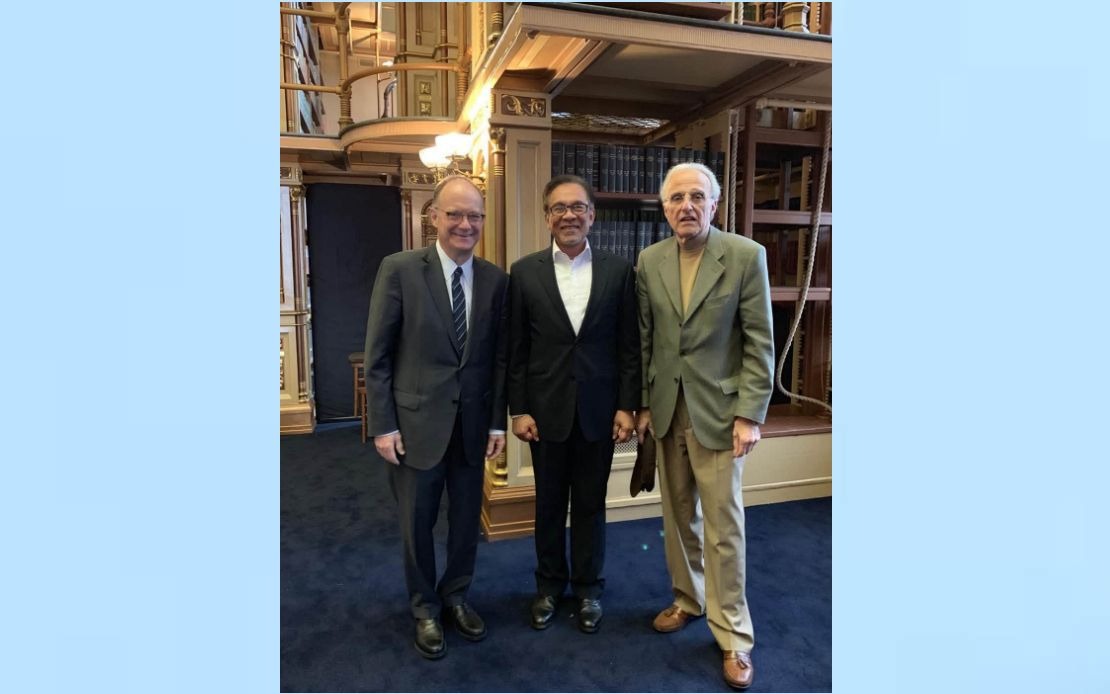
Prime Minister Datuk Seri Anwar Ibrahim has mourned the passing of Professor John L. Esposito, one of the world's most prominent scholars of Islam, extending his condolences through a Facebook statement on July 16. The death of the Georgetown University academic marks the loss of a towering intellectual figure whose life's work fundamentally reshaped how the Western world understood Islamic civilization, and whose personal friendship with Anwar spanned more than fifty years since their initial meeting in the early 1970s.
The Prime Minister's tribute underscored Esposito's extraordinary contribution to building intellectual bridges between the Islamic and Christian worlds during a period when misunderstanding and prejudice threatened to calcify into permanent antagonism. Rather than merely documenting Islamic thought, Esposito laboured throughout his career to create genuine dialogue—establishing Georgetown University's Centre for Muslim-Christian Understanding, an institution that became a beacon for scholars seeking to move beyond polemical approaches toward rigorous, empathetic engagement with Islamic civilization's complexity and diversity.
Anwar characterised Esposito as a scholar who consciously rejected the impulse to entrench civilizational divisions, instead working methodically to dismantle the intellectual and spiritual barriers that separated communities. This commitment became particularly vital in the aftermath of 9/11, when inflammatory rhetoric and simplistic characterisations of Islam threatened to poison public discourse in Western nations. Esposito's more popularly accessible works, including "What Everyone Needs to Know About Islam" and "Who Speaks for Islam?", served as crucial counterweights, bringing scholarly precision and nuance to mainstream audiences who desperately needed frameworks beyond sensationalism and fear-mongering.
The Prime Minister specifically highlighted Esposito's collaborative scholarship, notably his co-authorship of "Makers of Contemporary Islam", a work that demonstrated how Islamic thought continued to evolve and adapt across the contemporary Muslim world. This willingness to present Islam not as a monolithic, unchanging phenomenon but as a living intellectual tradition resonated deeply with Anwar's own philosophical orientation toward understanding religion as inherently dynamic and responsive to historical circumstances.
Beyond formal academic accomplishments, Anwar emphasised the personal dimensions of his five-decade association with Esposito, describing him as simultaneously rigorous in scholarly output yet generous and supportive in private conversation. The Prime Minister noted that Esposito "stood by him through thick and thin," suggesting a friendship that transcended professional networking and reflected genuine personal solidarity during periods of both triumph and adversity. This characterisation offers insight into how global intellectual networks operate at intimate levels, with personal bonds between scholars often proving as influential as published work in shaping the contours of international understanding.
Esposito's intellectual legacy carries particular resonance for Malaysia and Southeast Asia, where Muslim-majority societies navigate complex relationships with Western institutions and ideas. His work demonstrated that serious Western engagement with Islamic thought need not come from a position of cultural supremacy or orientalist condescension; instead, genuine scholarship requires humility before the subject matter and willingness to acknowledge Islam's intellectual sophistication and moral richness. For Malaysian policymakers and intellectuals seeking to foster constructive East-West dialogue, Esposito's methodology—combining academic rigour with interfaith respect—offered a proven model.
The timing of Esposito's passing assumes additional significance as global tensions over religious identity, Western foreign policy, and Muslim-Western relations remain volatile. In an era when populist movements in Western democracies frequently employ anti-Islamic rhetoric, and when Islamophobia remains a persistent challenge across multiple continents, the loss of a scholar who spent his entire career arguing for nuanced understanding represents a genuine diminishment of intellectual resources available to those promoting peace and mutual comprehension.
Anwar's public mourning of Esposito also reflects the Prime Minister's own positioning as a Muslim intellectual who bridges traditional Islamic scholarship with contemporary democratic governance. Throughout his political career, Anwar has emphasised that Islamic values need not conflict with pluralism, human rights, or interfaith cooperation—positions that Esposito's academic work consistently supported and illuminated. The friendship between these two figures thus represented a tangible manifestation of the Muslim-Christian understanding they both championed.
In extending condolences on behalf of Malaysia to Esposito's widow Jean and his extended family, colleagues, and students, Anwar implicitly recognised that scholars of Esposito's stature belong not merely to their home countries but to global intellectual communities. The scholar's influence extended across universities, policy circles, and religious institutions worldwide, touching lives across continents and faiths. His passing creates an absence that cannot easily be filled, as his unique combination of scholarly authority, moral clarity, and personal warmth represented an increasingly rare intellectual resource.
The Prime Minister concluded by expressing hope that Esposito's scholarship and the dialogue he spent a lifetime constructing would continue bearing fruit through successive generations of students, colleagues, and readers. This invocation of intellectual legacy reflects understanding that transformative scholarship achieves permanence not through monuments or memorials but through ideas that become embedded in how communities think and understand themselves. Esposito's contributions to helping Muslims and Westerners comprehend one another with greater depth and generosity represent a legacy that demands continuation and expansion, particularly in an era when such understanding faces mounting headwinds from those who profit from division and misrepresentation.

