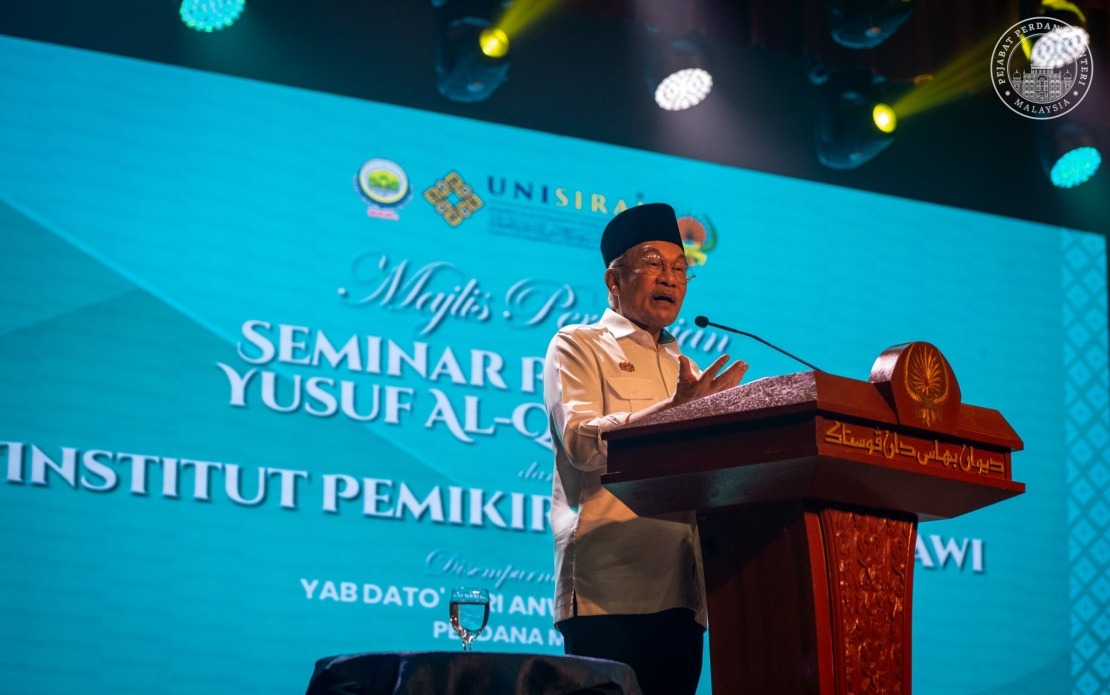
Prime Minister Datuk Seri Anwar Ibrahim has committed RM2 million in MADANI Government funding toward the Al-Qaradawi Thought Institute, underscoring the administration's backing for advanced Islamic scholarship and research infrastructure. The announcement came during the opening ceremony of the Yusuf Al-Qaradawi Thought Seminar and the establishment of the institute itself at Wisma Dewan Bahasa dan Pustaka (DBP) in Kuala Lumpur on July 21, marking a significant institutional investment in documenting and advancing the legacy of one of modern Islam's most influential intellectual figures.
Anwar's personal connection to the late Egyptian scholar Sheikh Dr Yusuf Al-Qaradawi runs deep, forming a critical thread through his political and intellectual biography. The Prime Minister emphasized this bond through social media, describing himself as "personally deeply indebted" to Al-Qaradawi across multiple dimensions—intellectual contributions, moral guidance, and a friendship rooted in shared commitment to Islamic principles. This public acknowledgement reflects how foundational Al-Qaradawi's thinking has been to Anwar's own worldview, particularly during formative years when Islamic thought was being contested across the Muslim world.
The financial commitment carries symbolic weight beyond its monetary value. By channeling government resources toward preserving and advancing Al-Qaradawi's scholarly output, Anwar signals that the MADANI administration prioritizes intellectual rigor and evidence-based Islamic jurisprudence. This positioning matters at a time when religious discourse in Malaysia faces pressures from competing interpretations, some emphasizing rigid orthodoxy while others advocate progressive reinterpretation. The institute's establishment suggests official endorsement of Al-Qaradawi's methodological approach—one that sought contemporary solutions within traditional Islamic frameworks.
Anwar traced his familiarity with Al-Qaradawi to his active years with the Malaysian Islamic Youth Movement (ABIM), where he served in leadership roles during Malaysia's Islamic resurgence of the 1980s. This biographical detail illuminates how the current Prime Minister internalized moderate Islamic thought at a formative stage, when many youth movements across the Muslim world were grappling with how to respond to modernization, secularization, and Western hegemony. The relationship between ABIM and Al-Qaradawi during this period exemplifies how transnational Islamic networks transmitted ideas across borders, shaping the intellectual contours of local movements.
Central to Anwar's recollection is Al-Qaradawi's counsel regarding the principle of wasatiyyah, or moderation in Islamic thought and practice. During the early 1980s, when Islamic fervor was rising and ideological boundaries were hardening, Al-Qaradawi reportedly sent correspondence to ABIM leadership urging the movement to avoid hardline positions and maintain openness to diverse viewpoints. This advice proved consequential, as it provided intellectual justification for ABIM to navigate between extremes—neither abandoning Islamic principles nor embracing isolationist or exclusionary approaches. Anwar has characterized this guidance as vital during a period when "fervor and trends of thought that were closed off from receiving differing views" dominated considerable segments of the Islamic movement.
Al-Qaradawi's intellectual influence extended beyond Malaysia. Throughout his long career, he became known as a reformist scholar who sought to reconcile Islamic law with contemporary realities, addressing questions ranging from women's rights to financial systems to international relations. His willingness to engage with modern complexities while maintaining Islamic foundations earned him respect across diverse Muslim communities, though his positions also generated controversy among more conservative scholars who viewed certain interpretations as insufficient departures from tradition. This contested legacy makes the institute's establishment particularly significant—it creates a scholarly space to examine and debate his contributions rather than merely celebrating them uncritically.
The characterization of Al-Qaradawi as a "zeitgeist"—a mover or spirit of the times—captures how Anwar understands his historical role. Rather than viewing the scholar as a static figure preserving past wisdom, Anwar presents him as an active agent responding to epochal shifts in Muslim societies. This framing proves instructive for contemporary Malaysian politics, where religious authority increasingly faces pressure to address rapid social change, technological disruption, and pluralistic coexistence. By memorializing Al-Qaradawi through an institutional commitment, Anwar implicitly endorses this responsive, reform-minded approach to Islamic scholarship as preferable to defensive or reactionary stances.
The Al-Qaradawi Thought Institute will likely become a venue for exploring how Islamic jurisprudence can engage substantive contemporary challenges—questions about bioethics, environmental stewardship, artificial intelligence, and social justice that demand religious perspectives yet exceed the frame of classical Islamic jurisprudence. Malaysian scholars and policymakers navigating these domains may find the institute a valuable resource for understanding methodologies that balance scriptural fidelity with contextual reasoning. This practical utility could cement the institute's relevance beyond academic circles, attracting policy attention and public interest.
From a regional perspective, the investment signals Malaysia's aspirations to position itself as a center for Islamic intellectual production and moderate Muslim thought. In a geopolitical landscape where different visions of Islam compete for influence—from rigid literalism to secular nationalism to theocratic governance models—Malaysia's government is asserting itself as a custodian and exponent of moderate, reason-engaged Islamic scholarship. This positioning carries implications for how Malaysia interfaces with regional and international religious debates, potentially leveraging intellectual authority to shape discourses around Islam's role in plural, modern societies.
The RM2 million allocation, while substantial, represents only initial capitalization. The institute's long-term impact will depend on recruitment of quality scholars, cultivation of research programs addressing pressing questions, and cultivation of international scholarly networks. Whether the institute becomes merely a monument to a respected thinker or evolves into a living research ecosystem engaging contemporary Islamic intellectual challenges remains to be determined. Anwar's public commitment suggests the government intends the former, but execution will test whether adequate resources and intellectual freedom follow the symbolic gesture.

