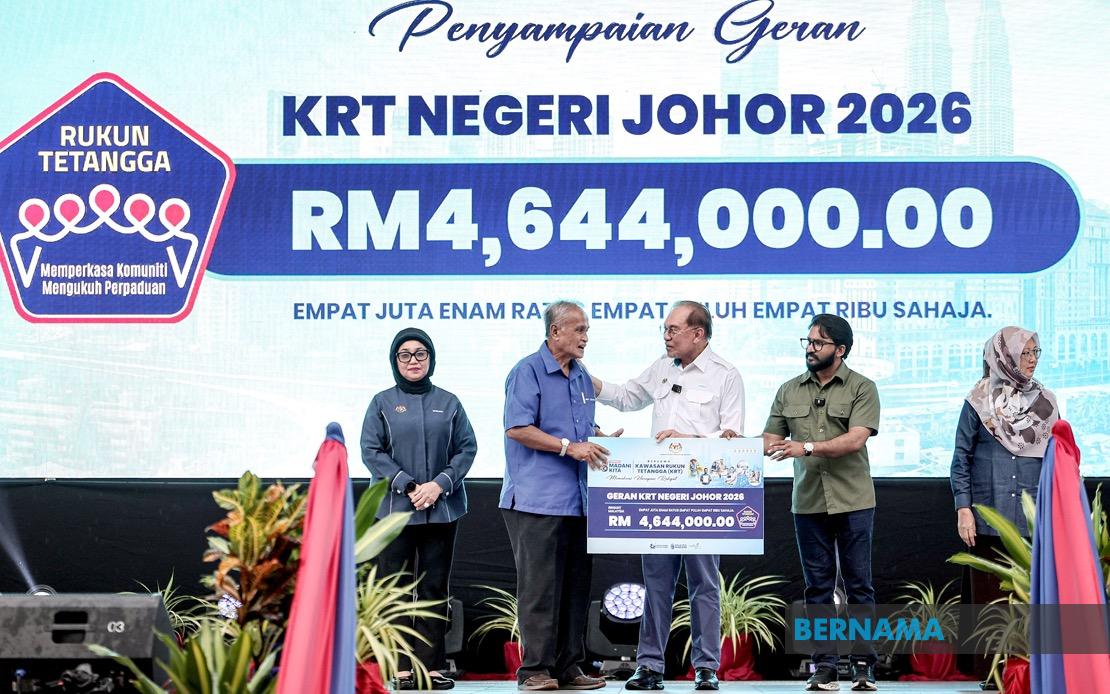
Prime Minister Datuk Seri Anwar Ibrahim has approved a substantial increase in annual funding for Neighbourhood Watch Areas (KRT) across Malaysia, raising the grant from RM6,000 to RM10,000 per unit. The enhancement, representing a 67 per cent boost, will take effect from January 1, 2027, and applies to all KRTs that maintain proper reporting on their development initiatives and community activities. The announcement was made during the MADANI KITA Programme at Dataran Segamat, attended by Deputy Minister of National Unity R. Yuneswaran and Deputy Minister of Domestic Trade and Cost of Living Datuk Dr Fuziah Salleh.
The decision to raise KRT allocations comes after a decade-long freeze at the previous level. For the past ten years, the government had maintained the annual grant at RM6,000 despite inflation and the expanding responsibilities shouldered by these grassroots organisations. Anwar emphasised that the timing of this uplift reflects the administration's recognition of KRT's instrumental contribution to addressing community challenges and building social cohesion at the neighbourhood level. The Prime Minister framed the increase as an investment in strengthening institutions that embody the principles of consultation, consensus-building, and collective action that have long anchored Malaysia's plural society.
Beyond the headline funding announcement, the Prime Minister underscored why KRT institutions merit enhanced support. These neighbourhood bodies serve as crucial intermediaries between residents and both security forces and government agencies, helping to identify and resolve issues ranging from minor disputes to serious welfare concerns. By revitalising the spirit of muafakat, or consensus, and reinforcing democratic participation at the grassroots level, KRTs contribute significantly to the maintenance of social harmony and public order. The Prime Minister's remarks suggested that the funding adjustment acknowledges this multifaceted role and seeks to enable KRTs to function more effectively in their communities.
Anwar also took the opportunity to reinforce a core message about Malaysia's foundational strength. He reminded attendees that the nation's ability to preserve harmony among its diverse racial, religious, and cultural communities since independence represents one of its greatest achievements. The Prime Minister cautioned against weaponising differences as a tool for division, instead advocating that such diversity be celebrated as a defining national asset. This framing positions the KRT grant increase within a broader policy narrative centred on national unity and the preservation of intercommunal peace—themes that have become increasingly prominent in government messaging.
In addition to the KRT funding enhancement, Anwar announced an immediate allocation of RM3.205 million for infrastructure repairs at Islamic educational institutions throughout Johor. The projects target religious schools, madrasahs, study centres, and tahfiz facilities across multiple districts including Batu Pahat, Muar, and Segamat. The Prime Minister emphasised that upgrading these learning environments serves the dual purpose of improving student comfort and creating more conducive spaces for Islamic education. This commitment reflects the MADANI Government's stated objective to strengthen support for religious educational infrastructure—an important constituency in Malaysia's multicommunal framework.
The maintenance and improvement of facilities at Islamic educational institutions holds particular significance in Malaysia's governance context. These institutions educate substantial numbers of students and serve as community anchors, particularly in rural and semi-rural areas. By allocating dedicated funds for critical repairs and upgrades, the government signals its commitment to ensuring that religious education receives comparable investment to secular education. The timing of this announcement alongside the KRT grant increase suggests a deliberate effort to demonstrate broad-based support for community institutions across different sectors.
Parallel to these education-focused initiatives, the Prime Minister also approved RM1.0 million in immediate funding for urgent repair work at Royal Malaysian Police (PDRM) quarters in Johor. The allocation targets critical infrastructure needed to maintain satisfactory living conditions for police personnel and their families. Anwar linked this investment directly to the government's responsibility to uphold national security and social peace, framing police welfare as integral to ensuring their effectiveness in maintaining public order. This layering of announcements—combining support for neighbourhood watch groups, religious education, and police housing—constructs a comprehensive narrative about strengthening security and community resilience from multiple angles.
The decision to raise KRT allocations carries broader implications for Malaysia's approach to community policing and grassroots governance. In an era when centralised security arrangements often dominate policy discussions, the enhancement of neighbourhood watch funding reaffirms the value of distributed, community-based models of oversight and mutual aid. KRTs function as an early warning system for emerging social problems and serve as trust-building mechanisms between residents and authorities. Better-funded KRTs may prove more capable of conducting awareness campaigns, organising community activities, and creating communication channels that strengthen social fabric.
For Malaysian readers, particularly those in smaller towns and rural areas where KRT presence remains strong, the funding increase represents tangible recognition of the volunteer and semi-volunteer work that underpins these organisations. Many KRT members contribute significant time and resources without formal compensation, relying on modest allocations to cover basic operational costs. The jump from RM6,000 to RM10,000, while modest in absolute terms, may enable KRTs to invest more effectively in community programmes, safety initiatives, and coordination with local authorities.
The announcement also reflects international trends in community safety and governance that increasingly emphasise local participation and bottom-up approaches. Rather than concentrating resources solely in centralised police and security agencies, governments worldwide are recognising that prevention and harmony-building require engagement at the neighbourhood level. Malaysia's elevation of KRT funding aligns with this broader paradigm shift, suggesting a strategic intent to balance professional security services with community-based mechanisms.
For Southeast Asian observers, the Malaysian experience with KRT structures offers a model of institutionalised community participation in governance. While specific implementations vary across the region, most Southeast Asian nations grapple with similar challenges: building social cohesion in diverse societies, maintaining security within resource constraints, and creating meaningful channels for citizen engagement. Malaysia's deliberate investment in these grassroots structures, after a decade of stasis, signals renewed confidence in community-based solutions.
The implementation timeline merits attention as well. By delaying the effective date until January 1, 2027, the government allows time for budgetary planning and ensures that all KRTs receive the enhanced allocation simultaneously rather than in a staggered fashion. This deliberate approach suggests careful administration of the policy and an effort to avoid creating inconsistencies or delays that might undermine public confidence. The January start date also aligns with fiscal planning cycles, making the transition more orderly for government budgeting.
Looking forward, the success of the KRT funding enhancement will depend partly on how effectively these organisations channel the additional resources. Accountability mechanisms and transparent reporting requirements will likely determine whether the increased allocation translates into meaningful community benefits. The Prime Minister's explicit condition that KRTs must report on their development and activities suggests that enhanced funding comes with heightened expectations for performance and accountability—a reasonable trade-off that should ensure sustainable returns on the government's investment in these crucial grassroots institutions.