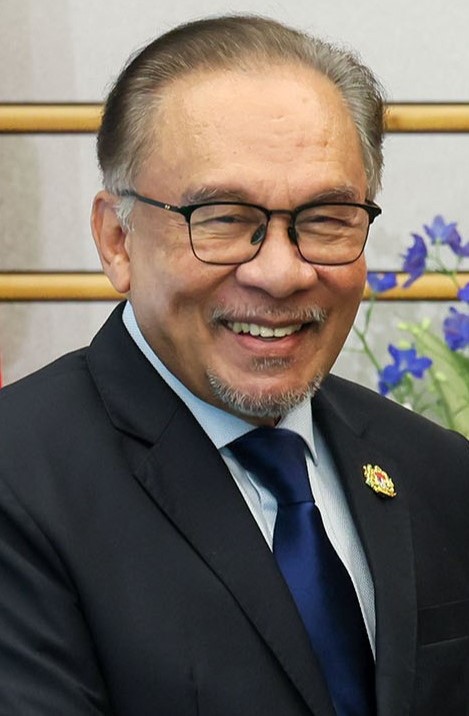
Prime Minister Datuk Seri Anwar Ibrahim is making his return to Johor state today, with a packed itinerary in Segamat as part of his intensifying efforts to mobilise grassroots support ahead of the 16th Johor state election. The visit marks his second appearance in the state within 72 hours, underlining the strategic importance of Johor as a political battleground for the ruling Pakatan Harapan coalition.
Segamat, located approximately 200 kilometres from Johor Bahru, will host two separate engagements this evening, beginning with the official launch of the MADANI KITA programme at Dataran Segamat at 5 pm. The initiative is designed to deepen the relationship between government and communities through collaborative grassroots activities, with a particular focus on strengthening social cohesion across different ethnic groups. The MADANI KITA platform functions as a communication channel allowing the administration to present policy initiatives directly to citizens in an accessible, community-centred format rather than through formal institutional channels.
Following the main launch event, the Prime Minister will pivot to a more informal gathering at the Yayasan Bazaar site in Segamat at 6.30 pm, where he will participate in the "Jom! Makan Durian" programme alongside local residents. This deliberate shift in tone—from officialised ceremony to casual social engagement—reflects a calculated approach to political messaging. By sharing traditional Malaysian food experiences in a relaxed setting, the Prime Minister aims to project accessibility and cultural familiarity, moving beyond the formal distance that often characterises high-level political appearances.
Anwar's current schedule comes just three days after he announced the complete slate of Pakatan Harapan candidates contesting the Johor state election in Bukit Gambir, Tangkak on Monday. The coalition fielded a total of 56 candidates across all state seats, comprising 20 from PKR, 19 from Amanah, and 17 from DAP. This distribution reflects the power-sharing agreement within the ruling coalition and signals the relative influence each party has negotiated within Pakatan Harapan's overall strategy in Johor.
The electoral timeline is now firmly set, with the Election Commission scheduling nomination day for June 27, early voting on July 7, and the main polling day on July 11. These dates compress the campaign period into a relatively short window, placing considerable pressure on all political contestants to maximise their ground presence and public visibility. The Prime Minister's personal engagement in Segamat, a constituency not traditionally regarded as a frontline battleground, suggests that Pakatan Harapan is attempting to consolidate support across all demographic areas rather than concentrating resources solely on marginal seats.
Johor represents critical electoral terrain for the federal government. The state has traditionally been a stronghold of the Barisan Nasional coalition, though demographic shifts and evolving political preferences have created opportunities for Pakatan Harapan to expand its footprint. By deploying the Prime Minister for consecutive visits and community-level engagement, the coalition signals serious commitment to contesting the state comprehensively rather than conceding any significant territory to opposition forces.
The MADANI KITA programme itself warrants examination as a political instrument. Rather than simply launching campaign rhetoric, the initiative frames government presence around shared community values and mutual strengthening of neighbourhood bonds. This messaging approach appeals to voters concerned with local stability and social harmony—concerns that often transcend narrow partisan divides and can influence swing voters who prioritise pragmatic governance over ideological positioning.
Segamat's selection as a venue for this high-level engagement also carries symbolic weight. The district represents a cross-section of Johor's demographic composition, combining urban and semi-rural elements while maintaining significant Malay-Muslim majorities alongside established Chinese and Indian communities. Successfully demonstrating inter-ethnic cooperation and inclusive governance messaging in such a setting provides political capital that can be translated across other constituencies with similar compositions.
For Malaysian and Southeast Asian observers, these ground-level political activities offer insight into how governing coalitions in the region approach electoral competition. Rather than relying solely on media campaigns or top-down messaging, the Pakatan Harapan leadership recognises the continued importance of direct, visible, and personally engaged political presence at community level. The Prime Minister's willingness to participate in informal social gatherings alongside formal government business indicates recognition that legitimacy in democratic contexts requires both institutional authority and demonstrated accessibility to ordinary citizens.
The compressed campaign timeline also creates pressure for all political actors to maximise their visibility and message penetration within a short period. This acceleration tends to favour incumbents and well-resourced organisations that can rapidly mobilise personnel and logistical support—an advantage that Pakatan Harapan, as the federal ruling coalition, theoretically possesses relative to opposition parties operating under resource constraints.
As the campaign progresses through late June and into early July, the frequency and geographic spread of Prime Ministerial visits will likely increase, with Johor remaining a focal point for federal government attention. These visits serve multiple purposes simultaneously: reinforcing party loyalty among existing supporters, attempting to persuade undecided voters, demonstrating active governance, and generating media coverage that amplifies political messaging beyond those physically present at campaign events.