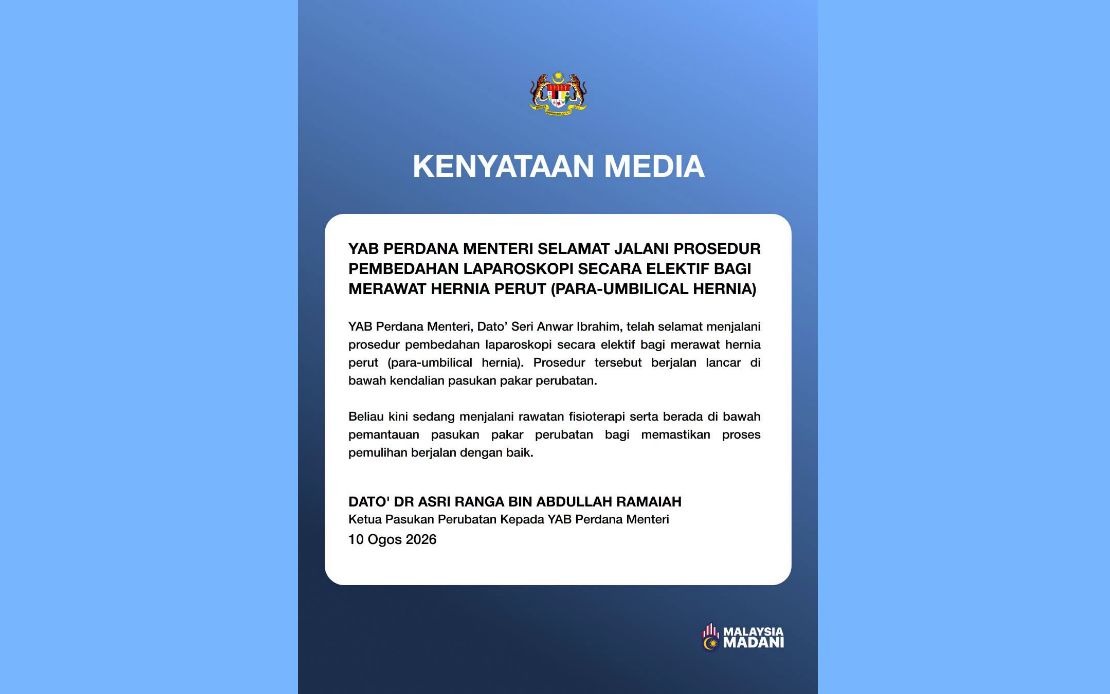
Prime Minister Datuk Seri Anwar Ibrahim has successfully completed an elective laparoscopic surgical procedure to treat a para-umbilical hernia, according to an official statement released on August 10. The minimally invasive operation proceeded without complications under the supervision of a dedicated team of medical specialists, marking another milestone in maintaining the Prime Minister's health and fitness for duty.
The head of the Prime Minister's Medical Team, Datuk Dr Asri Ranga Abdullah Ramaiah, confirmed that the surgical intervention achieved its intended objectives. In his statement, he emphasized the thoroughness of the specialist team's approach, highlighting their expertise in managing the procedure. The choice of laparoscopic surgery, a less invasive technique than traditional open surgery, reflects modern surgical best practices and typically results in shorter recovery periods and minimal post-operative discomfort for patients.
Following the successful completion of the operation, the Prime Minister entered the rehabilitation phase of his recovery plan. He is currently undergoing physiotherapy to rebuild strength and restore normal function. This carefully structured post-operative care regimen underscores the commitment of Malaysia's medical professionals to ensure the nation's highest-ranking political leader returns to full operational capacity as rapidly and safely as possible.
Datuk Dr Asri emphasized that continuous medical monitoring remains central to the Prime Minister's recovery strategy. The specialized supervision is designed to track his progress closely, identify any potential complications early, and adjust treatment protocols if necessary. This level of attentive care reflects international standards for post-operative management of government leaders, ensuring that any issues are caught and addressed promptly.
Tunku Nashrul Abaidah, the Prime Minister's senior press secretary, disclosed earlier that Anwar underwent a comprehensive series of examinations and diagnostic procedures as part of the pre-operative and immediate post-operative assessment. Medical specialists had prescribed these procedures to establish baseline health parameters and ensure optimal conditions for surgery. The planned observation period of two days represents a standard precautionary measure for laparoscopic procedures, during which medical staff can monitor vital signs and recovery indicators continuously.
The Prime Minister's office called upon the Malaysian public to offer prayers and well-wishes during this period of medical recovery. Such public expressions of concern reflect the deep connection between the nation's leadership and its citizens, and the collective interest in ensuring Malaysia's political stability by supporting the wellbeing of its key figures. The request for prayers also carries cultural and religious significance within the Malaysian context, where such gestures represent a shared national concern.
From a governance perspective, this planned and executed procedure demonstrates the importance of proactive health management among senior government officials. The decision to address the hernia condition through elective surgery rather than allowing it to deteriorate reflects responsible stewardship of one's health and capacity to fulfill demanding national responsibilities. Abdominal hernias, if left untreated, can potentially lead to complications that might necessitate emergency intervention, making planned surgical management the prudent approach.
The timing and transparency of the medical intervention also underscore modern standards of governmental accountability in Malaysia. By communicating clearly with the public and media about the Prime Minister's health situation and recovery progress, the government maintains public confidence in institutional continuity and demonstrates commitment to open governance regarding matters of legitimate national interest.
As Malaysia navigates complex regional and domestic challenges, ensuring the good health and full capacity of its political leadership remains crucial. The successful completion of this medical procedure, combined with the professional medical supervision and structured recovery program, positions the Prime Minister to resume his full range of duties with confidence. The nation's medical professionals have demonstrated their capability to provide world-class care to senior government officials, a reassuring indication of Malaysia's healthcare standards and institutional reliability.

