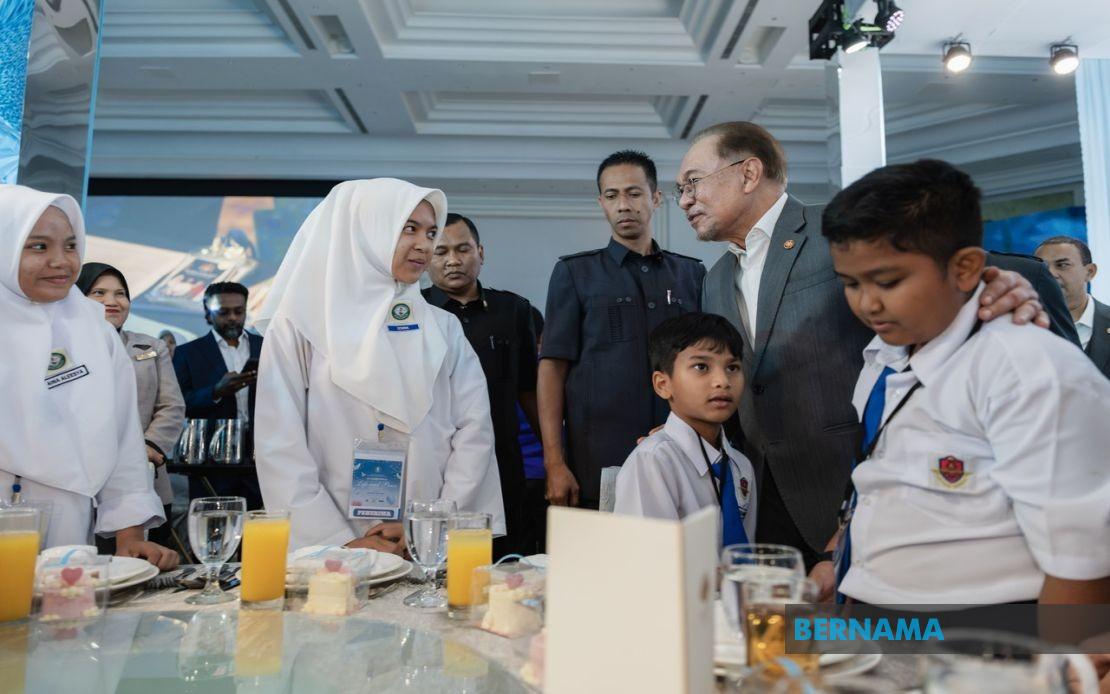
Prime Minister Datuk Seri Anwar Ibrahim has renewed his emphasis on the importance of raising children who possess not only intellectual capability but also strong moral values and respect for authority. Speaking at a youth gathering in Kuala Lumpur, Anwar articulated a vision of education that extends beyond textbook knowledge to encompass character formation, a message that resonates particularly in the Malaysian context where concerns about rising student misbehaviour and social breakdown have gained prominence in recent years.
Addressing approximately 700 pupils drawn from 47 schools across Kuala Lumpur and Putrajaya at the "Celebration of Life and Peace" event, the Prime Minister highlighted a fundamental contradiction he observed in contemporary society: the pursuit of academic excellence divorced from ethical conduct. He articulated this concern directly, noting that intellectual achievement becomes meaningless if accompanied by disruptive behaviour toward peers or a tendency to harm others. This statement carries weight given Malaysia's ongoing struggles with student discipline issues, cyberbullying, and violence in educational institutions, which have periodically made headlines and sparked debate about the quality of moral education in schools.
Anwar's remarks place responsibility squarely on multiple stakeholders rather than singling out any one group. Parents and teachers, he suggested, must fulfill their traditional roles as moral educators and behavioural guides, working in tandem to instill values that schools increasingly struggle to enforce in an era of digital distraction and shifting social norms. His framing acknowledges that the challenge of youth character development cannot fall to schools alone, but requires genuine partnership between home and institution. For Malaysian parents reading such statements, there is an implicit challenge to examine their own engagement with their children's moral formation beyond monitoring academic grades.
The Prime Minister's specific emphasis on bullying reflects a national concern that has gained urgency. Schools across Malaysia have reported incidents of physical intimidation, verbal harassment, and cyberbullying that have occasionally escalated to tragic outcomes. By singling out bullying as a behaviour that "jeopardises" young people's futures, Anwar suggested that such conduct carries consequences beyond immediate classroom disruption—it shapes character development and social integration in ways that could inhibit future success and social contribution. This framing may influence school discipline policies and parental vigilance going forward.
Anwar's appeal was delivered in notably personal, almost grandfatherly terms. He asked the gathered students directly to pledge to study diligently, honour their teachers, and show filial piety toward their parents. This rhetorical strategy, while seemingly informal, connects to traditional Malaysian and broader Asian values systems that emphasize hierarchy, respect for elders, and family obligation. In doing so, the Prime Minister positioned his advocacy not as imported Western educational theory but as rooted in indigenous cultural frameworks that many Malaysian families still recognize and practice.
The event itself, organized by the ERM Foundation and coinciding with the birthday celebration of its founder, Xin'er, embodied the practical application of the values Anwar was advocating. The foundation's approach—bringing together children from multiple schools to celebrate birthdays collectively, acknowledging that not all children have equal access to such celebrations due to illness or economic circumstance—reflects a philosophy that combines individual recognition with collective solidarity and compassion. The distribution of RM500 cash assistance to each attendee demonstrated that values advocacy need not remain purely rhetorical.
The presence of Anwar's wife, Datuk Seri Dr Wan Azizah Wan Ismail, at the event carried its own symbolic weight, reinforcing the message that family and parental involvement in character development is a priority for the nation's leadership. In Malaysian political culture, such ceremonial family presence often signals that an issue is treated as a matter of national importance rather than a passing policy announcement. The senior leadership's attendance at a children's celebration underscores that investment in youth character development ranks among governmental priorities.
Xin'er's remarks about celebrating birthdays in contexts of peace, health, and happiness rather than material accumulation added another dimension to the occasion. Her observation that many children lack access to such celebrations due to illness or other challenges positions childhood happiness and security as privileges rather than entitlements, potentially cultivating gratitude and empathy among attendees. This approach aligns with Anwar's broader message that character development requires understanding one's place within a broader community and recognizing the varying circumstances of one's peers.
The scale of the gathering—700 students from 47 schools—suggests this was not a token public relations exercise but a deliberate effort to reach significant numbers of young people with a consistent message about values. The diversity of schools represented indicates an attempt to ensure the message transcended socioeconomic divides and reached children from varying backgrounds and circumstances. For Malaysian educators and policymakers, such an event may serve as a model for how leadership can directly engage with youth on matters of character and conduct.
Anwar's emphasis on the relationship between individual conduct and societal benefit—positioning good character as essential to becoming "useful members of our society"—frames moral development not as an abstract virtue but as a practical necessity for national progress. In Malaysia's context, where rapid development and economic competition sometimes overshadow values-based education, this repositioning may prompt reconsideration of how schools allocate attention between examination results and character formation. The implicit argument is that a society composed of intelligent individuals lacking compassion or self-discipline ultimately weakens itself.
The Prime Minister's call for young people to "stay away from negative behaviour" encompasses not just bullying but a broader range of antisocial conduct that might jeopardize futures. This framing suggests that character education is an investment in individual longterm outcomes rather than merely a matter of institutional discipline. Young people who understand that their behaviour today shapes their life trajectories tomorrow may be more inclined to make considered choices during vulnerable developmental years.
For Southeast Asia more broadly, Malaysia's leadership articulating this message about balancing academic excellence with moral character reflects a regional concern. Societies across the region grapple with how to maintain traditional values while competing in globalized, technology-driven economies. Anwar's framing suggests that these need not be in opposition—that schools can produce both intellectually capable and ethically grounded citizens. This perspective may gain traction among educators and policymakers across the region who feel pressured to choose between traditional values education and modern academic competitiveness.
The event and the Prime Minister's remarks ultimately constitute a public investment in shaping the narrative about what constitutes success in Malaysian society. By elevating character alongside achievement, and by celebrating the birthdays of children from varying backgrounds, the occasion sends signals about inclusive development and shared responsibility for youth formation. Whether such signals translate into sustained policy changes in schools and families, however, remains an open question that will emerge through implementation and follow-up efforts beyond the celebratory event itself.

