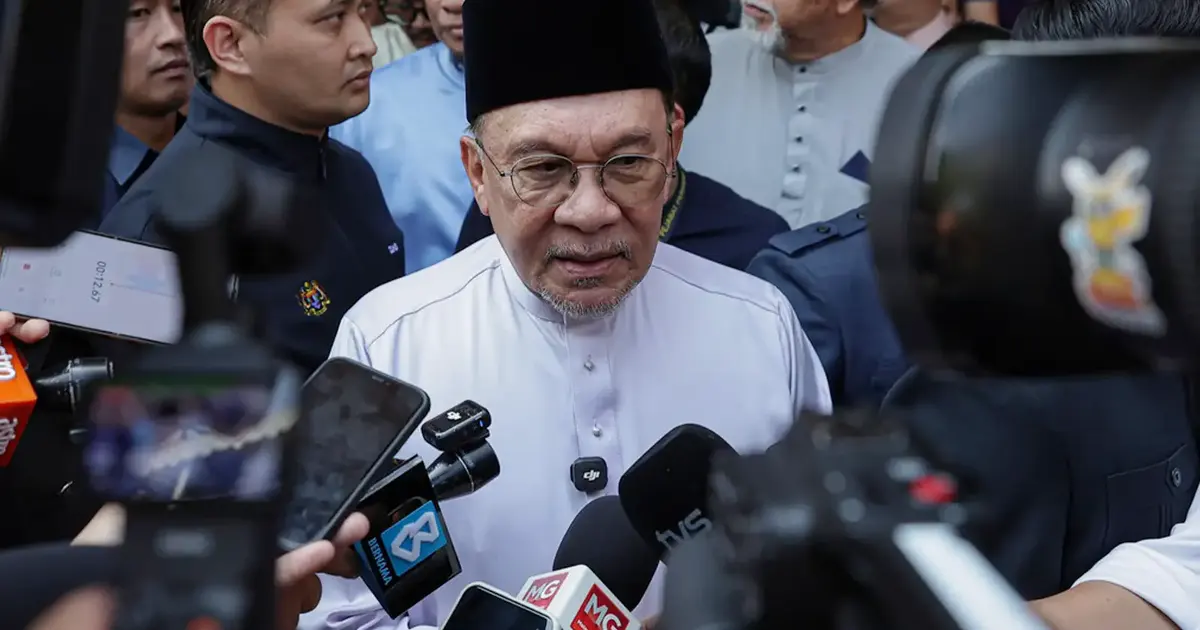
Prime Minister Anwar Ibrahim has used the occasion of topping a recent Merdeka Center public approval survey to issue a measured call for continued diligence within his administration, framing positive polling results not as cause for celebration but as a mandate requiring intensified effort and deeper commitment to governance.
The Merdeka Center survey, one of Malaysia's longest-running and most respected independent opinion polling operations, has traditionally served as a barometer of public confidence in the ruling establishment. Strong ratings in such surveys carry significant symbolic weight in Malaysian political discourse, often interpreted as validation of a government's direction and performance. Yet Anwar's immediate response to favourable results reveals a strategic understanding that public goodwill remains contingent and volatile, particularly in a nation where political sentiment can shift rapidly in response to economic conditions, service delivery failures, or corruption allegations.
Anwar's emphasis on avoiding complacency reflects the complex political environment Malaysia navigates following the 2022 general election, which produced a fractured parliament and necessitated coalition-building across ideological divides. His Pakatan Harapan alliance governs alongside Barisan Nasional and other parties, an arrangement that remains inherently unstable and dependent on maintaining visible momentum and tangible achievements. The coalition structure means that any perception of stalling or declining public satisfaction could provide disgruntled partners or opposition figures with justification to withdraw support or challenge government stability.
From an economic standpoint, Malaysia faces headwinds that could quickly erode public confidence regardless of current approval ratings. The country contends with persistent inflation affecting household purchasing power, a weakening ringgit that impacts import costs and wage competitiveness, and structural challenges in attracting high-value foreign investment. Consumer sentiment and business confidence remain fragile, meaning that strong political approval ratings may not translate into improved economic perception without visible policy wins on inflation, employment creation, and wage growth.
The prime minister's message also carries implications for internal government discipline and ministerial accountability. Complacency within government ranks often manifests as reduced urgency in project delivery, increased tolerance for bureaucratic inefficiency, and vulnerability to corruption. By publicly cautioning against such tendencies, Anwar is signalling to his cabinet and civil service that high approval ratings should increase rather than decrease scrutiny of their performance. This framing positions strong public support as a tool for enforcing higher standards rather than an endorsement to ease off on reform efforts.
Merdeka Center surveys have historically captured shifts in Malaysian public opinion across diverse demographic groups—urban and rural, different income brackets, and various ethnic communities. Strong approval across such a heterogeneous population base is particularly rare in Malaysian politics, where polarisation often runs deep along community lines. If the current survey indeed reflects broad-based approval, this suggests Anwar's administration has managed the delicate balance of maintaining multiethnic coalition governance without triggering sharp backlash from any major constituency—a significant achievement given the heightened sensitivities around religious affairs, subsidy policies, and development spending.
However, the prime minister's caution also implicitly acknowledges the volatility of such ratings. Historical precedent in Malaysian politics demonstrates that approval ratings can collapse swiftly when major policy stumbles occur, corruption allegations surface, or economic conditions deteriorate. The Najib Razak administration, for instance, enjoyed substantial public support in its early years before the 1Malaysia Development Berhad scandal and subsequent economic challenges decimated its approval metrics. Anwar's insistence on continued hard work signals awareness that maintaining approval requires constant delivery and vigilance against governance failures.
For opposition parties, the prime minister's guarded response to positive polling may frustrate attempts to frame the government as complacent or losing touch. By pre-emptively claiming that approval ratings necessitate greater accountability rather than celebration, Anwar positions himself on the offensive side of the governance narrative. Opposition criticism that the government is underperforming becomes harder to sustain if the administration itself is publicly demanding higher standards from its own institutions and officials.
The broader implications for Malaysian governance extend to how the government manages resource allocation and policy priorities. Strong public approval could justify postponing difficult but necessary decisions—subsidy rationalisation, tax increases, or unpopular industrial restructuring. Anwar's rhetoric suggests the opposite approach: using public confidence as political capital to tackle harder reforms that require sustained public trust to implement successfully. This framing aligns with the government's stated commitment to addressing structural fiscal imbalances and modernising Malaysia's economic foundations, challenges that require public understanding even when policies impose short-term costs on specific groups.
Looking forward, whether Anwar's call for heightened effort translates into measurable policy changes will significantly influence the trajectory of public opinion. Merdeka Center surveys conducted over coming months will reveal whether approval ratings prove sustainable or represent merely a temporary phenomenon. The prime minister's challenge lies in converting rhetorical commitment to continued hard work into demonstrable improvements in service delivery, infrastructure development, and corruption prevention—the concrete matters that ultimately shape public confidence. His cautious response to positive polling suggests strategic awareness that in Malaysian politics, approval ratings are neither secure nor permanent, and governing in their aftermath requires enhanced rather than diminished commitment to performance.

