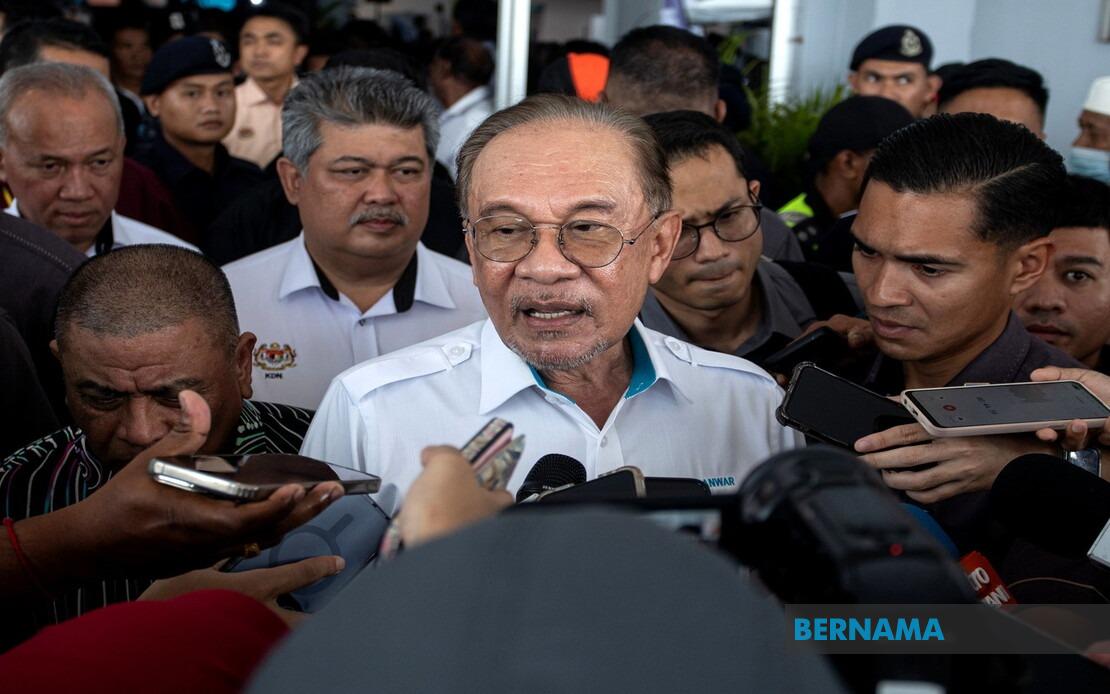
Prime Minister Datuk Seri Anwar Ibrahim issued a clear directive to government personnel on Tuesday, instructing them to maintain decorum while campaigning in ongoing state elections and to avoid launching attacks against the Federal Government. Speaking in Ipoh after attending a community engagement programme, the PM underscored that officials holding ministerial or agency positions must adhere to strict disciplinary standards, particularly when their parties compete against each other at the state level within the broader Unity Government framework.
The admonition reflects a persistent tension within Malaysia's coalition administration, where multiple political parties occupy federal government roles while simultaneously contesting rival coalitions' candidates in state-level races. This structural dynamic, while commonplace in federal systems globally, has occasionally resulted in coalition members using state campaigns as platforms to critique federal-level policies or performance—a practice the Prime Minister views as counterproductive to governance objectives.
Anwar articulated a nuanced position distinguishing between acceptable and unacceptable campaign conduct. He acknowledged that competing against coalition partners at the state level represents normal democratic practice, emphasising that candidates remain free to address state-specific issues and raise local grievances. However, he drew a clear boundary regarding the Federal Government itself, stating that officials who choose to attack the administration should resign their positions rather than retain both their government roles and their ability to campaign against federal policies.
The Prime Minister's remarks carried particular weight given his dual role as both chief executive and chairman of Pakatan Harapan, one of the three major blocs within the Unity Government. His statement suggested recent instances of discipline violations had necessitated this public clarification, though he refrained from identifying specific individuals or incidents. The fact that he felt compelled to reiterate these expectations suggests that informal guidelines had proven insufficient in moderating campaign rhetoric among some officials.
Anwar indicated that the matter had received attention at the highest levels of government, confirming discussions with his two deputies—Datuk Seri Dr Ahmad Zahid Hamidi and Datuk Seri Fadillah Yusof—regarding expected conduct standards. This consultation with the Deputy Prime Ministers signals that the issue extends beyond isolated cases and reflects a coordinated concern among the federal executive regarding potential damage to the stability and credibility of the Unity Government coalition.
Beyond the immediate campaign context, the Prime Minister's intervention addresses a deeper institutional challenge facing Malaysia's coalition governance model. The Unity Government, formed following the 2022 general election, comprises ideologically diverse parties that sometimes maintain competing regional bases and electoral strategies. While this diversity can enhance political representation, it simultaneously creates opportunities for public disagreement that may undermine public confidence in the administration's coherence and effectiveness.
Anwar's emphasis on preserving cordial federal-state relationships reflects recognition that political tensions at the electoral level inevitably affect the government's capacity to function smoothly across administrative levels. When federal officials publicly criticise the administration they serve, it creates ambiguity for civil servants, state-level bureaucrats, and the public regarding policy direction and governmental legitimacy. This operational consideration transcends mere political etiquette, affecting the practical delivery of services to citizens.
The Prime Minister characterised the expected standard as one of continued discipline for those holding government positions. He framed the choice clearly: officials may campaign aggressively on state issues and even compete against coalition partners, but they forfeit the option to simultaneously attack federal policies or governance while retaining their ministerial or agency appointments. This either-or framing eliminates ambiguity about acceptable behaviour and provides a mechanism for addressing violations.
Anwar's statement also included an appeal to Unity Government parties collectively to strengthen rather than weaken their relationships across federal and state levels. He articulated the principle that political competition at one level need not—and should not—necessitate deterioration of working relationships at other levels. This reflects lessons learned from previous coalition governments in Malaysia that foundered when internal tensions overwhelmed collaborative commitments.
For Malaysian observers, the Prime Minister's remarks underscore the ongoing fragility of coalition governance and the necessity of maintaining institutional discipline when multiple parties share executive responsibility. The Unity Government's continuation depends substantially on all constituent parties prioritising systemic stability over short-term electoral advantage at state elections. Anwar's intervention, while procedurally routine, carries weight as a reminder of that foundational requirement.
The implications extend to Malaysian voters observing state elections, who face the potentially confusing spectacle of federal government officials criticising the very administration they represent. Anwar's directive aims to eliminate that contradiction, clarifying that those unwilling to maintain that consistency should exit government roles. This approach attempts to preserve both electoral competition and administrative coherence—a challenging balance in Malaysia's multi-party, multi-level political system.

