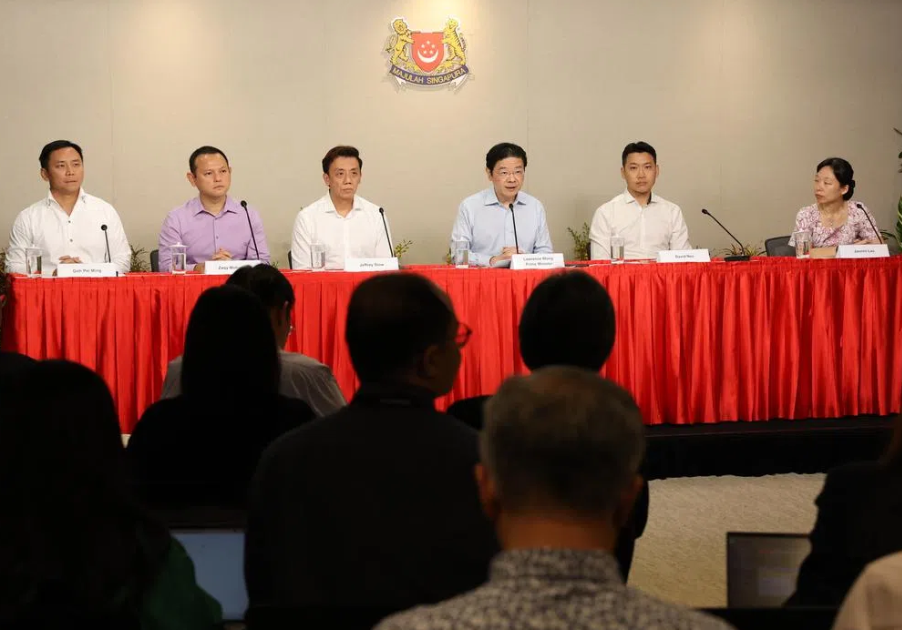
Prime Minister Lawrence Wong has announced a substantial restructuring of Singapore's Cabinet on July 22, marked by the elevation of several first-term politicians to senior roles. The reshuffle comes amid a period of significant personnel changes in the ruling party, with the Government seeking to balance the need for continuity with the imperative of building fresh leadership capacity. Wong framed the changes as essential to Singapore's governance architecture, arguing that the city-state requires both seasoned administrators to navigate immediate challenges and emerging leaders equipped to guide the nation forward.
Two newly-elected politicians from the 2025 general election are being elevated to full ministerial rank. Jeffrey Siow and David Neo, who have spent recent months in acting capacities, will now assume permanent positions as full ministers. Siow has been serving as Acting Transport Minister since May 2025 and will continue in that portfolio, while Neo, who has held the Acting Minister role for Culture, Community and Youth, similarly retains his current ministry. Their transition from acting to confirmed appointments represents a significant confidence vote from the Prime Minister, reflecting their performance over the past year and their demonstrated ability to work effectively with both Cabinet colleagues and the civil service.
Beyond these two full ministerial promotions, the Cabinet restructuring extends across multiple portfolios and levels of seniority. Sim Ann, another first-term legislator, will assume the position of Second Minister for both Foreign Affairs and Home Affairs, significantly expanding her portfolio responsibilities. Jasmin Lau, also serving her inaugural parliamentary term, has been appointed as acting minister of the Manpower Ministry, assuming responsibility for labour policy from the departing Tan See Leng. These moves demonstrate the Government's determination to provide high-profile, portfolio-holding opportunities to politicians who have completed only one election cycle.
The reshuffle also witnesses important shifts at the apex of Singapore's political hierarchy. K. Shanmugam, long regarded as one of the most influential figures in Government, transitions to the position of Senior Minister, a designation acknowledging his status as one of the two most experienced members of the Cabinet alongside Senior Minister Lee Hsien Loong. Labour movement leader Ng Chee Meng returns to the ministerial ranks after an interlude, taking on the position of Minister in the Prime Minister's Office. These moves signal that the Government intends to maintain counsel from its most experienced officials even as it distributes greater operational authority among its newer cohort.
Tan See Leng, stepping down from the Manpower Ministry, transitions to become Minister for Trade and Industry with responsibility for energy and industry matters. This represents a lateral move rather than a demotion, reflecting the Government's careful management of its senior officials' career trajectories. Two backbench Members of Parliament with previous senior civil service experience, Foo Cexiang and Shawn Loh, will become Ministers of State, continuing the pattern of identifying and advancing capable administrators from within the broader parliamentary membership.
The timing of this reshuffle reflects both planned governance rhythms and unexpected disruptions. Wong explained that Cabinet composition is reviewed annually, but the Government must also respond to unforeseen circumstances. Two notable resignations in 2026 have necessitated accelerated succession planning. Faishal Ibrahim, Acting Minister-in-charge of Muslim Affairs and Senior Minister of State for Home Affairs, resigned on July 20, citing what he described as a lapse of judgment in handling interactions with a woman. Earlier, in June, senior minister of state Koh Poh Koon had stepped down for family reasons. These departures compelled the Government to undertake broader restructuring to ensure adequate coverage across key portfolios and to demonstrate renewed capacity and stability.
Wong's articulation of the reshuffle's rationale emphasises the Government's commitment to systematic, continuous leadership renewal rather than episodic generational change. He described Singapore's approach as intentionally maintaining a blend of veteran and emerging leadership, with the newest ministers learning from and working alongside experienced colleagues. This philosophy extends beyond Cabinet rank; Wong emphasised the importance of developing a robust pipeline of younger office-holders and capable backbenchers who can progress into higher responsibilities as their development matures. The concept treats leadership renewal as a sustained process of assessment, mentoring, and calibrated advancement rather than sudden or wholesale transition.
A conspicuous decision in this reshuffle involves the Deputy Prime Minister position. Wong chose not to appoint a second deputy prime minister alongside the incumbent Gan Kim Yong, despite what some observers might have expected given the scale of Cabinet changes and the emphasis on leadership renewal. Wong defended this decision by characterising the current structure, augmented by three Coordinating Ministers overseeing particular domains, as providing a strong senior leadership team. Significantly, K. Shanmugam serves as Coordinating Minister for National Security, while Chan Chun Sing and Ong Ye Kung hold similar coordinating positions across other governmental portfolios. This configuration distributes senior strategic responsibility across multiple experienced officials rather than concentrating it in a single deputy.
One portfolio that remains unresolved concerns Wong's own tenure as Finance Minister, a position he has held since 2021. When pressed on this point, Wong acknowledged that he actively seeks a suitable successor but characterised the search as an ongoing endeavour. His remarks suggest that no current Cabinet member has yet demonstrated the requisite combination of experience, economic acumen, and readiness that the Premier deems essential for this particularly sensitive ministry. Wong's approach to succession in finance reflects a broader philosophy that political figures develop at varying paces, and premature elevation to positions of such consequence risks institutional vulnerability. His stated objective is to assess each minister's development trajectory and assign responsibilities only when genuine readiness becomes apparent.
From a regional perspective, Singapore's Cabinet reshuffle carries implications for how the city-state manages its governance during a period of leadership transition. The decision to rapidly elevate first-term politicians to full ministerial and senior ministerial positions suggests confidence in generational quality and a determination to avoid the governance vacuums that can afflict systems relying too heavily on ageing leadership cohorts. For Malaysia and other Southeast Asian neighbours, Singapore's approach to systematic leadership renewal offers a case study in how mature political systems manage continuity while facilitating change. The emphasis on mentoring relationships between senior and junior ministers, the careful assessment of individual development, and the avoidance of purely seniority-based advancement reflect institutional sophistication.
The reshuffle also highlights Singapore's particular approach to managing unexpected political disruptions. The two 2026 resignations might have triggered defensive retrenchment in some systems, but Wong's response demonstrates how purposeful restructuring can convert crises into opportunities for leadership development. By redistributing responsibilities in response to departures, the Government reaffirms its institutional stability and its capacity to develop replacement talent. For Malaysia, where Cabinet changes often generate more visible political turbulence, Singapore's presentation of reshuffle rationales as methodical and developmental rather than factional or reactive illustrates how governance narratives can be constructed.
The implementation timeline for these changes, proceeding progressively from July 27 with some taking effect later, suggests a managed transition designed to minimise disruption to ongoing governmental functions. Each minister will transition into expanded or revised responsibilities with adequate handover periods, avoiding the abruptness that could undermine departmental continuity or ministerial learning curves. This phased approach contrasts with the more sudden reorganisations sometimes seen in neighbouring systems. For Malaysian observers and administrators, the care with which Singapore structures even routine Cabinet changes reflects the premium the city-state places on administrative continuity and institutional memory, priorities that shape how it approaches leadership renewal.

