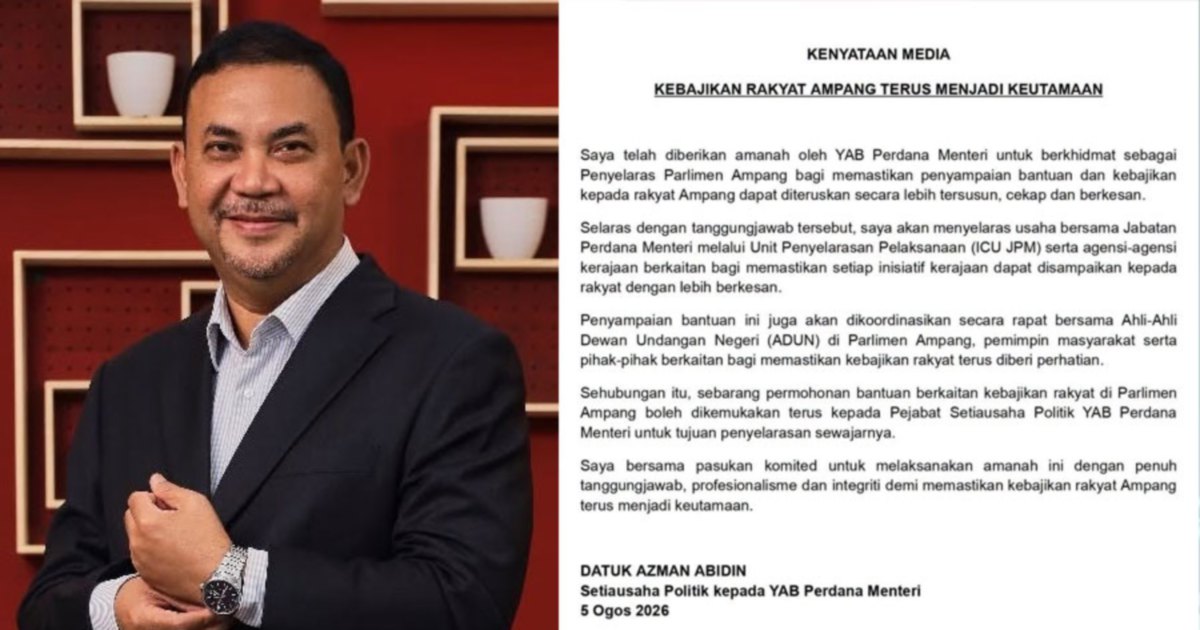
Prime Minister Datuk Seri Anwar Ibrahim's office has appointed one of his political secretaries to serve as the new parliamentary coordinator for Ampang, a move that comes on the heels of suspending PKR lawmaker Rodziah Ismail's access to the MyKhas constituency allocation system. The appointment signals a significant shift in how the Ampang parliamentary administrative and financial operations will be managed going forward, placing decision-making authority directly within the Prime Minister's inner circle.
The MyKhas system, which stands for Matching Grants for Independent Schools and Hospitals, represents a critical funding mechanism that allows elected representatives to direct resources to local community projects and initiatives. When an MP's access to this allocation platform is suspended, it effectively removes their ability to independently approve expenditure for constituency development, a power that has traditionally been central to an elected representative's role in serving their constituents. The timing and nature of Rodziah Ismail's suspension suggests an internal party dispute or governance concern that necessitated reassigning these powers to a neutral third party.
Rodziah Ismail, who represents the Ampang constituency under the PKR banner, now finds herself in an unprecedented position where her parliamentary functions have been substantially curtailed. For an MP, losing access to constituency funds represents a significant operational constraint, particularly when facing pressing local demands for infrastructure improvements, educational programmes, or community welfare initiatives. The impact on constituent services could be substantial, as residents typically approach their elected representatives with requests for assistance with local projects and grievances.
The appointment of a Prime Minister's aide to this coordinator position elevates the role beyond a simple administrative function. This individual will now hold considerable discretionary power over how MyKhas funds are deployed in Ampang, creating a direct line of accountability to the Prime Minister's office rather than to the elected MP. Such an arrangement is unusual within Malaysia's parliamentary system, where MPs have traditionally maintained considerable autonomy over their constituency development allocations, a prerogative viewed as fundamental to their political legitimacy.
Within PKR's internal structure, this development carries broader implications for party discipline and hierarchy. The appointment suggests that party leadership has determined that maintaining control over Ampang's resource allocation supersedes allowing the sitting MP unfettered access to these funds. This could reflect concerns about how those resources have been managed, allegations of misuse, or a response to some form of intraparty conflict. For other PKR MPs observing this situation, the signal is clear: failure to comply with party directives or maintain party leadership's confidence could result in similar restrictions on their parliamentary prerogatives.
For Ampang residents, the practical consequence is that their elected representative is now operating under constraints that limit her ability to deliver on development promises or respond swiftly to community requests. The introduction of a middleman in the approval process could create bottlenecks and delays in fund distribution, potentially affecting the timely implementation of community projects that MPs traditionally expedite. This bureaucratic layer may also create ambiguity about who actually holds responsibility when projects falter or funds are misallocated—the elected MP or the Prime Minister's appointed coordinator.
The political dimensions of this appointment are equally significant. In Malaysia's contemporary political landscape, where coalitional stability remains fragile and party internal dynamics are frequently volatile, the ability to manage troublesome MPs through financial control mechanisms has become an increasingly important leverage point. By demonstrating that access to resources can be revoked, party leadership sends a message about the consequences of failing to toe the line, whether that involves attendance records, voting patterns, or public statements.
From the perspective of governance and constitutional convention, the arrangement raises questions about the separation of executive and parliamentary functions. Traditionally, an MP's authority to represent and serve their constituency operates independently from the executive branch, even when the MP belongs to the ruling party. The intrusion of a Prime Minister's aide into direct management of constituency funds blurs these boundaries and concentrates executive power over local governance in ways that diverge from Westminster traditions Malaysia inherited.
Regionally, Malaysia's political system has been closely watched by other Southeast Asian democracies grappling with similar tensions between executive power and parliamentary autonomy. The Ampang case exemplifies how dominant-party systems can evolve mechanisms for internal control that, while technically legal, challenge conventional understandings of representative governance. Other nations in the region have observed how Malaysia's political leaders navigate these tensions, and this appointment may inform discussions about institutional safeguards elsewhere in Asia.
PKR leadership has not publicly explained the precise rationale for suspending Rodziah Ismail's fund access or the appointment of the Prime Minister's secretary as coordinator. This opacity around decision-making contributes to uncertainty among party members and the public about whether this represents a temporary disciplinary measure or signals deeper problems within the Ampang constituency's political management. Clarity on these points would help establish whether this represents standard intraparty governance or an unprecedented intervention warranting broader concern.
Looking ahead, the sustainability of this arrangement remains uncertain. If constituency residents begin experiencing difficulties in accessing the development services they expect from their MP, pressure may build within PKR to restore Rodziah Ismail's full parliamentary functions. Conversely, if the new coordinator proves effective and maintains party leadership's confidence, this model could potentially serve as a template for managing future internal party conflicts, though such an outcome would represent a meaningful shift in how Malaysian parliamentarians traditionally exercise their roles.

