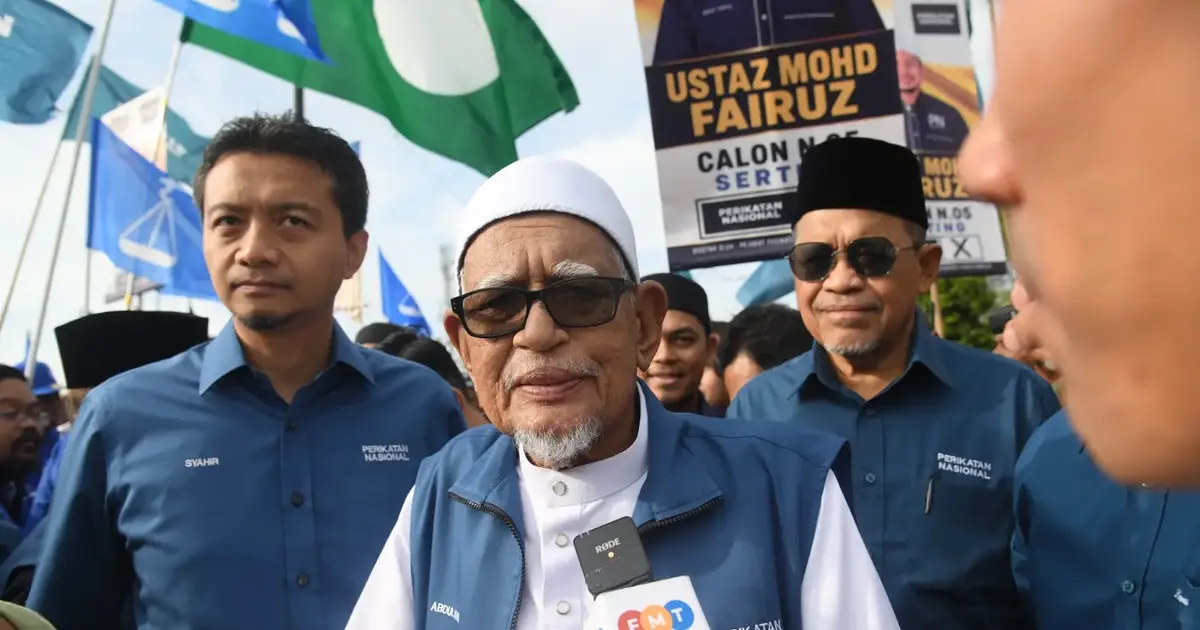
PAS president Hadi Awang has elevated the rhetorical stakes surrounding Perikatan Nasional and Barisan Nasional's working relationship in Negeri Sembilan, describing their collaboration as fundamentally deeper than a conventional political marriage. Speaking at a gathering of party supporters, Hadi suggested that the two major blocs have forged a bond that transcends the temporary or transactional nature typically associated with electoral alliances and parliamentary arrangements.
The characterisation comes as both coalitions continue to navigate their complex relationship across Malaysia's federal and state systems. While PN and BN have maintained separate identities at the national level, their interactions in various states—including Negeri Sembilan—have remained fluid and subject to shifting political calculations. Hadi's language appears designed to reassure party members and grassroots supporters that any cooperation is grounded in shared ideological or strategic principles rather than mere political opportunism.
Negeri Sembilan holds particular significance within Malaysia's political landscape as a swing state with volatile voting patterns and a history of coalition realignments. The state has seen multiple shifts in control between major political blocs, making its governance structure a barometer for broader national political trends. Any formal arrangement between PN and BN in the state could reshape regional political dynamics and send ripples through neighbouring constituencies in Selangor and Kuala Lumpur.
Hadi deliberately left the question of formalising the partnership in abeyance, indicating that any institutional consolidation of the PN-BN relationship would come at a time and manner determined by party leadership rather than through immediate announcement. This measured approach allows both coalitions to maintain flexibility in their strategic positioning while avoiding the appearance of hasty or ill-considered institutional changes. The timing of such decisions often carries significant political weight, potentially coinciding with state assembly dissolution, scheduled elections, or shifts in national political dynamics.
The PAS president's comments reflect ongoing discussions within both PN and BN about the sustainability and direction of their collaboration. Since the 2022 general election, which resulted in a fractured parliament and subsequent Malay-Muslim coalition formation, the relationship between these two blocs has remained ambiguous. Some parties within each coalition have sought closer integration, while others have maintained that separate identities better serve their electoral and organisational interests.
Negeri Sembilan's governance structure makes it a critical testing ground for coalition dynamics. The state assembly comprises representatives elected on distinct party tickets, meaning that any formalisation of PN-BN ties would require careful negotiation to ensure that both blocs' representatives maintain their constituencies' confidence. Local assemblypersons may resist arrangements that appear to dilute their individual party's identity or influence at the grassroots level.
For Malaysian political observers, Hadi's metaphorical language warrants closer examination. The phrase "more than a marriage" can be interpreted as suggesting either a deeper spiritual or ideological bond, or conversely, a relationship unmoored from legal and institutional frameworks. In Malaysian political discourse, such characterisations often precede either formal mergers or, alternatively, amicable separations. The deliberate ambiguity appears intentional, allowing room for multiple interpretations as strategic circumstances evolve.
The broader context involves multiple strands of political negotiation across Malaysia's federal architecture. National-level dynamics in Parliament, state-level governance arrangements, and municipal administration all intersect in determining how coalitions operationalise their relationships. A formalised arrangement in Negeri Sembilan could establish a template applicable elsewhere or might remain specific to that state's unique circumstances.
PAS's willingness to discuss its relationship with BN in such explicit terms represents a noteworthy shift from earlier periods when intra-coalition dynamics were discussed more obliquely. The increased transparency, even while leaving specific timelines vague, suggests confidence within the party leadership about the direction of the partnership. It also indicates that grassroots members and supporters increasingly demand clarity about their party's strategic positioning and coalition commitments.
For Negeri Sembilan residents and political stakeholders, the practical implications depend heavily on how any formalisation proceeds. Enhanced coordination between PN and BN representatives could streamline state governance and reduce parliamentary obstruction, or it could entrench incumbent advantages and reduce political competition. The state's electorate will ultimately judge whether such arrangements serve the public interest or primarily benefit the coalitions' organisational and political objectives.
The question of timing remains crucial. Hadi's statement that decisions will arrive "later" provides both coalitions with strategic breathing room, allowing leaders to assess evolving political conditions before committing to institutional changes. Such deliberateness reflects the high stakes involved in formal coalition restructuring, which can reshape state politics for years to come.

