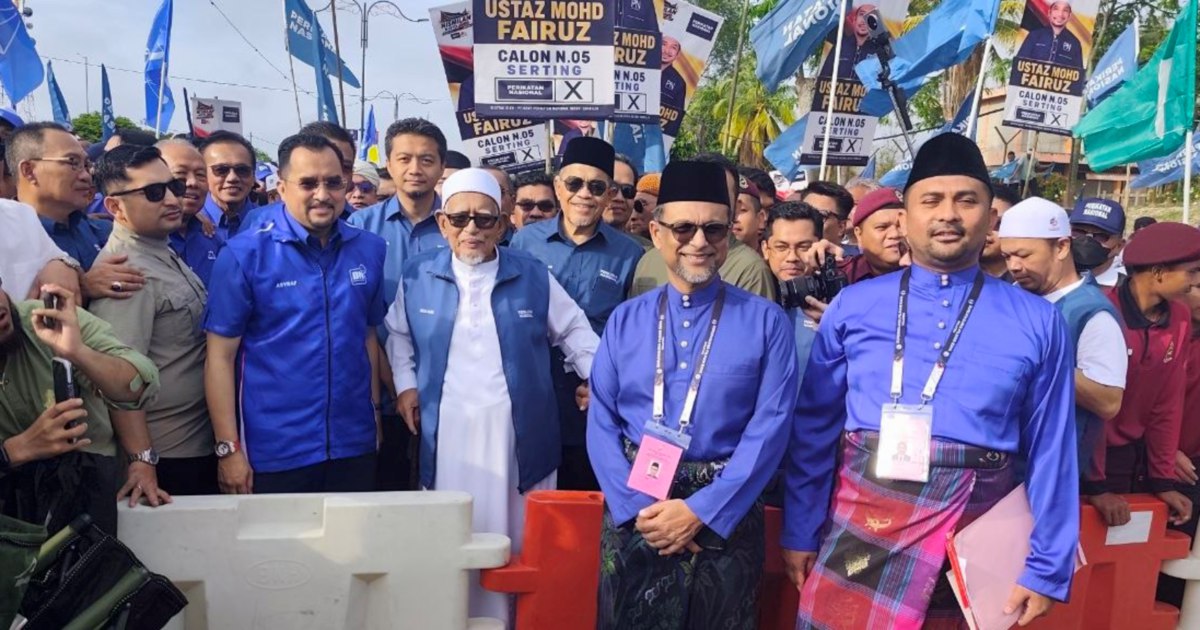
Perikatan Nasional will throw its organisational muscle behind Barisan Nasional during the campaign for the Negri Sembilan state election, PAS president Tan Sri Abdul Hadi Awang announced while in Jempol. The pledge of campaign assistance from the opposition-aligned coalition represents a fresh development in the intricate political choreography that has defined Malaysian electoral contests since the 2022 general election.
The commitment underscores the evolving relationship between PN, which secured considerable parliamentary representation in the 2022 federal polls, and BN, which continues to maintain state-level strongholds despite losing federal power in 2018. Negri Sembilan, traditionally a BN bastion, carries particular significance for both coalitions as they manoeuvre for positioning ahead of future national elections. PN's willingness to lend organisational support rather than field competing candidates in the state contest suggests a tactical calculation aimed at maintaining coalition cohesion and signalling goodwill between the two major power blocs.
The nature of PN's campaign assistance remains to be clarified in coming weeks, as the coalition could deploy strategies ranging from deploying party machinery and volunteers to coordinating voter outreach across constituencies. PAS, as the largest component of PN with the most extensive grassroots network in many regions, would likely serve as the primary vehicle for such assistance. The party's vast membership and experience in community mobilisation could prove particularly valuable in rural areas of Negri Sembilan where personal campaigning and direct voter engagement remain decisive.
This development reflects broader shifts in Malaysian coalition politics since the 2022 election. Rather than the winner-take-all competition that once characterised state elections, the country has witnessed increasing pragmatism in which coalitions negotiate implicit understandings about contesting particular races or territories. Such arrangements allow political forces to consolidate their bases while avoiding the destructive internal competition that weakens their collective bargaining position at the national level. For Negri Sembilan specifically, PN's supportive stance could help BN maintain its legislative majority in the state assembly.
The political dynamics of Negri Sembilan hold implications for understanding how Malaysian electoral politics may unfold before the next general election, expected by 2025 or 2026. The state has traditionally leaned toward BN, but demographic shifts and evolving voter preferences have gradually altered its political complexion. Strong performance by either coalition in the forthcoming election could generate momentum and morale effects that ripple into the national arena. An emphatic BN victory, potentially bolstered by PN's campaign assistance, would signal renewed vitality for the older coalition, while underperformance could be portrayed as validating PN's emergence as an alternative power centre.
From a regional Southeast Asian perspective, Malaysia's coalition-building strategies offer insights into how multi-ethnic democracies manage electoral competition without descending into winner-take-all dynamics that risk social fragmentation. Unlike political systems where coalitions form solely after elections, Malaysian parties increasingly negotiate and coordinate campaign positioning beforehand, allowing diverse constituencies to anticipate which coalition partners will govern their states and at what price. This approach, while sometimes criticised for reducing voter choice, has enabled Malaysia to navigate complex ethnic and religious sensitivities more smoothly than some neighbours.
PAS's explicit public endorsement of PN's campaign support for BN also carries messaging significance for the party's own supporters and the broader Malay-Muslim electorate. By positioning itself as willing to collaborate with BN—a coalition long associated with UMNO and the Malay-Muslim agenda—PAS signals that its opposition status does not preclude pragmatic cooperation on matters of mutual interest. This helps counter narratives that PN represents ideological rupture from the established order, portraying it instead as a competing but ultimately compatible political force.
The mechanics of campaign coordination between PN and BN in Negri Sembilan will likely become clearer once Tan Sri Abdul Hadi Awang and BN leadership discuss detailed arrangements. Such coordination might include jointly organised rallies, coordinated messaging on key policy themes, or simply PN refraining from campaigning against BN candidates in selected constituencies. The efficacy of such arrangements often depends on the discipline of party cadres at state and district levels, where local rivalries and historical tensions sometimes override central directives.
Looking ahead, the Negri Sembilan election will serve as an important bellwether for both coalitions. For BN, it represents an opportunity to demonstrate that it retains electoral competitiveness under its current leadership constellation. For PN, even without directly contesting, the election provides a stage to display its organisational capabilities and reinforce its role as a major force in Malaysian politics. The cooperation between the two coalitions in this state contest may establish precedents for how they manage electoral competition in other state elections scheduled for the coming months, shaping the landscape in which Malaysian voters will assess their options heading toward the next general election.

