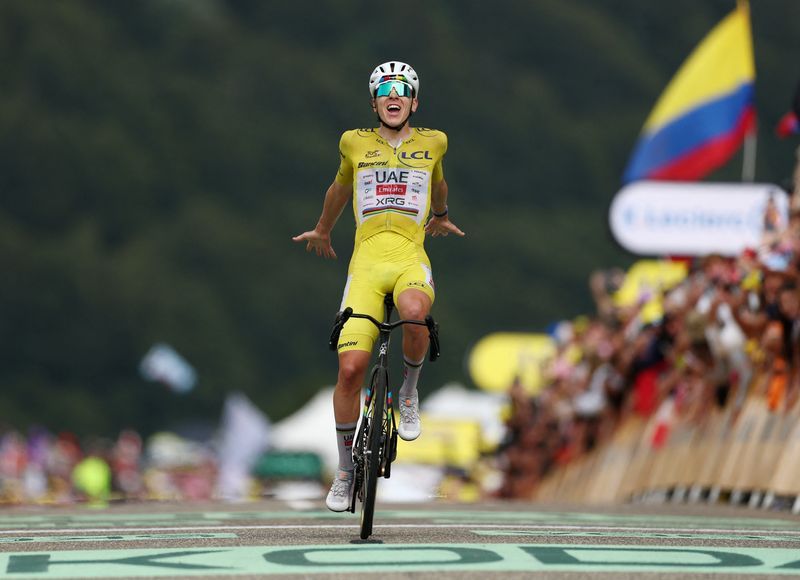
Tadej Pogacar delivered a masterclass in mountain cycling on Saturday, launching a decisive attack during the steepest sections of the Col du Haag to claim his fourth stage victory of the 2024 Tour de France. The 27-year-old Slovenian's performance on the 155.3-kilometre route from Mulhouse to Le Markstein Fellering has substantially increased his advantage in the hunt for an unprecedented third consecutive yellow jersey, now sitting four minutes and 30 seconds ahead of his closest challenger Jonas Vingegaard.
The stage itself presented a formidable examination of the peloton's climbing credentials. Three category one peaks punctuated the demanding circuit, with treacherous weather conditions adding another layer of difficulty. Heavy rain swept across the descent from Col du Page, forcing riders to navigate slippery roads with extreme caution. Such unpredictable conditions often create opportunities for breakaway attacks, yet Pogacar's team managed the racing intelligently, positioning the leader perfectly for the crucial finale on Col du Haag.
The early kilometres saw Frenchman Valentin Paret-Peintre of Soudal Quick-Step establish himself at the front, cresting Grand Ballon ahead of Richard Carapaz while the main field trailed by nearly two minutes. Paret-Peintre and Carapaz would eventually form the nucleus of a breakaway group that also included four other riders, extending their advantage as the peloton initially struggled to organize a coordinated pursuit. Yet the mathematics of stage racing favoured Pogacar's stronger team, which gradually closed the gap through sustained pressure.
The drama intensified on the final two climbs. At Ballon d'Alsace, Paret-Peintre and Carapaz again crested first, but by then Pogacar's teammates had reduced the deficit to just one minute and 20 seconds as they approached the decisive Col du Haag. The breakaway duo made one final stand when Carapaz attacked the 11.2-kilometre climb, drawing Tobias Johannessen with him, yet these efforts proved ultimately futile. The general classification contenders caught and absorbed the leaders with approximately 2.5 kilometres remaining on the ascent.
Pogacar's winning move came precisely when it mattered most. As the gradient steepened to an intimidating 16 percent in the final two kilometres, the UAE Team Emirates leader accelerated with apparent effortlessness, creating an immediate gap that his rivals could not bridge. His 30-second advantage at the summit proved sufficient to manage the final descent and flat run to the finish, where he crossed the line 38 seconds ahead of teammate Isaac del Toro, who claimed second place.
Del Toro's runner-up finish represented an excellent day for the UAE Team Emirates squad, as the rider demonstrated his own climbing credentials while also controlling the chase behind Pogacar. The Colombian further improved his general classification standing by overtaking Egan Bernal to move into fourth overall, one position ahead of his team leader's nearest challenger. The concentration of strength within a single team often proves decisive at the Tour, particularly when racing through the high mountains where numerical advantage can create insurmountable tactical situations.
Vingegaard, the winner of the previous two editions, could only manage fourth place on the stage, crossing the line behind local favourite Paul Seixas. This performance underscores the Frenchman's increasingly desperate situation in the overall standings. With nearly a week of racing remaining before the Tour concludes in Paris, Vingegaard requires either a dramatic reversal of form or a collapse from Pogacar to mount any realistic title challenge. The four-and-a-half-minute margin represents a substantial buffer that few riders have overcome in the race's modern era.
Pogacar himself appeared remarkably composed in his post-stage assessment, acknowledging that Saturday's victory represented the culmination of meticulous planning rather than opportunistic fortune. "A really perfect day, we marked this stage since the beginning. I know it very well, it is beautiful and an incredible place for cycling," he reflected. His familiarity with these Alsatian roads likely contributed to his confidence and tactical execution, though such local knowledge alone cannot account for the physical dominance he has consistently displayed throughout this year's race.
The Slovenian was careful to avoid complacency regarding the challenges ahead. Stage 15 on Sunday, running from Champagnole to Plateau de Solaison, presents another mountainous obstacle that will test whether Pogacar can maintain his devastating form. "Will be a hard day for us, but we will be ready to fight and see what will happen," he stated, refusing to declare the race settled despite his commanding position. This measured perspective reflects the maturity of a rider who has learned from past experiences that cycling's mountains can produce surprising reversals of fortune.
For Malaysian and Southeast Asian cycling enthusiasts, Pogacar's dominance offers valuable lessons in preparation, team cohesion, and mental resilience. The rider's methodical approach to stage racing, combined with his team's unwavering support structure, demonstrates how modern professional cycling has evolved into a sophisticated blend of individual brilliance and collective strategy. As the race heads toward its conclusion, Pogacar appears to have successfully assembled all the elements necessary to capture his third consecutive title and further cement his status among the sport's all-time greats.

