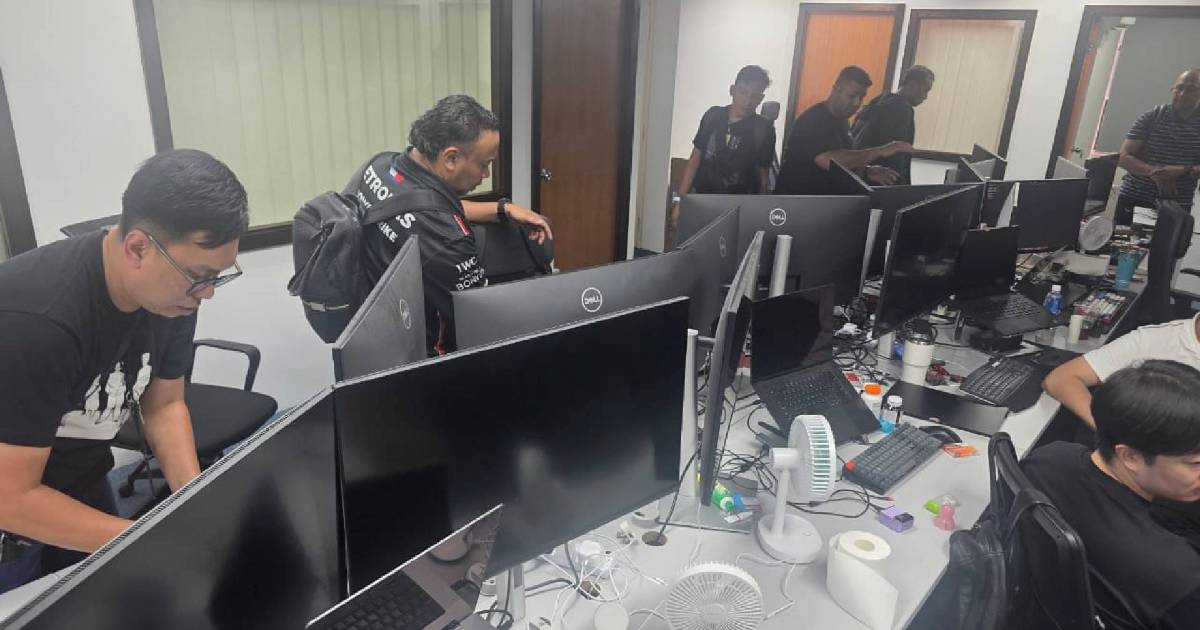
Malaysian police have dismantled a clandestine World Cup betting operation in the heart of Kuala Lumpur following a coordinated raid on Tuesday. The enforcement action at an office building in Taman Desa, Brickfields resulted in the detention of 11 individuals, with six identified as South Korean nationals. The arrests underscore the persistent challenge that illicit gambling networks pose to Malaysian law enforcement, particularly during major international sporting events when underground syndicates intensify operations to capitalise on heightened betting interest.
The call centre facility, concealed within a commercial building in one of Kuala Lumpur's older residential neighbourhoods, represents a sophisticated operation designed to service clients across multiple jurisdictions. Such operations typically employ advanced telecommunications infrastructure and encrypted communication channels to maintain operational security while processing bets remotely. The involvement of foreign nationals in the management structure suggests an international dimension to the syndicate, indicating coordination with networks potentially operating in other Southeast Asian countries or beyond.
World Cup tournaments have historically attracted substantial underground wagering activity across Southeast Asia, where betting markets remain tightly restricted. The global nature of football's biggest competition, coupled with its compressed tournament schedule and the time zone advantages that allow 24-hour betting cycles across different markets, makes it particularly attractive to illegal gambling networks. Malaysia's substantial expatriate communities from East and South Asia create ready customer bases for operators who can offer services in multiple languages and accommodate diverse cultural preferences around sports betting.
The Brickfields location carries particular significance in the context of law enforcement concerns. The neighbourhood, known for its diverse commercial activity and floating population, has periodically emerged as a focal point for illegal operations ranging from document forgery to financial crimes. The operational security provided by high foot traffic and mixed-use commercial establishments makes such locations attractive to syndicates seeking to operate discreetly. Police coordination across different precincts and databases would have been essential to establishing patterns of suspicious activity that eventually triggered the raid.
The detention of six South Korean nationals raises questions about whether this operation functioned as a regional hub serving customers throughout East and Southeast Asia, or whether it was primarily oriented toward serving Korean expatriate communities and their networks. South Korea's strict gambling laws, coupled with sophisticated internet infrastructure and high sports engagement rates, have historically made underground betting networks attractive to Korean demographics. The international dimension of the arrests may ultimately reveal connections to broader syndicate operations spanning multiple countries across the region.
Illegal gambling syndicates typically operate on razor-thin margins relative to their turnover, compensating through massive volume. The infrastructure costs of maintaining call centres, employing multilingual operators, securing telecommunications bandwidth, and managing payment systems require sustained investment and regularised cash flows. The overhead structure suggests this was not an ad-hoc operation but rather an established concern with experienced management and adequate capitalization—exactly the type of target that law enforcement agencies prioritise because of their capacity to rapidly expand if left unchecked.
The raid demonstrates an ongoing commitment by Malaysian authorities to dismantle gambling operations, though the persistent reappearance of such syndicates highlights the demand-side dynamics that continue to fuel their existence. Despite the operation's discovery and the resulting arrests, replacement networks and alternative operators are likely to surface elsewhere, reflecting the economic incentives embedded in the gap between illegal market demand and the strictly regulated legal wagering options available to consumers. The challenge confronting Malaysian law enforcement extends beyond disruption of individual operations toward disrupting the financial and logistical networks that sustain them across borders.
The timing of such enforcement operations has typically aligned with major sporting calendar events, suggesting that intelligence agencies monitor patterns of telecommunications traffic and financial movement around known gambling trigger dates. The World Cup, occurring every four years and attracting unprecedented global wagering volume, represents a predictable escalation point that triggers enhanced surveillance and targeted enforcement initiatives. Security agencies across the region often share information during such periods, with ASEAN member states increasingly coordinating cross-border responses to organised gambling networks.
Investigation outcomes from this raid will likely reveal the sophistication of payment processing mechanisms employed by the syndicate. Modern illegal gambling operations frequently utilise cryptocurrency, hawala networks, and business-to-business payment platforms that exploit regulatory gaps. Understanding the financial flows underpinning such operations provides intelligence agencies with insights into how to disrupt similar networks and raises questions about whether financial regulators should strengthen monitoring capabilities around certain transaction types.
The arrest of foreign nationals presents additional legal complexities regarding jurisdiction, extradition procedures, and cooperation mechanisms with international counterparts. Malaysia's approach to prosecution will signal its commitment to treating illegal gambling networks as serious organised crime rather than minor regulatory infractions. The diplomatic dimensions of handling foreign detainees accused of financial crimes simultaneously require careful navigation of bilateral relationships, particularly with South Korea, which maintains substantial commercial and people-to-people connections with Malaysia.
Beyond this specific operation, the incident illustrates why some Malaysia policy analysts have advocated for reconsidering the regulatory framework around sports betting. Alternative models employed in certain jurisdictions involve controlled, taxed betting markets that capture revenue while maintaining quality-of-life standards and preventing the emergence of associated criminal enterprises. The underground betting market's resilience despite ongoing enforcement efforts suggests that prohibition without viable legal alternatives may be suboptimal public policy, though such debates remain politically sensitive in the Malaysian context.
The investigation's continuation will determine whether additional suspects require apprehension, whether assets merit seizure for proceeds-of-crime purposes, and whether intelligence gathered reveals connections to other suspected illegal operations across Malaysia and the region. For residents in Brickfields and surrounding areas, the operation's exposure serves as a reminder that significant criminal enterprises continue operating within commercial districts citywide, often invisible to casual observation despite substantial transaction volumes and technical infrastructure requirements.

