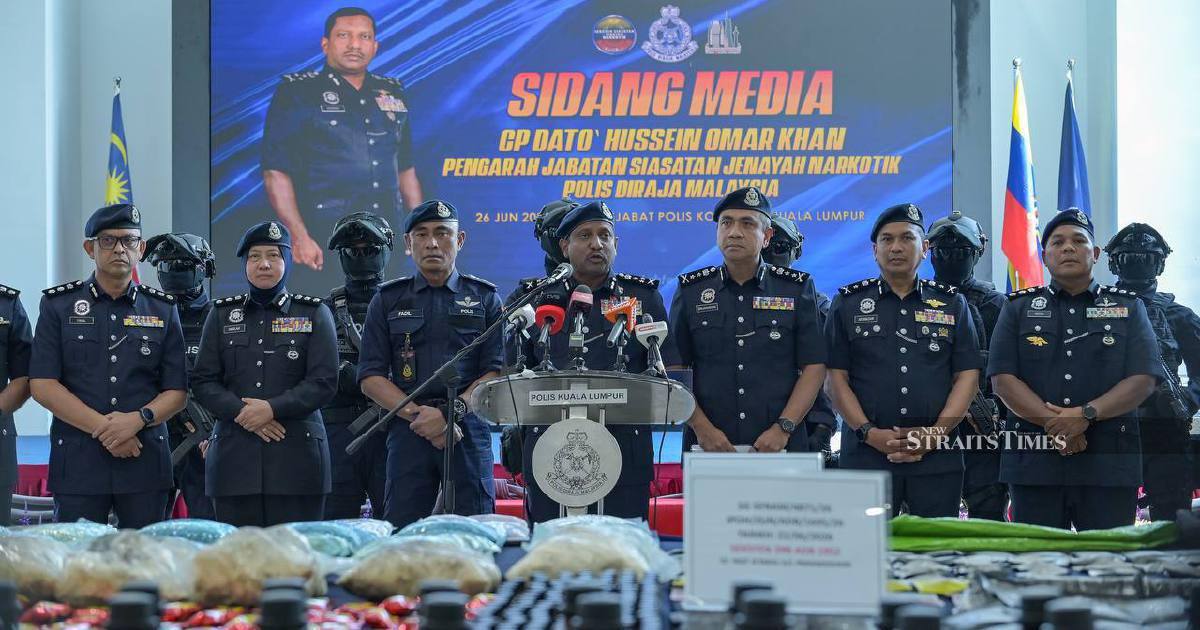
Police forces in Kuala Lumpur have dealt a significant blow to organised drug trafficking networks after executing three simultaneous raids in the Cheras area on June 20, during which officers apprehended seven suspects and confiscated narcotics worth an estimated RM135.63 million. The coordinated enforcement operation represents one of the more substantial drug interdictions in recent months and highlights the ongoing efforts by Malaysian authorities to disrupt the supply chains that feed illicit drug markets across the country.
The operation in Cheras, a densely populated residential and commercial district in the eastern portion of the capital, targeted multiple locations suspected of serving as distribution and storage hubs for the trafficking network. The simultaneous execution of searches across three separate premises was designed to prevent suspects from destroying evidence or fleeing the area, a tactical approach that has proven increasingly effective in dismantling organised criminal enterprises operating within Kuala Lumpur's urban landscape.
Among the seven individuals taken into custody during the enforcement action, authorities have begun conducting detailed interrogations to establish the hierarchical structure of the trafficking organisation, identify key decision-makers, and trace the origin of the seized substances. The swift apprehension of multiple suspects at interconnected locations suggests that investigators had been conducting extended surveillance operations prior to the raids, allowing them to establish the necessary probable cause for simultaneous warrants.
The sheer volume and estimated value of the confiscated drugs underscore the scale at which these criminal networks operate within Malaysia's major urban centres. A seizure of this magnitude indicates not merely a retail or street-level operation, but rather a wholesale enterprise with capacity to distribute large quantities across multiple retail points throughout the Klang Valley and potentially beyond. The sophisticated logistics required to manage such volumes point to criminal organisations with established supply chains, reliable transportation networks, and entrenched distribution relationships.
From a regional perspective, this operation reflects Malaysia's strategic position within Southeast Asia's drug trafficking routes. The country serves simultaneously as a consumption market, a transit point for shipments moving between source countries in the Golden Triangle and Golden Crescent regions, and a distribution hub for narcotics destined for other Southeast Asian markets. Disruptions to major trafficking operations such as this one create temporary supply constraints that ripple across the entire regional drug economy.
The authorities' focus on preventing a market flooding scenario—as indicated in the operation's designation—reveals that investigators assessed these particular drug quantities as earmarked for rapid distribution into Malaysian streets. Such scenarios involve criminal syndicates purchasing large quantities from upstream suppliers with the explicit intention of saturating local retail markets to maximise profits and increase user dependency. Prevention of such dumping operations protects not only the immediate consumer population but also constrains the revenue streams that finance larger trafficking organisations and their associated criminal enterprises.
The timing and execution of the Cheras operation demonstrates the maturation of Malaysia's drug enforcement strategies beyond simple interdiction toward targeted disruption of criminal organisational capacity. Rather than focusing exclusively on street-level dealers, law enforcement agencies increasingly target the mid-level distribution infrastructure that connects international suppliers to local retail markets. This approach addresses the systemic vulnerabilities within trafficking networks and requires sustained intelligence work, financial investigation, and coordination across multiple police units.
For Malaysian communities and policymakers, the successful operation provides temporary relief from additional drug availability but also illustrates the persistent threat posed by sophisticated trafficking organisations. The fact that a single operation uncovered narcotics valued at over RM135 million demonstrates the enormous financial incentives driving drug trafficking into Malaysia. These profits, often exceeding legitimate business returns, enable criminal organisations to invest in corruption of officials, sophisticated communications infrastructure, and international smuggling logistics that make their operations increasingly difficult to penetrate.
The investigation phase following the arrests will prove equally critical to the operation's ultimate success. Interrogations of the seven suspects should yield information about upstream suppliers, downstream distribution networks, financial arrangements, and communication protocols. This intelligence can inform subsequent operations targeting other layers of the trafficking hierarchy and contribute to the cumulative intelligence picture that guides Malaysia's broader counter-narcotics strategy.
Beyond the immediate enforcement action, this operation contributes to Malaysia's international obligations under various drug control treaties and conventions that bind it to combat organised trafficking. Successful high-profile operations such as the Cheras seizure strengthen Malaysia's credibility within international law enforcement partnerships and support bilateral cooperation frameworks with drug source countries and transit nations throughout Southeast Asia and beyond.

