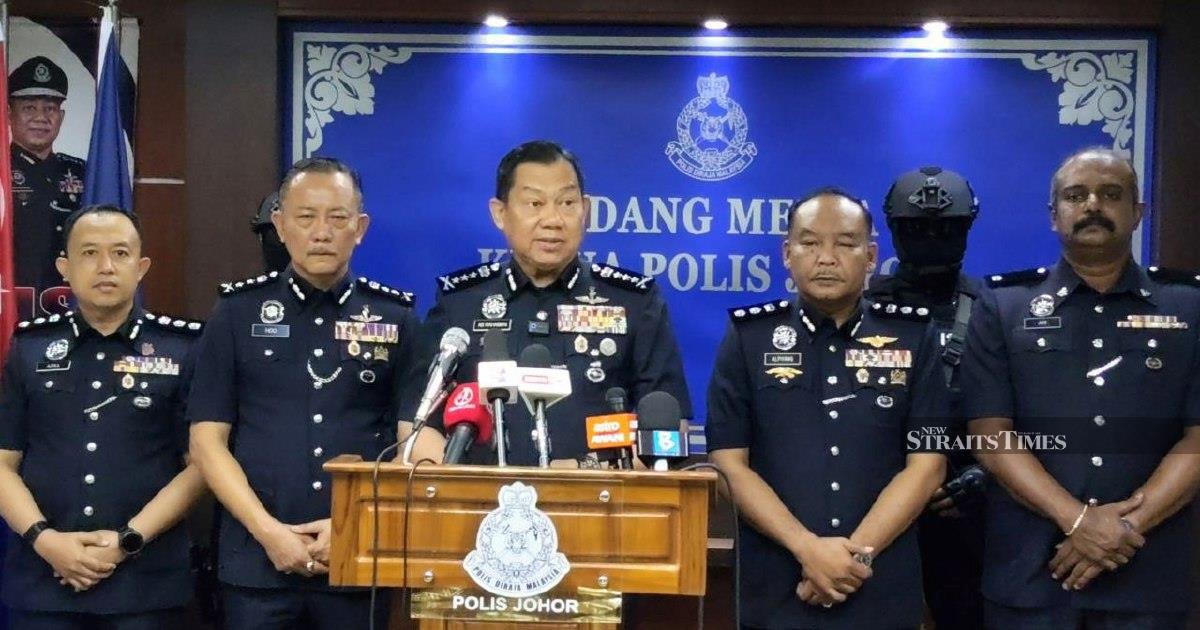
Johor Baru law enforcement authorities dealt a substantial blow to local drug trafficking networks on Saturday when coordinated police raids resulted in the seizure of 60.78kg of methamphetamine with a street value of RM3.04 million. Eight men, including a teenage school dropout functioning as a courier for the syndicate, were taken into custody during the operation, marking a significant disruption to what investigators describe as an organised distribution apparatus.
The scale of the seizure underscores the persistent challenge Malaysia faces in combating methamphetamine trafficking, a drug that has become increasingly prevalent across Southeast Asia. The captured quantity represents enough product to supply local addiction networks for months, and the diversity of suspects arrested suggests the operation extended beyond simple street-level dealing. The involvement of a teenager highlights a troubling trend in which criminal networks exploit young people, offering them quick money while exposing them to severe criminal penalties.
School dropouts have long been identified by law enforcement as vulnerable recruitment targets for drug syndicates. These individuals often lack economic alternatives and stable social structures, making them susceptible to promises of income that trafficking operations provide. Once inducted, such youth become expendable foot soldiers in larger networks, bearing disproportionate legal risk while insulating higher-ranking organisers from direct prosecution. The Johor operation illustrates how modern drug syndicates deliberately stratify their operations, creating layers of deniability that challenge investigators attempting to dismantle entire networks rather than merely removing individual actors.
Johor Baru's position as a significant trafficking hub reflects broader regional dynamics. Its proximity to Singapore, a wealthy market where methamphetamine commands premium prices, creates powerful economic incentives for cross-border smuggling operations. The state's extensive port infrastructure and established smuggling routes position it as a natural transit point for drugs entering Malaysia from southern Thailand and destined for consumption or redistribution throughout the peninsula. Understanding these geographic realities is essential for appreciating why police resources remain heavily concentrated in this particular jurisdiction.
The arrest timing on Saturday suggests police possessed actionable intelligence regarding the operation's location and personnel. Such intelligence typically emerges through either confidential informants embedded within criminal networks or through interdiction of communications between suspects. The simultaneous nature of multiple raids indicates a coordinated investigation where officers systematically moved against identified key figures and storage locations within a compressed timeframe, a tactic designed to prevent suspects from destroying evidence or alerting network partners.
Methamphetamine production and distribution have evolved considerably throughout Southeast Asia over the past decade. The drug's chemical precursors are readily available from industrial suppliers across the region, and clandestine laboratories operate with relative impunity in several countries, particularly Myanmar and Thailand. This supply abundance has depressed street prices whilst simultaneously increasing purity levels in many markets, making the drug simultaneously more accessible and more dangerous to users. Malaysian authorities contend with both local production and substantial imports, creating a two-front enforcement challenge.
The financial dimensions of this seizure merit examination. A RM3.04 million retail valuation suggests the network possessed sophisticated market knowledge and distribution channels capable of monetising products at premium street rates rather than bulk wholesale prices. This indicates the operation functioned at something beyond casual trafficking levels, operating with sufficient organisational sophistication to maintain retail customer bases across multiple locations. The presence of a dedicated transporter role confirms the operation maintained enough complexity to separate functions between procurement, storage, distribution, and street-level sales.
For Malaysian policymakers and enforcement agencies, such operations represent the visible portion of a substantially larger problem. Arrest and seizure statistics, whilst demonstrating police effectiveness, capture only a fraction of overall drug traffic. For every kilogramme seized, law enforcement estimates several more successfully reach consumption markets. Addressing this reality requires sustained investment in intelligence capacity, international cooperation with neighbouring countries, and prevention programmes targeting youth vulnerable to recruitment.
The teenage defendant now faces serious criminal charges under Malaysia's Dangerous Drugs Act, which provides mandatory minimum sentences including lengthy imprisonment for trafficking convictions. His involvement raises questions about rehabilitation opportunities and intervention points where early intervention might have redirected his trajectory. Malaysia's current drug policy emphasises punishment and supply-side interdiction, with limited resources devoted to demand reduction and treatment infrastructure, a balance that increasingly faces scrutiny from public health perspectives.
Looking forward, this Johor operation exemplifies ongoing cat-and-mouse dynamics between enforcement agencies and adaptable criminal networks. Police successes remain episodic and incomplete; dismantling one trafficking organisation typically creates market opportunities for competing syndicates. Sustainable progress requires moving beyond individual arrests toward systemic disruption of supply chains, enhanced international cooperation particularly with Thailand and Singapore, and serious investment in addressing the socioeconomic factors that make drug trafficking an attractive livelihood for economically marginalised youth throughout the region.

