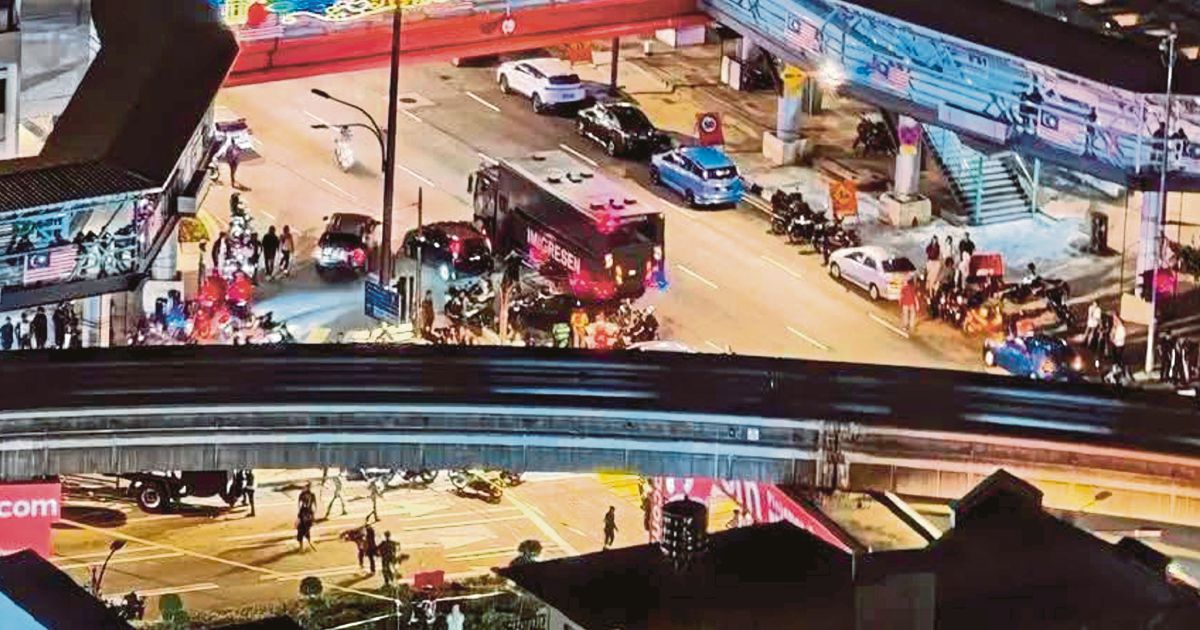
Police have launched a comprehensive forensic investigation into a collision involving an Immigration Department vehicle that claimed three lives on Jalan Sultan Ismail in Kuala Lumpur. The tragic accident, which unfolded in the early hours of the previous day, resulted in the deaths of a father and his two daughters. Investigators are now sifting through dashcam recordings and CCTV camera footage from the vicinity to piece together the sequence of events leading to the fatal impact.
The review of video evidence represents a critical phase in the police's effort to establish how the Immigration Department lorry came to strike the vehicle carrying the family. The availability of multiple footage sources—including dashcam recordings that may have been installed on nearby vehicles and stationary surveillance cameras positioned along the busy thoroughfare—provides investigators with potentially valuable documentation of the collision's dynamics. This multi-angle approach to evidence gathering is standard practice in high-fatality traffic incidents, allowing authorities to reconstruct vehicle trajectories, speeds, and points of impact with greater precision.
Jalan Sultan Ismail is a major arterial route through the heart of Kuala Lumpur's commercial and administrative district, making it a location frequently monitored by both public security cameras and private surveillance infrastructure. The early-morning timing of the accident may actually assist investigators, as traffic flow tends to be more predictable during off-peak hours, potentially simplifying the analysis of vehicle movements before the collision occurred. The presence of dashcam footage from other road users adds another dimension to the investigative process, as such recordings often capture critical details that fixed-position cameras might miss.
The death of a father alongside both his daughters represents a particularly devastating outcome that will likely prompt heightened scrutiny of the circumstances. Authorities will be examining whether speed, driver fatigue, mechanical failure, or other factors contributed to the accident. The involvement of a government vehicle—specifically one operated by the Immigration Department—may also subject the investigation to additional administrative oversight and public accountability measures, given that it involves a state agency in a collision resulting in civilian deaths.
Police investigations into fatal traffic collisions typically proceed along several parallel tracks. While video analysis forms the foundation of understanding the physical sequence of events, officers will simultaneously be conducting interviews with any witnesses present at the scene, gathering information from the vehicle operators involved, and potentially arranging for technical examination of both vehicles to assess mechanical integrity and identify any pre-accident defects. This multi-pronged approach ensures that the visual evidence can be corroborated and explained through complementary investigative findings.
The analysis of dashcam and CCTV material can reveal numerous critical details that might not be apparent to eyewitnesses. Frame-by-frame examination allows investigators to measure reaction times, identify the exact moment of impact, and determine whether vehicles had activated warning signals such as brake lights or indicators. Such footage can also clarify whether traffic signals were functioning correctly and whether drivers had complied with applicable traffic regulations at the time of the collision.
For Malaysian road safety officials, fatal accidents involving government vehicles operating in urban settings underscore the ongoing challenges around driver training, vehicle maintenance standards, and the pressures faced by operators conducting official duties on congested roads. The Kuala Lumpur incident occurs against a backdrop of persistent road fatality concerns across Malaysia, where the number of deaths in traffic accidents remains a significant public health issue requiring comprehensive intervention across driver behaviour, infrastructure design, and enforcement.
The investigation's findings will be of particular interest to transport safety advocates and the families of the victims, as the conclusions drawn from the video evidence may determine whether charges are preferred and inform any civil liability claims. Police statements are typically released once initial analysis of the footage is complete and preliminary conclusions can be stated with reasonable confidence regarding the accident's causation.
Investigators are likely to scrutinize whether the Immigration Department lorry operator had maintained adequate vehicle-to-vehicle distance, reacted appropriately to traffic conditions, and adhered to speed restrictions applicable to the location. The same analysis will be applied to the vehicle occupied by the family to determine if defensive driving measures might have mitigated the severity of the collision. Such detailed examination is essential not merely for assigning responsibility but for generating insights that might prevent similar tragedies in future.
As analysis of the video evidence continues, the police investigation represents an important formal process through which the full circumstances of the tragedy will be documented and examined. The footage analysis, combined with other investigative techniques, will ultimately support the authorities' understanding of how this fatal collision unfolded and inform public discourse around traffic safety practices affecting Malaysian roads.

