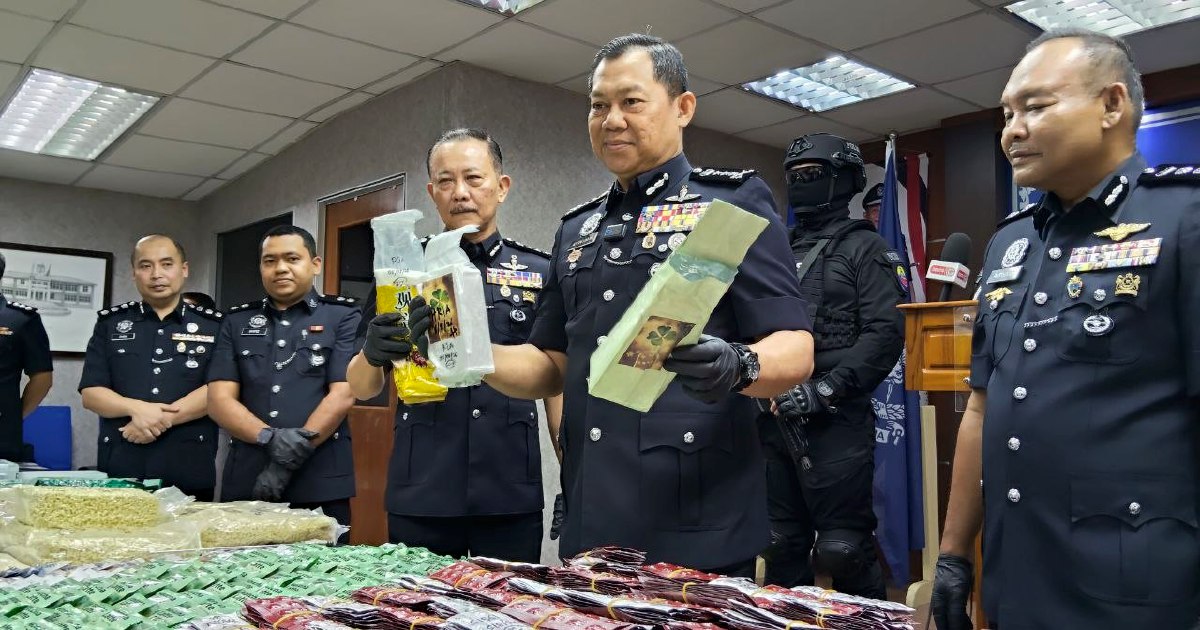
Law enforcement authorities in Johor Baru have successfully disrupted a significant drug trafficking operation after uncovering a substantial cache of narcotics hidden within a residential apartment in Persiaran Senibong, Masai. The operation led to the seizure of 96.76 kilograms of various controlled substances estimated to have a street value of RM8.49 million, marking one of the more substantial drug recoveries in the state in recent months. The apartment, which had been specifically rented to function as a storage and distribution point for the syndicate's operations, became the focal point of an investigation that ultimately resulted in the arrest of two individuals connected to the ring.
The strategic use of residential properties as clandestine storage facilities represents a persistent challenge for Malaysian law enforcement agencies. Rather than maintaining traditional drug production or processing sites, sophisticated trafficking networks increasingly rely on nondescript apartments and rented accommodation to store and manage their inventory before distribution to street-level dealers. This approach reduces their visibility and allows operators to remain mobile and difficult to track. The Masai apartment exemplified this operational model, with the landlord likely unaware that the property had been repurposed for illegal activity.
The scale of the seizure reflects the substantial demand for illegal drugs throughout the Johor region, which remains a crucial transit and consumption hub in Malaysia's narcotics trade. Sitting directly across from Singapore, Johor has historically served as a conduit for drugs flowing between international suppliers and Malaysian markets. The proximity to Singapore, combined with established smuggling routes and organised criminal networks, makes the state a strategic location for traffickers seeking to establish distribution networks that supply not only the local population but also extend their reach into the broader Peninsular Malaysian drug market.
Investigations by Johor police revealed that the apartment had been deliberately selected and leased under arrangements designed to obscure the true identity of the actual operators. This method of compartmentalising operations—where front persons lease properties under assumed identities or through intermediaries—complicates law enforcement efforts to trace the broader network and identify higher-level organisers. The two arrests made during the operation represent only the visible portion of what investigators believe to be a more extensive criminal organisation with multiple distribution points and supply chains throughout the region.
The diversity of drug types recovered during the raid indicates that the syndicate was engaged in large-scale wholesale distribution rather than small-scale peddling. Trafficking organisations handling multiple categories of controlled substances simultaneously require sophisticated logistics, reliable suppliers, and established wholesale buyers. This operational scope suggests the network had been functioning for a considerable period, accumulating sufficient inventory to warrant maintaining such a large storage facility.
The seizure carries significant implications for regional drug policy and enforcement strategy. The sheer volume recovered demonstrates that despite ongoing operations by the Royal Malaysia Police and international law enforcement agencies, substantial quantities of drugs continue to flow through Malaysia's borders and into distribution networks. The recovery value of RM8.49 million reflects not just the quantity of drugs removed from circulation, but also the enormous profit margins that incentivise trafficking organisations to take substantial risks in pursuit of their operations.
For Malaysian readers, the bust underscores the pervasive nature of the drug problem that extends well beyond street-level distribution. The sophisticated nature of the operation, involving rented premises, compartmentalised logistics, and coordinated storage and distribution, indicates that organised crime syndicates view the Malaysian market as sufficiently lucrative to justify complex criminal infrastructure. Residents in residential areas should remain vigilant about unusual activity in neighbouring properties, as traffickers frequently target ordinary apartment complexes and residential neighbourhoods precisely because they blend into the broader urban landscape.
Police investigations will now focus on tracing the supply and demand networks connected to this particular operation. Interrogation of the two arrested individuals is expected to yield information about upstream suppliers, downstream distributors, and financial mechanisms used to move proceeds from drug sales. Understanding these networks is crucial not only for dismantling this particular ring but also for mapping the broader architecture of drug trafficking in the region.
The operation demonstrates the ongoing effectiveness of intelligence-led law enforcement when properly resourced and coordinated. The targeting of a specific apartment suggests that police received actionable intelligence regarding the location, underscoring the importance of community reporting and inter-agency cooperation in combating drug trafficking. Neighbours' observations, telecommunications intercepts, and financial investigations all likely contributed to identifying this particular distribution hub.
Moving forward, the successful operation will provide investigators with valuable intelligence regarding operational methods, supply routes, and criminal networks active in the Johor region. The seizure will disrupt the syndicate's immediate operations and reduce the quantity of drugs available in the local market, at least in the short term. However, law enforcement officials recognise that addressing the drug problem requires sustained, comprehensive strategies that target not only street-level distribution but also the upstream production and supply networks that feed Malaysian markets. This bust, whilst significant, represents only one engagement in the broader ongoing struggle against narcotics trafficking.

