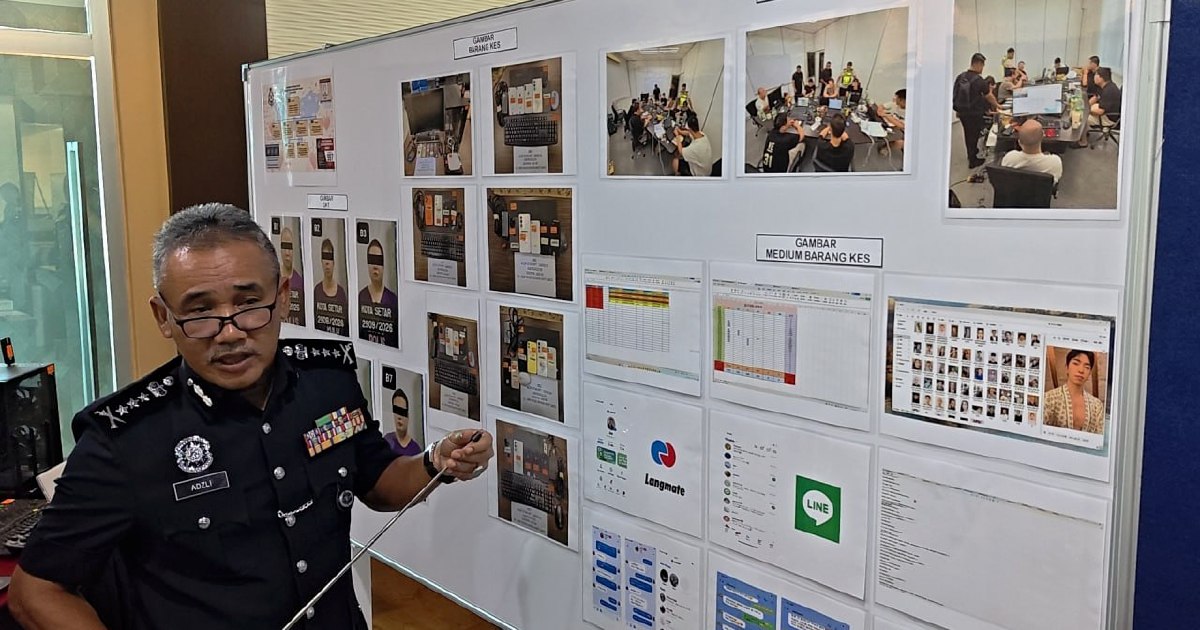
Malaysian law enforcement has delivered a significant blow to organised cybercrime by dismantling a coordinated digital deception ring that specifically targeted vulnerable Japanese citizens. The operation culminated in the arrest of seven Chinese nationals following a carefully planned raid on a commercial property located in Kristal Light Industrial Park in Alor Star, the capital of Kedah state, during the weekend.
Romance scams—also known as confidence fraud or catfishing operations—represent one of the fastest-growing cybercrime categories affecting Southeast Asian nations and their trading partners. These schemes exploit emotional vulnerabilities by creating fabricated romantic personas online, gradually building trust and intimacy with victims before extracting money through increasingly elaborate pretexts. The targeting of Japanese citizens suggests a deliberate strategy by the syndicate to focus on a specific demographic, likely based on perception of financial capacity or susceptibility to particular narratives.
The industrial park location where authorities discovered the operation points to the evolution of these criminal enterprises beyond small-scale home-based activities. Legitimate-appearing business premises provide cover for substantial operations, allowing perpetrators to maintain infrastructure for managing dozens or potentially hundreds of victim interactions simultaneously. The use of physical workspace also indicates a hierarchical organisation with specialised roles—such as victim contact handlers, money managers, and technical operators—typical of mature criminal networks rather than lone fraudsters.
Japan and Malaysia maintain extensive economic and cultural ties, with significant Japanese expatriate communities across Malaysian cities and substantial bilateral trade relationships. This interconnectedness creates conditions where scam syndicates can identify and pursue Japanese targets with relative ease. Language capabilities, cultural knowledge, and access to victim information through professional networks make Japanese nationals accessible to determined fraud operations. The particular vulnerability of this group to romance-based approaches may reflect cultural differences in how online relationships are perceived and managed.
The mechanics of such operations typically involve creating convincing false identities through stolen photographs and fabricated biographical narratives. Perpetrators invest considerable time in relationship-building, often maintaining contact over weeks or months to establish emotional bonds before initiating financial requests. Initial requests are typically modest—perhaps gifts for a supposed family emergency or business investment—to test victim responsiveness. Once victims demonstrate willingness to send money, demands escalate, sometimes involving requests to finance shipping costs for supposed gifts, medical emergencies, or business failures. Sophisticated variants employ cryptocurrency and money mule networks to obscure fund origins and complicate tracing.
Malaysia has increasingly become a regional hub for cybercriminal operations, partly due to its developed telecommunications infrastructure, financial services connectivity, and English-speaking workforce. The country's geographic position and transportation links facilitate movement of proceeds, while its growing sophistication in digital systems paradoxically creates opportunities for tech-savvy criminals. Previous investigations have identified Malaysia as a staging ground for scams targeting victims across East Asia, South Asia, and Western nations, with criminal organisations operating from commercial districts in major cities and industrial parks.
The identification and apprehension of the seven Chinese nationals suggests collaborative intelligence between Malaysian police and potentially international partners. Law enforcement agencies increasingly share information on transnational cybercrime operations, particularly when victims span multiple countries. Japanese authorities and Malaysian police likely coordinated investigative efforts once the scale and international nature of the scheme became apparent. Such cooperation remains essential given the borderless character of digital fraud, where perpetrators operate from one nation while victimising residents of others.
Beyond the arrests themselves, authorities will focus on dismantling the operational infrastructure—recovering digital devices, identifying victim lists, tracking financial flows, and determining the destination of proceeds. Many romance scam syndicates operate under loose franchise or commission models, with individual operators receiving shares of extracted funds. Understanding the network's structure helps identify higher-level organisers and financial beneficiaries. Tracing money flows through banking channels and cryptocurrency exchanges provides evidence of coordinated activity and helps authorities identify other linked networks.
For potential victims and their families, the disruption of this particular operation offers a timely reminder of romance scam dangers. The emotional investment that victims develop in false relationships makes them reluctant to report fraud, often internalising shame rather than seeking police assistance. Cultural factors may amplify this tendency within Japanese communities, where discussions of romantic victimisation carry particular sensitivity. Education campaigns emphasising that scam victims bear no responsibility, combined with accessible reporting mechanisms, remain critical for encouraging disclosure.
The broader challenge facing Malaysian and regional authorities involves the continuous emergence of new syndicate cells replacing dismantled operations. While this raid represents a concrete success, enforcement agencies acknowledge that cybercrime infrastructure continuously regenerates. Effective countermeasures require sustained international cooperation, investment in digital forensics capacity, and disruption of underlying financial mechanisms that allow criminals to monetise fraudulent schemes. Pressure on cryptocurrency exchanges, money transfer services, and financial institutions to implement stronger verification protocols creates friction that, while not eliminating crime, increases operational costs for perpetrators.
Moving forward, this operation illustrates the vulnerability of transnational victims and the necessity for coordinated response frameworks. Notifications to Japanese authorities regarding identified victims should facilitate repatriation claims and support mechanisms. Public disclosure of such operations also serves a preventative function, raising awareness among potential targets about methodologies employed by sophisticated scammers. As digital platforms continue evolving and criminals adapt techniques, maintaining vigilance and supporting victims through the trauma of financial and emotional betrayal remain paramount for law enforcement priorities.

