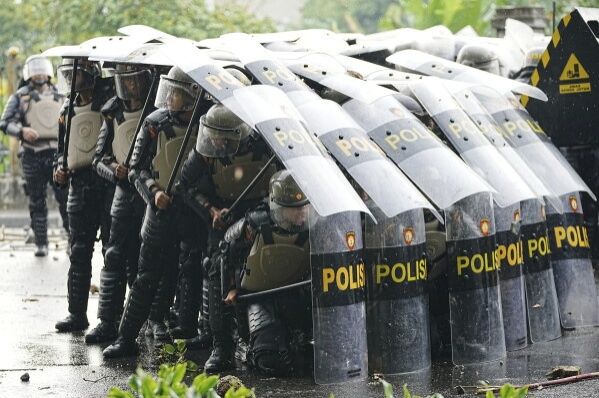
Indonesia's law enforcement agencies have drawn fresh scrutiny after a series of raids targeting officials and businesses revealed deepening fissures within the country's security establishment. Police operations this week in and around Jakarta uncovered substantial quantities of gold, cash and foreign currency in what officials described as investigations into corruption and money laundering, yet the involvement of military personnel at one of the search locations has ignited concerns about potential institutional conflict and the erosion of civilian oversight.
The raids centred on multiple corruption allegations spanning coal supply irregularities linked to recent power disruptions, questionable handling of claims by state insurers Asabri and Jiwasraya, and suspected debt settlement violations involving Krakatau Steel-connected enterprises. The most prominent element of the operation targeted Deputy Attorney General for Special Crimes Febrie Adriansyah, whose residence south of Jakarta yielded 74 kilogrammes of gold bars alongside cash and multiple foreign currencies stored in seven locked suitcases within a safe. Authorities valued this haul at approximately $26.3 million. Separately, investigators recovered rupiah and foreign currency equivalent to more than $3 million from a concealed two-metre safe at a South Jakarta restaurant and an adjacent money exchange facility.
Febrie commands considerable influence within Indonesia's prosecutorial hierarchy, overseeing the special crimes division responsible for high-profile corruption investigations affecting major state enterprises and programmes. His portfolio encompasses ongoing probes into state mining company Timah, oil corporation Pertamina, flag carrier Garuda Indonesia, matters involving former education minister Nadiem Makarim, and inquiries related to President Prabowo Subianto's flagship free-meals initiative. The discovery of assets at his residence therefore carries symbolic weight beyond the material value involved, potentially signalling divisions at the highest levels of law enforcement.
Military deployment to Febrie's Jakarta property introduced an additional layer of complexity. Armed personnel arrived following the police search, with the military justifying their presence as protective measures for prosecutors based on established regulations. The Attorney General's Office reportedly requested the deployment, attempting to situate it within standard security protocol. However, the timing and optics of military personnel appearing at a senior prosecutor's residence during a corruption investigation have fuelled public concern about competing institutional interests and the blurring of civilian-military boundaries in domestic law enforcement.
Government spokespeople moved swiftly to contain the narrative, with military officials insisting Thursday that security arrangements would not obstruct ongoing investigations and denying institutional conflict. The Indonesian military released a statement asserting full support for law enforcement activities and disclaiming any interference in legal processes. These assurances, however, appear calibrated to address growing anxiety rather than substantive concerns about the underlying dynamics at play.
Febrie acknowledged ownership of the residence but categorically denied connection to the seized assets, framing the matter as requiring patience during investigative procedures. He cautioned against premature conclusions based on media reports or social media commentary, invoking the principle of presumption of innocence and calling for respect for due process. The Attorney General's Office simultaneously signalled deference to police findings, positioning itself as a neutral party awaiting investigative conclusions rather than as an institution with institutional interests at stake.
President Prabowo appeared to address the controversy indirectly during Friday's dam inauguration on Lombok island, delivering remarks that functioned as moral suasion directed at the security establishment. His comments emphasised that military personnel, police officers and prosecutors ultimately serve the population rather than institutional prerogatives, exhorting officials to maintain perspective about their subordinate position within the democratic order. The president extended this message specifically to the Attorney General's Office, reinforcing the notion that prosecutorial authority derives from and remains answerable to public interests.
International observers have expressed alarm regarding implications for Indonesia's institutional architecture. Amnesty International Indonesia warned that military involvement in civilian legal matters threatens to undermine democratic civilian control and the independence of law enforcement institutions, and called for guarantees protecting investigators from obstruction or intimidation. Such warnings echo longstanding concerns about the boundaries between military and police functions in Southeast Asia's largest democracy.
Analysts working within Indonesia's policy sphere have characterised the situation as symptomatic of broader institutional decay. Nicky Fahrizal, researcher at the Jakarta-based Center for Strategic and International Studies, described the standoff as reflecting systemic breakdown and enabling what he termed "creeping militarization", whereby military involvement in civilian law enforcement progressively normalises expanded security force mandates. He cautioned that continued escalation risks fundamentally compromising Indonesia's rule of law framework and deterring both domestic confidence and international investment.
The convergence of high-profile corruption allegations, asset seizures, military deployment and competing institutional narratives illustrates vulnerability within Indonesia's enforcement mechanisms. For regional observers and investors, the situation underscores questions about institutional coherence and the political vulnerabilities that arise when multiple security agencies operate without clear hierarchical relationships or transparent coordination mechanisms. Whether these tensions reflect temporary procedural friction or deeper structural problems remains contested, but the visibility of disagreement between police and military forces has already inflicted reputational costs on Indonesia's governance institutions.

