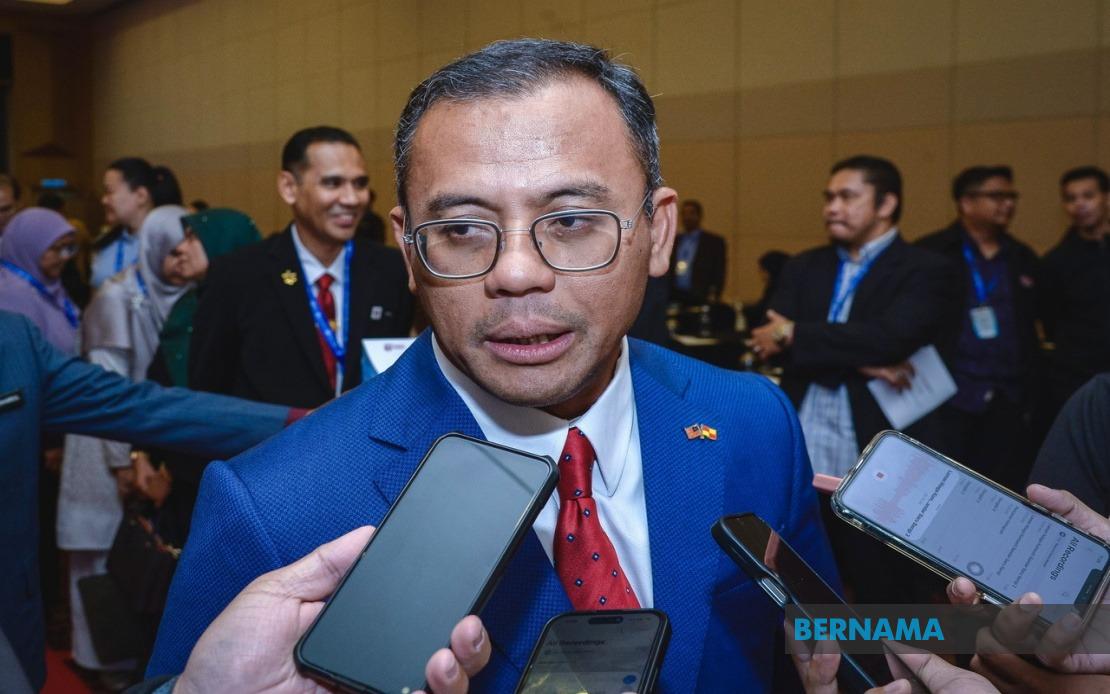
Selangor Menteri Besar Datuk Seri Amirudin Shari has called for a fundamental shift in how governments approach policymaking, insisting that successful governance must recognise the intricate web of challenges that shape people's everyday experiences. Speaking at the Human Ecology International Conference II 2026 in Bangi, Amirudin articulated a vision of integrated policy frameworks that move beyond compartmentalised solutions to address the real complexities confronting families and communities across the region.
The core of Amirudin's argument centres on a simple but profound observation: citizens do not experience the challenges facing them as isolated policy domains neatly separated into healthcare, childcare, transport, employment and cost of living concerns. Rather, these elements intersect and compound one another, creating a totality of pressure that no single-issue intervention can adequately resolve. When a parent struggles with childcare costs while commuting long distances to work in an environment of rising living expenses, these are not three distinct problems requiring three separate policies. They are instead facets of a unified crisis that demands coordinated, holistic responses from government.
This perspective challenges the traditional siloed approach to governance where different ministries and agencies develop and implement policies within their own jurisdictions with limited coordination. Such fragmentation, Amirudin suggested, misses the lived reality of families who experience their challenges as an overwhelming constellation of interconnected demands. His call represents a recognition that structural pressures have intensified across Southeast Asia, where households now contend simultaneously with escalating housing expenses, lengthy commutes from affordable residential areas to employment centres, caregiving obligations intensified by changing family structures, shifting employment patterns that lack traditional stability, and the disruptive influence of rapid technological transformation on existing livelihood patterns.
The menteri besar posed a critical reframing of the success metrics by which governments should evaluate policy effectiveness. Rather than simply determining whether families are merely managing to cope with existing circumstances, policymakers should assess whether the broader environment surrounding these families actually enables them to flourish and build secure futures. This distinction between survival and thriving captures an essential gap in much contemporary governance. An environment may prevent outright destitution while simultaneously constraining opportunity, limiting mobility and foreclosing pathways to genuine prosperity. True policy success, in Amirudin's formulation, requires not just mitigation of harm but positive enablement of human potential.
The emphasis on connected environments extends beyond government itself to encompass collaboration between policymakers and academic institutions. Amirudin advocated for universities to function as active partners throughout the entire policy cycle, from the initial diagnosis of societal problems and the design of potential solutions through to rigorous evaluation of what strategies actually deliver tangible benefits. This vision acknowledges that effective governance requires sophisticated understanding grounded in research and evidence, coupled with the flexibility to learn and adapt when interventions fail to produce intended outcomes. Universities bring both analytical capacity and institutional credibility that can enhance policy legitimacy and effectiveness.
The conference itself, conducted under the banner "Sustaining Human Well-being," assembled a substantial gathering of academics, research specialists, implementation practitioners, government officials, institutional administrators, students and grassroots community voices from Malaysia, Indonesia, the Philippines and beyond. This multifaceted composition reflects recognition that understanding and addressing challenges to human well-being requires perspectives spanning the theoretical, practical and experiential domains. The diversity of participants created a genuinely regional conversation about contemporary pressures affecting populations across Southeast Asia.
Concretely signalling commitment to enhanced regional cooperation and knowledge-sharing, Amirudin presided over the formalisation of a Memorandum of Understanding between Universiti Putra Malaysia (UPM) and the University of the Philippines Los Baños. This partnership anchors a broader initiative to establish the ASEAN Human Ecology Consortium, positioned as a collaborative mechanism to advance joint research initiatives, facilitate movement of students and faculty across member institutions, coordinate academic publications, conduct evidence-informed policy dialogue, and engage meaningfully with communities across the bloc.
The consortium represents an important institutional innovation for Southeast Asia, creating dedicated infrastructure for regional intellectual collaboration precisely when diverging national policy approaches risk fragmenting regional responses to shared challenges. By establishing formal mechanisms for research mobility, publications and community engagement, the consortium can generate comparative insights about what policy approaches prove effective across different national contexts. Such knowledge-sharing becomes increasingly valuable as individual nations implement varying experiments in addressing human well-being, creating natural laboratories from which others can learn.
For Malaysia specifically, Amirudin's intervention carries particular significance given Selangor's status as the nation's most economically dynamic and demographically complex state. The rapid urbanisation, housing pressures, transport congestion and high cost of living that characterise the Klang Valley epitomise exactly the interconnected challenges his speech addressed. Selangor residents, whether living in the increasingly expensive central urban areas or in sprawling suburban developments accessible only via lengthy commutes, experience precisely the environmental constraints that thwart family thriving despite adequate individual incomes. A state-level commitment to genuinely integrated policymaking, rather than sectoral approaches, could yield valuable lessons applicable across Malaysia and the region.
The timing of this emphasis on human-centred, integrated governance also reflects growing regional recognition that economic growth alone, despite its importance, neither automatically translates into improved human well-being nor addresses the qualitative dimensions of life quality that matter profoundly to citizens. Southeast Asian nations have achieved impressive economic expansion but confronted simultaneously with persistent challenges around affordable housing, transport accessibility, childcare adequacy and work-life sustainability. These cannot be resolved through continued economic expansion alone but require deliberate policy redesign that explicitly prioritises interconnected human welfare.
Amirudin's framing also implicitly critiques the compartmentalisation reflected in many current governance structures, where different agencies operating within distinct mandates create misalignments and gaps in service delivery. A family seeking to improve its situation must navigate multiple bureaucratic processes, each following its own logic and timeline, without integrating into a coordinated support ecosystem. Moving toward integrated policy design would require not just intellectual reorientation but structural reorganisation of how government actually functions and how agencies coordinate.
The vision advanced at the conference points toward a more sophisticated understanding of governance in the Southeast Asian context, one that recognises complexity, interdependence and the necessity of coordination across sectors and nations. It suggests that genuine progress on human well-being requires moving beyond competitive policy experiments conducted in isolation toward genuine regional knowledge-sharing and coordinated learning about what actually works.

