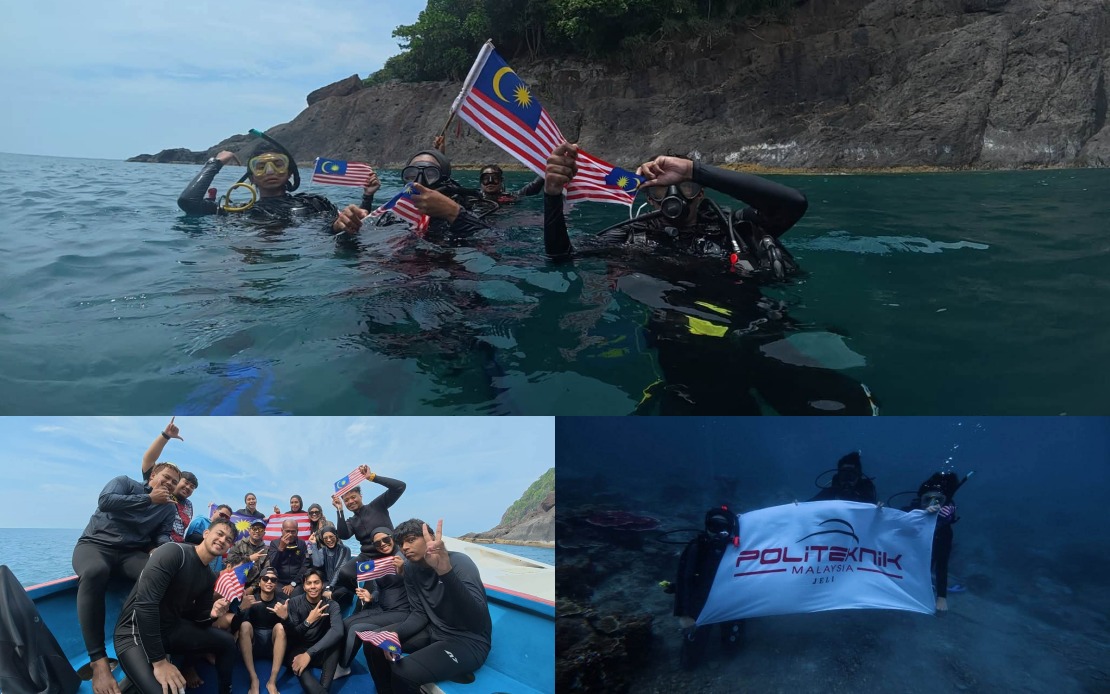
Politeknik Jeli Kelantan turned the waters off Pulau Tenggol into an unexpected theatre of patriotism this August, orchestrating a subaquatic display of the Jalur Gemilang to commemorate the nation's 69th National Day. The gesture, executed at a depth of 18 metres, transcended mere symbolic nationalism, embedding the institution's commitment to both national pride and vocational excellence within an educational framework that marries practical competency with civic consciousness.
The initiative emerged from the polytechnic's Aquaculture Technology Unit and Department of Agrotechnology and Bio-Industry, which organised a comprehensive scuba diving training and certification programme between August 27 and 30 at Dive Buddy Dungun. Rather than treating National Day as a conventional observance confined to terrestrial ceremonies and flag-hoisting rituals, Politeknik Jeli conceived the underwater placement as an integral component of its pedagogical mission—one that deliberately fused skills development with patriotic expression.
Mohd Adam Nashriq Bani Yamin, an aquaculture lecturer at the institution, articulated the programme's dual objectives during interviews with Bernama. The underwater flag display served as more than decorative patriotism; it functioned as a tangible demonstration of the technical proficiencies expected of students enrolled in aquaculture disciplines. By performing a meaningful national gesture within the context of legitimate aquatic training, the polytechnic modelled how professional competency and national identity could be mutually reinforcing rather than separate concerns.
The scuba diving training regimen incorporated internationally recognised certifications through the Professional Association of Diving Instructors, commonly known as PADI. Two lecturers and two fifth-semester diploma students participated in the scheme, progressing through structured curricula that culminated in PADI Open Water Diver and PADI Divemaster certifications. These credentials represent standardised qualifications recognised across maritime industries globally, positioning graduates from Politeknik Jeli for employment within an increasingly internationalised marine sector.
Water safety constituted the pedagogical bedrock of the initiative. Aquaculture professionals working in Malaysian waters and beyond face genuine hazards—rapid changes in pressure, equipment malfunction, disorientation, or environmental emergencies that could prove fatal without proper training and preparation. By embedding water safety protocols within the certification process, Politeknik Jeli acknowledged that technical competency alone insufficient; students require comprehensive understanding of risk mitigation and emergency response procedures applicable to maritime employment.
The instructional team included Dr Nabila Talib, a PADI-qualified instructor from Dive Buddy Malaysia, whose expertise ensured that training met international standards rather than merely national benchmarks. This partnership between the polytechnic and private diving operators reflects Malaysia's broader positioning within global supply chains, where local vocational institutions increasingly collaborate with industry practitioners to calibrate curricula against international demand.
Beyond the immediate certification benefits, the programme cultivated competencies directly applicable to emerging sectors within Malaysia's marine economy. Graduates equipped with scuba certification gain access to employment niches in marine aquaculture operations, submarine infrastructure inspection, marine biotechnology research, and ecosystem conservation initiatives—domains where underwater proficiency distinguishes candidates in competitive labour markets. Politeknik Jeli essentially provided students with marketable credentials extending well beyond traditional classroom instruction.
The placement of the institution's own flag alongside the Jalur Gemilang at 18 metres conveyed institutional identity and pride, signalling that Politeknik Jeli stakes its reputation on producing graduates capable of executing tasks within challenging and unforgiving environments. This symbolism carried particular resonance within Malaysia's polytechnic sector, where technical institutions compete for student enrolment and employer recognition by demonstrating practical relevance and contemporary competency standards.
The initiative also illuminates how vocational education in Southeast Asia increasingly intersects with experiential learning methodologies. Rather than confining aquaculture studies to classroom lectures and laboratory simulations, Politeknik Jeli deployed authentic real-world scenarios—the seabed itself becoming an educational setting. This approach aligns with evolving employer expectations across maritime industries, where graduates must demonstrate not merely theoretical knowledge but capacity to perform under actual operational conditions.
From a broader regional perspective, Malaysia's emphasis on developing skilled labour within marine-dependent economies positions the nation competitively within ASEAN's expanding maritime sector. Nations throughout Southeast Asia contend with similar challenges: rapidly expanding aquaculture industries, growing offshore infrastructure development, and mounting demand for qualified underwater professionals. Politeknik Jeli's approach—integrating certification training with patriotic observance and institutional identity—offers a replicable model for polytechnic systems across the region seeking to enhance graduate employability while strengthening national consciousness.
The underwater National Day gesture ultimately reflected sophisticated institutional thinking. Politeknik Jeli recognised that modern vocational education extends beyond transferring technical knowledge; it encompasses cultivating professional identities, instilling workplace safety consciousness, and maintaining connection to broader national communities. By orchestrating a patriotic ceremony that simultaneously served as legitimate training activity, the polytechnic demonstrated how technical excellence and civic responsibility need not occupy separate domains—they can become mutually constitutive elements of meaningful educational experience.

