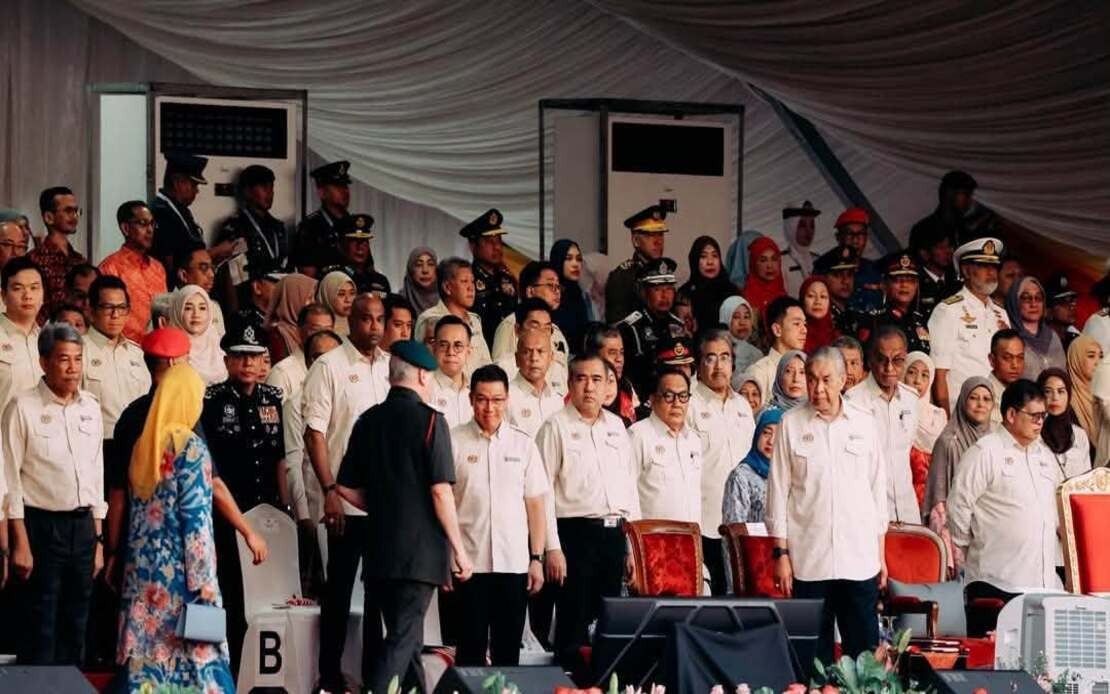
Malaysia's coalition government depends fundamentally on political maturity from its leadership, according to Domestic Trade and Cost of Living Minister Datuk Armizan Mohd Ali, who highlighted the delicate balance required to maintain governmental stability as the country navigates its post-15th General Election landscape. Speaking on National Day, Armizan underscored that the shift away from decades of single-party dominance represents a watershed moment demanding political consciousness and shared commitment to nation-building over narrow partisan interests.
The minister's remarks come as Malaysia continues to adjust to a transformed political environment. The electoral outcome fundamentally altered the distribution of power, creating a multilateral coalition where multiple parties must cooperate for effective governance. This configuration stands in marked contrast to the historical norm of one-party rule, presenting both opportunities for broader representation and challenges in maintaining coherent policymaking.
Armizan emphasized that accepting this new political reality represents a crucial learning opportunity for Malaysian leadership. The years spanning 2018 to 2022 offer a cautionary tale, during which three successive prime ministers and three separate Cabinet configurations emerged within a single parliamentary term. This period of instability, marked by frequent ministerial reshuffles and shifting coalitions, failed to deliver sustained economic development or welfare improvements for ordinary Malaysians. The cumulative effect of such uncertainty was reduced investor confidence and delayed implementation of long-term national development initiatives.
What distinguishes the current administration, according to the minister, is the demonstrated capacity of Cabinet members to maintain professional and constructive relationships despite party-level rivalries. While rank-and-file party activists continue their traditional sparring through public statements and social media exchanges, senior government figures have managed to conduct business with cordiality and focus during Cabinet sessions. This compartmentalization of political competition from governance operations suggests a degree of institutional maturity that, if sustained, could provide the stability Malaysia requires.
The concept of political maturity that Armizan articulated extends beyond mere civility between leaders. It encompasses a fundamental understanding that individual political rights and party prerogatives must be weighed against the collective responsibility to advance national interests. This calibration proves especially challenging in coalition arrangements where parties retain distinct organizational identities and policy preferences yet must collectively defend government decisions. The minister frames this tension not as an obstacle but as a defining characteristic of mature democratic practice.
The stability of the Unity Government carries direct implications for Malaysia's economic trajectory and regional standing. Investors, both domestic and foreign, make long-term commitments based partly on perceptions of governmental reliability and policy continuity. A government prone to frequent leadership changes or coalition breakdowns risks capital flight and reduced foreign direct investment. Conversely, a stable coalition capable of implementing multi-year development programs can attract sustained investment and execute infrastructure projects with completion certainty.
Armizan's emphasis on shared responsibility also addresses the broader Malaysian electorate. Citizens benefit tangibly from governmental stability through consistent welfare provision, reliable public services, and coherent economic policy. The fragmentation witnessed between 2018 and 2022 disrupted initiatives across multiple ministries and created confusion regarding policy direction. By contrast, a coalition government that prioritizes stability can deliver sustained improvements in living standards, cost management, and employment generation.
The National Day platform chosen for these remarks carries symbolic weight, connecting political stability to national cohesion. Armizan framed the celebration not merely as commemoration of historical independence but as a renewing commitment to collective nation-building. Every citizen, he suggested, occupies a defined role within the governance ecosystem, whether as political leader, civil servant, business participant, or engaged member of civil society. This inclusive vision posits that Malaysia's success depends on recognizing commonalities despite political and ideological differences.
The minister's acknowledgment that party activists continue their traditional competitive behaviors while Cabinet ministers maintain professional relationships suggests a nuanced understanding of Malaysian politics. Rather than demanding that political competition cease entirely, Armizan implicitly recognizes that party systems depend on internal debate and organizational vigor. What he advocates is the channeling of such competitive energy into parliamentary and public discourse rather than allowing it to destabilize executive functions.
For Southeast Asian observers, Malaysia's current coalition arrangement offers lessons about managing democratic politics in plural societies. The region contains numerous nations attempting to balance multiple ethnic, religious, and ideological communities within democratic frameworks. Malaysia's experience demonstrates both the challenges and possibilities of sustaining such arrangements through conscious commitment to institutional stability.
The fragility of coalition governments remains evident, and Armizan's call for political maturity implicitly acknowledges this vulnerability. Party leaders must continually renew their commitment to collective governance, resisting the temptation to exploit short-term advantages at the expense of long-term stability. This restraint becomes increasingly difficult as election cycles approach, when parties face pressure from their grassroots to differentiate themselves.
Moving forward, Malaysia's political maturity will be tested through inevitable disagreements over budgetary allocation, policy priorities, and legislative initiatives. How successfully the government navigates these disputes while maintaining unity will determine whether the current arrangement endures or fragments. Armizan's National Day message essentially calls upon his Cabinet colleagues and coalition partners to internalize the lessons of recent instability and to choose stability and shared national purpose over factional advantage.

