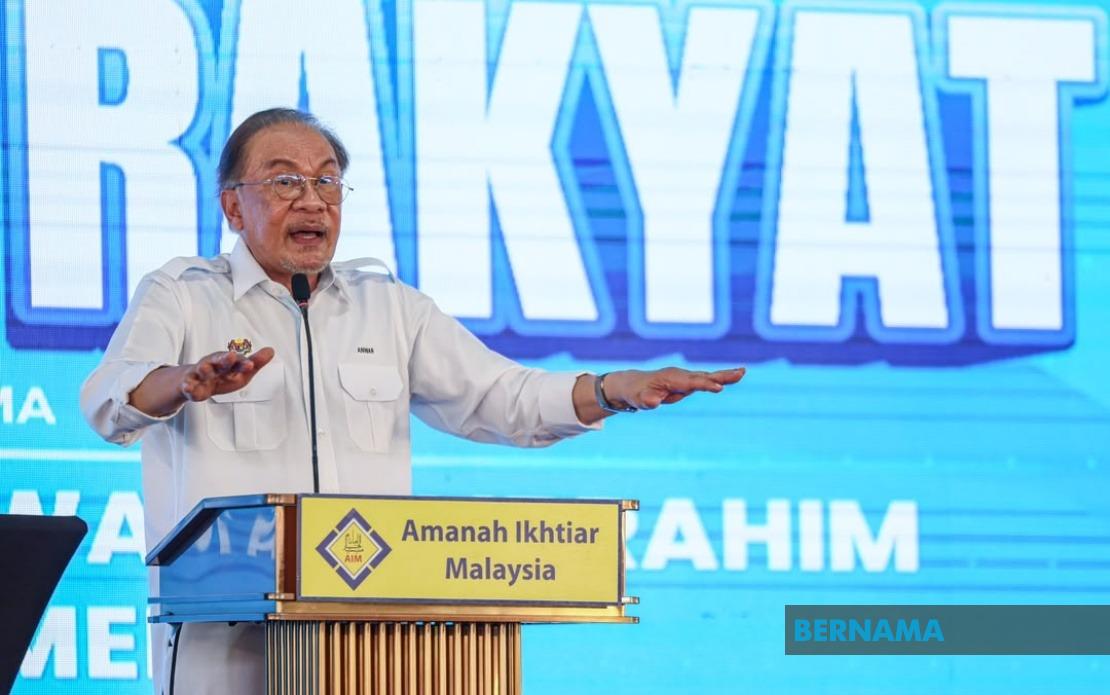
Prime Minister Datuk Seri Anwar Ibrahim has accused certain political parties of forming alliances specifically to unseat his government, attributing their opposition to the administration's resolute stance against corruption and the misuse of state power. Speaking at a campaign event in Batu Pahat during the Johor state election campaign, Anwar suggested that rival parties recognise the severity of his government's anti-corruption measures and view them as a direct threat to their traditional sources of political patronage and personal enrichment. His comments reveal the extent to which graft has become a central battleground in Malaysian politics, with the Prime Minister positioning his administration as fundamentally different from its predecessors in its willingness to prosecute those who abuse public office.
Anwar, who also leads Pakatan Harapan (PH), framed the anti-corruption effort as a defining principle of the MADANI Government's approach to governance. He stressed that his administration pursues those who pilfer public funds or exploit their positions for personal benefit with equal vigour, regardless of political affiliation or standing. This uncompromising approach, he argued, has generated significant discomfort among factions that had previously operated with relative impunity. The Prime Minister appeared to dismiss suggestions that the political pressure he faces constitutes a genuine threat to his hold on power, instead presenting it as an inevitable consequence of taking principled action against entrenched interests.
The Prime Minister used his personal conduct as evidence of his commitment to ethical governance. He recounted his numerous official visits to Johor as Prime Minister and pointed out that he had not acquired any land, secured any projects, or obtained any shareholdings in the state during that time. By highlighting his own restraint, Anwar sought to model the behaviour he expects from elected representatives and political figures throughout the country. This personal testimony was designed to persuade voters that his administration represents a genuine departure from the pattern of self-enrichment that has long characterised Malaysian politics at all levels. The contrast between his position and that of his political rivals formed a key element of his campaign narrative for the Johor election.
Anwar appealed directly to Johor voters to support Pakatan Harapan in the state election, arguing that alignment between state and federal governments would enable more effective implementation of development initiatives and welfare programmes. He acknowledged that Johor had received billions of ringgit in development funding but contended that fundamental issues affecting ordinary residents remained unresolved. Housing affordability, road infrastructure, places of worship, and support services for vulnerable populations had all been inadequately addressed, despite the state's significant wealth. His argument implied that the state government's existing leadership had failed in its obligation to translate economic resources into tangible improvements in quality of life for the majority of Johor's residents.
The Prime Minister's critique of development spending without corresponding improvement in living standards struck at what remains a core tension in Malaysian governance. Despite massive public and private investment, substantial portions of the population still struggle to access affordable housing, adequate healthcare, and quality education. Anwar suggested that this paradox results from governance failures at the state level, where resources are either misallocated, misdirected to connected interests, or simply inadequately supervised. By placing this issue at the centre of the Johor campaign, he sought to shift the election debate away from the ethnic and religious questions that have traditionally dominated Malaysian politics and toward bread-and-butter governance competence.
Anwar took the opportunity to address persistent concerns among Malay-Muslim voters regarding Pakatan Harapan's partnership with DAP, a party that has long faced suspicion from conservative constituencies. He stated categorically that during his three-and-a-half years as Prime Minister, DAP ministers in the Cabinet had never opposed any programme benefiting Malay communities or Islam. This assertion was intended to counter the narrative, often deployed by opposition parties, that PH's multiethnic coalition necessarily disadvantages Malay-Muslim interests. By challenging voters to verify his claim against the public record, Anwar sought to reframe concerns about DAP participation as either unfounded or deliberately propagated by his political opponents.
The presence of Communications Minister Datuk Fahmi Fadzil at the campaign event underscored the federal government's direct involvement in the Johor state election campaign. The participation of federal ministers in state-level contests has become increasingly prominent as elections have become more centralised around national political leaders rather than state-based figures. This development reflects both the personalisation of Malaysian politics around the office of Prime Minister and the stakes that major parties perceive in state-level outcomes. For Pakatan Harapan, capturing or retaining Johor would represent a significant expansion of the coalition's influence in a state that has historically been dominated by the Barisan Nasional.
Anwar remarked on the enthusiasm displayed by PH supporters at the Senggarang meet-and-greet, noting the willingness of attendees to wait in intense heat to hear him speak. His observation that such dedication was rarely witnessed at his campaign events suggested both genuine grassroots mobilisation and, implicitly, confidence in the party's prospects. The contrast between such enthusiasm and the claims of opposition parties uniting against him presented a potential contradiction: if his government faces a serious coordinated threat, why would supporters demonstrate such public commitment? The implicit message was that ordinary Malaysians support the anti-corruption agenda sufficiently to overlook the political pressures his administration faces.
The Johor state election, scheduled for polling on 11 July with early voting on 7 July, represented a significant test of both the federal government's political strength and the public appetite for governance reform. The contest involved 172 candidates competing for 56 state assembly seats, making it a substantial electoral exercise by any measure. For Anwar's government, the election offered an opportunity to translate its stated anti-corruption principles into political capital and electoral success. A strong performance in Johor would validate his claim that voters support his approach despite, or perhaps because of, the opposition it generates from rival parties.
The framing of opposition parties as motivated primarily by alarm at the government's anti-corruption stance contains an element of political calculation. By attributing rival parties' opposition to his government's ethical rigour rather than to substantive policy disagreements or concerns about governance effectiveness, Anwar positioned himself on the moral high ground. This narrative strategy seeks to transform political opposition from a legitimate expression of competing visions for Malaysia into a self-interested attempt to protect corrupt interests. Whether this framing resonates with voters, particularly in Johor, would have significant implications for both the state election outcome and Anwar's broader political prospects at the federal level. The election thus becomes a referendum not merely on state-level competence but on the legitimacy of the anti-corruption agenda itself.

