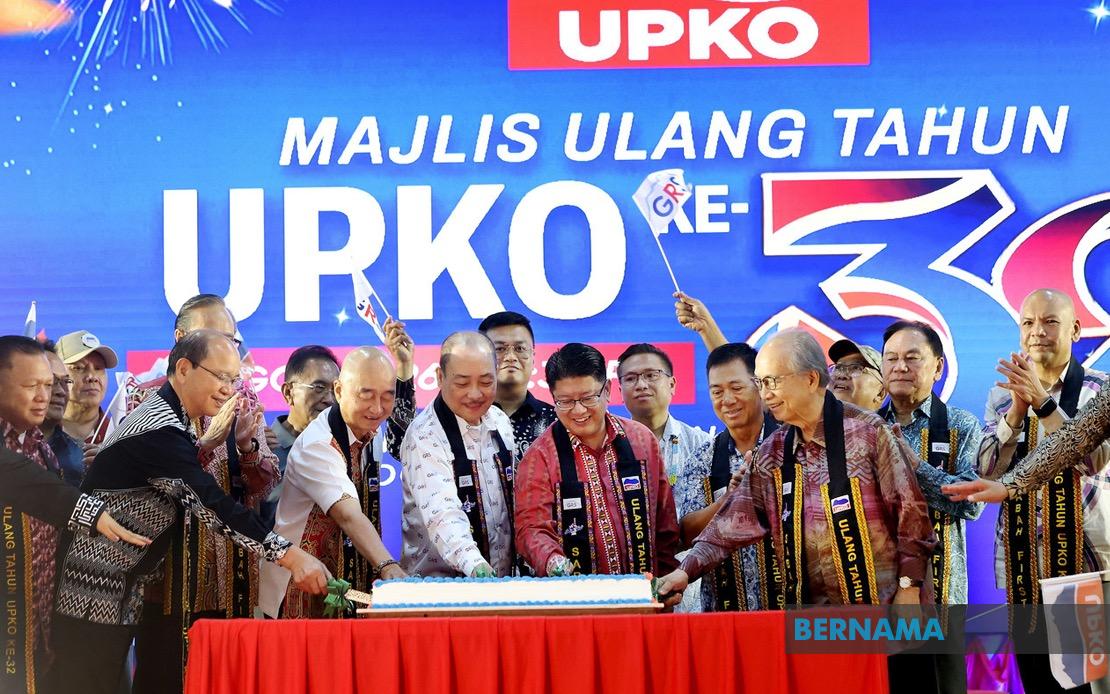
Sabah's path toward sustained development hinges fundamentally on political stability, according to Chief Minister Datuk Seri Hajiji Noor, who underscored the necessity for his administration to maintain focus on economic growth and infrastructure expansion without the distraction of internal political turbulence.
Speaking at the 32nd United Progressive Kinabalu Organisation (UPKO) anniversary celebration and opening of the party's 17th Triennial Delegates Conference in Kota Kinabalu, Hajiji articulated a vision where political cohesion among ruling coalition members becomes the bedrock upon which tangible improvements in citizens' lives can be constructed. The remarks come at a time when Sabah, like much of Malaysia, grapples with managing diverse political interests while delivering concrete governance outcomes.
The Chief Minister emphasised that despite the disparate ideological backgrounds and political foundations of the six parties now comprising Gabungan Rakyat Sabah (GRS), their shared commitment to the state's welfare must transcend factional considerations. This framing transforms the coalition from merely a pragmatic political arrangement into something more foundational—a unifying structure that allows Sabah to direct resources and attention toward substantive policy goals rather than internal political management.
Hajiji invoked a metaphor of shared shelter and common cause, suggesting that GRS serves as a protective roof under which diverse political entities work toward a singular objective: advancing Sabah's interests. This language, while familiar in political discourse, reflects a genuine challenge facing the coalition—maintaining internal discipline and cohesion among parties with differing political DNA and potentially competing constituency interests.
The expansion of GRS to include UPKO represents a strategic consolidation aimed at reinforcing this stability. UPKO's formal entry in June as the coalition's newest member brings the total component parties to six, joining Parti Gagasan Rakyat Sabah, Parti Bersatu Sabah, Liberal Democratic Party, Parti Harapan Rakyat Sabah and Parti Cinta Sabah. For Malaysia's broader political landscape, this expansion demonstrates continued reliance on multi-party coalitions as the governing model, particularly in East Malaysia where such arrangements have become standard practice.
EWON Benedick, UPKO president and Sabah Deputy Chief Minister III with ministerial responsibilities for Industrial Development, Entrepreneurship and Transportation, was present to affirm the party's commitment to the coalition. His portfolio—spanning industrial policy and economic entrepreneurship—connects directly to the development agenda Hajiji emphasises, suggesting that stability at the political level directly enables more coherent policy implementation across governance domains.
The Chief Minister's articulation of the "Sabah First, Sabah United, Sabah Forward and Sabah Prosper" vision reflects an attempt to anchor coalition solidarity not in narrow partisan advantage but in developmental outcomes. For Malaysian readers accustomed to federal coalition dynamics, this approach mirrors strategies employed nationally, where emphasis on common governance objectives theoretically transcends party lines. The effectiveness of such messaging depends largely on whether the coalition partners can indeed subordinate internal interests to collective governance.
For Sabah specifically, the stakes are substantial. The state faces persistent development challenges including infrastructure gaps, economic diversification needs beyond traditional commodities, and human capital development. Political instability—manifested in frequent government changes or coalition fractures—diverts executive attention and creates policy uncertainty that deters investment and delays implementation of long-term initiatives. Conversely, stable governance environments allow bureaucracies to function more effectively and enable political leaders to pursue coherent, multi-year development strategies.
The expansion of GRS also carries implications for how power is distributed within the coalition and among local Sabah-based political parties. Smaller parties gain leverage by holding pivotal coalition positions, which can either strengthen commitment to stability or create opportunities for extracting concessions that may not always align with broader development objectives. The balance between accommodation and effective governance remains delicate.
Moreover, Hajiji's emphasis on political stability resonates with Southeast Asian governance patterns where political predictability is increasingly recognised as essential to economic competitiveness. Investors and international partners view political turmoil as a risk factor that affects credit ratings, foreign investment flows, and a region's attractiveness for business expansion. Sabah's efforts to position itself as politically stable thus carry economic ramifications extending beyond symbolic gestures.
The Chief Minister's message also implicitly acknowledges that maintaining coalition harmony requires constant attention and proactive leadership. By publicly emphasising shared commitment and reiterating collective vision, he signals to component parties and their leaders that defection or internal contestation carries political costs. This performative dimension of coalition management—visible in public events and formal statements—serves both as reassurance to stakeholders and as a subtle enforcement mechanism.
Looking forward, GRS's continued effectiveness as a governing coalition will depend on whether political stability translates into measurable development outcomes. Citizens and voters ultimately assess governance not merely by the absence of political crisis but by concrete improvements in service delivery, economic opportunities, and living standards. The coalition's strategic wisdom lies in recognising that true stability must be anchored in tangible progress rather than rhetorical unity alone.
For the broader Malaysian context, Sabah's coalition model and its emphasis on stability-as-prerequisite-for-development offers lessons applicable to federal governance. As Malaysia navigates its own political complexities, the principle that effective administration requires sustained political arrangements—even imperfect ones—may resonate beyond East Malaysia.

