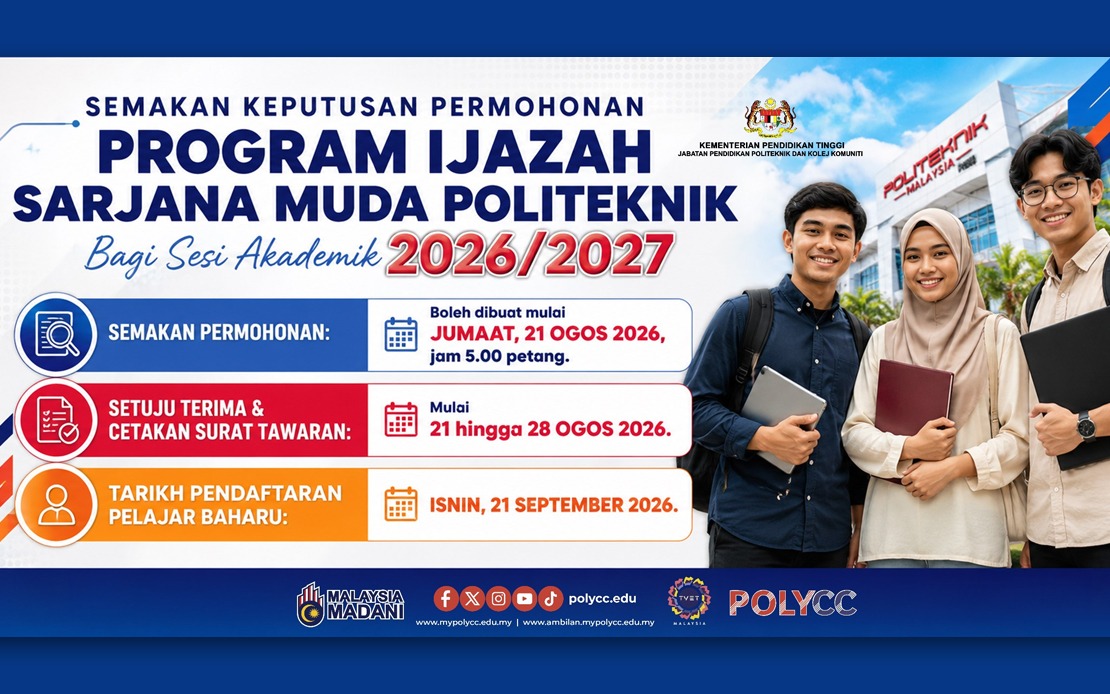
The Department of Polytechnic Education and Community Colleges has made application results available for Malaysia's polytechnic bachelor's degree programmes, allowing qualified candidates to check their admission status beginning today. This intake round represents a significant expansion of diploma-to-degree pathways at Malaysia's polytechnic institutions, reflecting the government's commitment to providing alternative routes to higher education credentials beyond the traditional university system.
Candidates who have received offers must act promptly, as the confirmation window closes on August 28. This compressed timeline requires successful applicants to review their results and make informed decisions about their academic future within just one week, emphasising the importance of checking the official portal immediately upon notification. The requirement for immediate confirmation ensures institutions can accurately gauge enrolment numbers and plan resources accordingly for the upcoming academic session.
The current cycle features 12 distinct bachelor's degree programmes delivered across four polytechnic campuses strategically located throughout Peninsular Malaysia. Politeknik Ungku Omar in Ipoh, Perak, Politeknik Sultan Salahuddin Abdul Aziz Shah in Shah Alam, Selangor, Politeknik Ibrahim Sultan in Pasir Gudang, Johor, and Politeknik Sultan Azlan Shah in Behrang, Perak, collectively offer these qualifications. This geographic distribution ensures that aspiring polytechnic graduates in different regions have access to degree-level vocational education without necessarily relocating to major urban centres.
The 12 programmes encompass diverse technical and creative fields designed to meet evolving labour market demands. Mechanical Engineering Technology and Civil Engineering Technology attract students interested in infrastructure and manufacturing sectors, while Built Environment caters to those pursuing careers in construction and urban development. Electrical and Electronic Engineering Technology programmes address Malaysia's ongoing need for skilled technicians in the energy and electronics industries. Beyond engineering, Visual Communication and Design programmes recognise the growing creative economy, and Tourism and Hospitality qualifications support Southeast Asia's significant travel and accommodation sectors.
A total of 534 places have been allocated across these various fields of study, representing substantial capacity expansion at the polytechnic level. This substantial intake reflects Malaysia's strategic pivot toward skills-based education and workforce development, acknowledging that not all students require or desire university pathways. Polytechnic qualifications have gained increased employer recognition, particularly in technical fields where practical competence often matters more to hiring decisions than academic credentials alone. The availability of nearly 540 spots signals genuine commitment to democratising access to tertiary education.
New student registration commences on September 21, providing a window for admitted candidates to complete enrolment procedures and prepare for their studies. This date allows sufficient time for successful applicants to complete administrative requirements, secure necessary documentation, arrange accommodation if required, and mentally transition from secondary or post-secondary education into the polytechnic environment. Early registration also enables institutions to organise orientation programmes and ensure adequate facilities and staffing are in place.
Applicants who did not receive offers in this round need not abandon their aspirations. The system provides recourse through an online appeal mechanism available from today until September 4. This appeals process acknowledges that initial selection may not capture all qualified candidates, particularly those whose applications faced processing delays or administrative oversights. Those pursuing appeals should meticulously prepare supporting documentation and clearly articulate why they merit reconsideration, focusing on academic achievements and career objectives aligned with their chosen programmes.
Results of the first follow-up offer round for appeal candidates will be announced on September 8, providing a second pathway into these programmes. Unsuccessful candidates in the appeal process would theoretically have the option to pursue other educational avenues, though specific guidance on alternative routes remains unclear from available information. The staggered timeline for appeals ensures that while some students confirm their places in late August, the institution retains flexibility to optimise intake numbers through the appeal and follow-up rounds.
The expansion of bachelor's degree programmes at polytechnics represents a pivotal shift in Malaysia's education ecosystem. Historically, polytechnics focused primarily on diploma-level qualifications providing direct entry into technical employment. The introduction of degree programmes creates clear pathways for diploma graduates to advance their qualifications without necessarily transferring to universities, preserving the practical orientation of polytechnic education while elevating credential levels. This structure appeals particularly to working professionals seeking advancement through evening or weekend degree programmes.
For Malaysian parents and students, this development expands realistic options for post-secondary education. Not every student thrives in traditional university environments; some benefit from the more structured, career-focused pedagogical approach common at polytechnics. The availability of degree qualifications at these institutions validates vocational education pathways and potentially improves employment prospects for graduates entering fields where practical skills and certifications prove more valuable than general academic credentials.
Prospective students from lower-income backgrounds may find polytechnic degrees particularly attractive, as these institutions typically charge lower fees than private universities and offer more flexible scheduling than public universities. Malaysian families in rural or semi-urban areas likewise benefit from the geographic distribution of these programmes, potentially reducing relocation costs and family disruption associated with degree studies.
For further information regarding applications, the Student Intake and Development Division within the Department of Polytechnic Education and Community Colleges stands ready to assist. Prospective students and their families should not hesitate to contact relevant authorities with questions about programme content, career prospects, financial support, or administrative procedures. Clear communication during this critical decision-making period helps ensure that only genuinely interested and appropriately qualified candidates proceed to confirmation.

