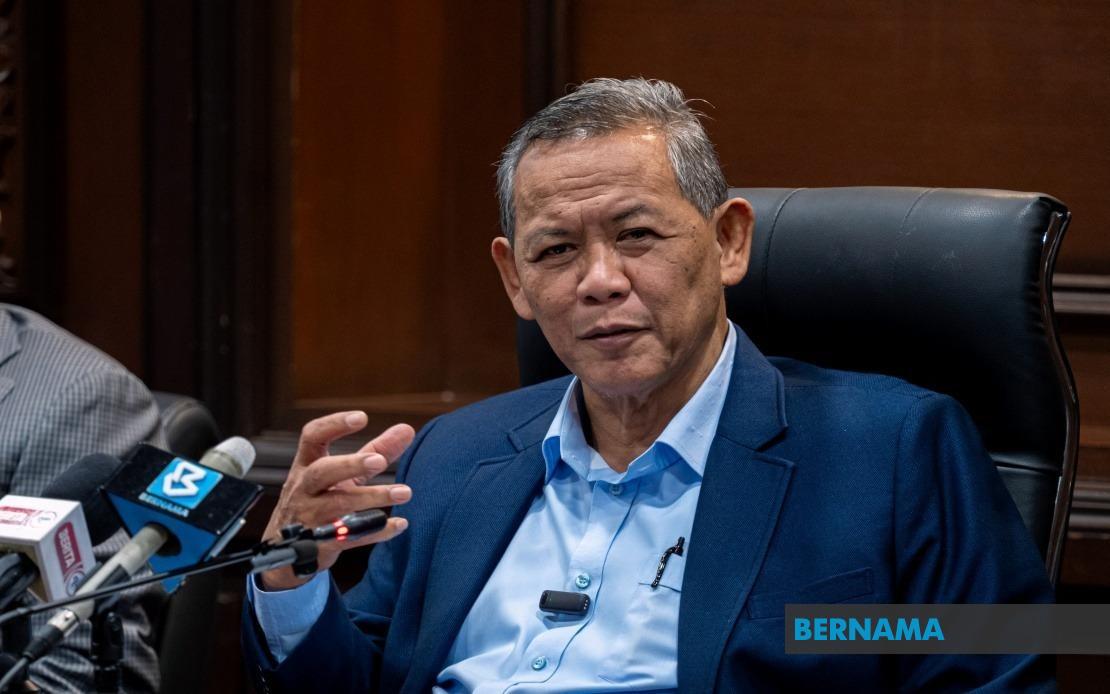
The AI-powered Smart Port initiative planned for Port Dickson will proceed without acquiring any land beyond what Tanco Holdings Berhad and its subsidiary Midports Holdings Sdn Bhd already possess, according to Negeri Sembilan Menteri Besar Datuk Seri Aminuddin Harun. The clarification comes amid public concern about the project's footprint and its potential impact on local communities and natural resources in the state's key coastal zone.
Aminuddin firmly rejected widespread claims that the development would necessitate the acquisition of approximately 566 hectares—equivalent to roughly 1,400 acres—spanning village areas, forest reserves, indigenous land, industrial zones, agricultural land, and residential properties. He characterised such assertions as groundless and without factual foundation. The Menteri Besar's emphatic denial signals an attempt to quell growing anxiety among residents about displacement and land rights, issues historically sensitive in Malaysian development contexts.
The state leader provided specific geographical details to underpin his position, noting that Tanco Holdings controls approximately 202 hectares designated specifically for port operations. This figure represents less than 40 per cent of the land area that critics had claimed would be needed, suggesting either significant overestimation in public fears or fundamental disagreement about the project's true scope. The discrepancy between official projections and community perception reflects a broader communication challenge that development authorities frequently encounter when introducing large-scale infrastructure projects to populated regions.
Aminuddin stressed that no villages would be displaced for the project's implementation and that forest reserves would remain untouched. He further clarified that Port Dickson contains no customary land subject to indigenous ownership rights, a distinction he highlighted by noting that such land concentrations exist only in Kuala Pilah, Jelebu, Rembau, and Tampin—interior districts within Negeri Sembilan where Orang Asli communities maintain stronger territorial claims. This assertion, if accurate, removes a significant category of protected land from consideration, though it may prompt further scrutiny from indigenous rights advocates.
The first phase of development carries an estimated investment value of RM3.4 billion and is positioned as a transformative economic opportunity for Port Dickson, a port city that has experienced relative stagnation compared to more developed Malaysian maritime centres. Aminuddin described the undertaking as a "game changer" capable of generating substantial economic returns for surrounding communities, particularly in the Linggi and Pasir Panjang areas. This framing attempts to reposition the project from a potential threat into a development engine that could deliver employment, commercial opportunities, and improved infrastructure across the region.
The Prime Minister's July 14 statement provides national-level endorsement for the initiative. Datuk Seri Anwar Ibrahim characterised the Midport development as essential infrastructure that would strengthen Malaysia's standing as a digital and maritime technology leader while bolstering the country's capacity to handle expanding international trade volumes. He contextualised the project within Malaysia's strategic location along the Strait of Malacca, one of the world's most critical shipping corridors, where technological advancement and operational efficiency translate directly into competitive advantage and economic impact.
Aminuddin's reaffirmation of the state government's commitment to protecting Malay-owned land and preserving community interests appears designed to address concerns within the dominant political constituencies of Negeri Sembilan. His explicit pledge that Malay landholdings would remain secure and unaffected represents acknowledgment of how land acquisition disproportionately affects Bumiputera communities and how such matters can inflame political sentiment at state level. The statement also suggests awareness that misinformation regarding land seizures has circulated widely enough to require direct presidential-level denial.
Significant confusion has surrounded the project's relationship to fishing communities and river-dependent livelihoods. Aminuddin clarified that the Smart Port development does not encompass Kampung Tanjung Agas, Kampung Sungai Raya, or the Linggi River itself, thereby excluding crucial fishing grounds and settlement areas from the project footprint. He attributed some community anxiety to misidentification with a separate undertaking—the Kuala Linggi International Port, situated on the Negeri Sembilan–Melaka border and falling under Melaka state administration. This distinction is crucial, as the KLIP project may carry different environmental and social implications that residents inadvertently associated with the Smart Port initiative.
The separation between the two port projects underscores an important administrative reality: Port Dickson and Kuala Linggi represent distinct development zones with different governance structures and strategic purposes. For Malaysian readers, particularly those in the wider Klang Valley and southern Selangor region, the Port Dickson Smart Port carries implications for maritime commerce flows, supply chain efficiency, and digital port technology adoption across Southeast Asia. As a duty-free commercial hub, the facility would compete with existing maritime centres and potentially redirect some trading activity from established ports.
The project's AI-powered infrastructure represents Malaysia's aspiration to lead regional maritime digitalisation. Smart port technology—encompassing automated cargo handling, real-time tracking, predictive analytics, and AI-driven logistics optimisation—has become standard in competitive global maritime hubs. Port Dickson's positioning as a technology-enabled facility would signal Malaysia's readiness to modernise port operations and maintain relevance in increasingly digital supply chains. For regional commerce and Malaysian export industries, such technological adoption at major port facilities offers efficiency gains and cost reductions that can enhance competitiveness.
Aminuddin's emphasis on economic benefits for Linggi and Pasir Panjang communities highlights how large infrastructure projects are increasingly justified through local community enhancement narratives. The RM3.4 billion investment figure, while substantial, requires examination regarding actual job creation trajectories and whether projected benefits would materialise for existing residents or primarily advantage external investors and skilled foreign workers. Malaysian development history offers cautionary examples where megaprojects generated wealth concentration rather than broad-based community advancement.
The state government's defensive posture regarding land acquisition and customary rights suggests that public resistance to the Smart Port remains considerable despite official optimism. The need for repeated clarification indicates that trust gaps persist between development authorities and affected populations. For the project to succeed without community backlash, authorities will likely need to engage beyond press statements to address lingering concerns about environmental impact, livelihood preservation, and benefit-sharing arrangements.
As Malaysia positions itself as a digital maritime leader and Port Dickson seeks renewed economic relevance, the Smart Port project represents a significant bet on technological modernisation and regional commercial repositioning. The project's success will depend not merely on technical implementation but on genuinely demonstrating that large-scale infrastructure development can proceed without displacing communities or degrading environmental assets—a demonstration that Southeast Asian societies increasingly demand before accepting such undertakings.

