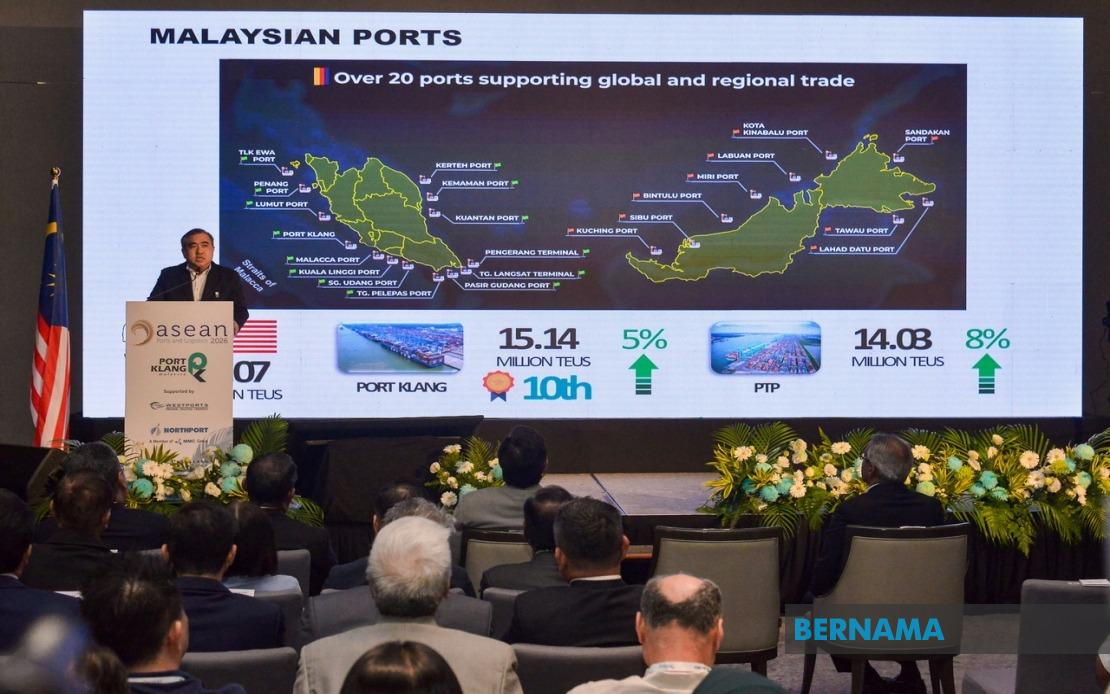
Malaysia's aspirations to cement its position as a dominant maritime force in Southeast Asia have taken tangible shape with Transport Minister Anthony Loke's confirmation of a major expansion programme for Port Klang. Speaking at the ASEAN Ports and Logistics Conference and Exhibition in Kuala Lumpur, Loke unveiled plans for Port Klang's Third Terminal on Carey Island, a transformative project expected to unfold across two decades and reshape the nation's competitive standing in global shipping lanes.
The strategic imperative driving this initiative reflects Malaysia's recognition of a widening capacity gap with neighbouring rivals. Port Klang's existing infrastructure can accommodate approximately 20 million twenty-foot equivalent units annually, a figure that pales against Singapore's Tuas Port, which boasts a handling capacity three times larger at roughly 60 million TEUs yearly. This substantial disparity underscores why Malaysian policymakers view the Carey Island development not merely as infrastructure enhancement but as essential to maintaining economic relevance within a competitive regional port ecosystem over the coming three decades.
The scale of ambition behind this project cannot be overstated. By transforming Port Klang into what officials describe as a mega-port capable of managing substantially expanded container volumes, Malaysia aims to create competitive advantages that transcend simple capacity metrics. Such expansion would enable the nation to absorb growing regional trade flows, particularly as manufacturing and logistics networks across Southeast Asia become increasingly sophisticated and interconnected. The phased implementation approach suggests a pragmatic recognition that such monumental undertakings require staged development to manage financial, environmental, and operational risks.
Significant progress has already been registered in the project's development trajectory. Feasibility studies that commenced in 2018 have reached completion, establishing the technical and economic foundations for proceeding. More critically, Malaysia's Cabinet granted in-principle approval for advancing the initiative under a public-private partnership model, a financing structure that distributes risk between government and private sector participants while potentially accelerating implementation timelines. This PPP framework reflects contemporary global best practices in infrastructure development, particularly for port expansions requiring substantial capital investment.
However, the path to commencement remains encumbered by territorial complexities requiring resolution between federal and state authorities. Loke acknowledged that land-related negotiations with the Selangor state government remain outstanding, though he conveyed optimism that once these administrative hurdles are cleared, project mobilisation would proceed without further delay. This bureaucratic dependency highlights how even strategically vital national infrastructure can encounter friction at the federal-state governance interface, a recurring challenge within Malaysia's federal architecture.
Beyond capacity expansion, Malaysia's geographic positioning has conferred unexpected strategic advantages in an increasingly volatile geopolitical environment. Tensions in West Asia have paradoxically benefited Malaysian ports by catalysing a shift in transshipment patterns, with operators and shipping lines gravitating towards perceived safer jurisdictions. Both Port Klang and Port Tanjung Pelepas demonstrated positive cargo growth during the first quarter of the current year despite global uncertainty, suggesting that safety considerations are actively reshaping maritime trade routes to Malaysia's advantage. This phenomenon demonstrates how geopolitical disruption can yield economic opportunities for well-positioned regions.
The broader implications extend beyond Malaysia's domestic interests. Loke's emphasis on ASEAN-wide coordination to preserve the Strait of Melaka's security reflects recognition that Southeast Asian prosperity depends fundamentally upon maintaining the integrity and neutrality of critical international maritime corridors. The Strait remains one of the world's most crucial shipping passages, channelling roughly a third of global maritime trade and connecting major industrial economies. Any escalation of regional tensions threatens not merely Malaysian port operations but the foundational stability underpinning ASEAN's economic integration and global trade connectivity.
Port Klang's historical evolution illustrates Malaysia's broader transformation from colonial entrepôt to modern maritime operator. The port has evolved substantially since its inception, and the third terminal represents a logical continuation of modernisation efforts designed to accommodate 21st-century container shipping requirements. Contemporary container vessels dwarf their predecessors in scale and efficiency, necessitating updated berths, handling equipment, and logistics infrastructure capable of maximising rapid turnaround times and minimising operational costs.
The competitive dynamics within Southeast Asian port operations underscore why Malaysia cannot afford complacency. Beyond Singapore, emerging competitors including Vietnam and Thailand have invested heavily in port modernisation, intensifying the regional competition for shipping line patronage and transshipment business. Port Klang's expansion represents Malaysia's strategic response to this competitive pressure, ensuring that the nation retains sufficient infrastructure to capture its proportionate share of regional container traffic and associated value-added logistics activities.
For Malaysian stakeholders across manufacturing, retail, and export sectors, the implications are substantial. Enhanced port capacity and efficiency translate directly into reduced shipping costs, faster clearance times, and improved supply chain predictability. These operational improvements enhance Malaysia's attractiveness as a manufacturing and trading hub, potentially catalysing foreign direct investment inflows seeking locations with efficient export logistics. The project's phased approach also suggests extended employment opportunities across construction, engineering, and port operations throughout its 20-year implementation horizon.
The timing of this project announcement carries additional significance within Malaysia's broader economic positioning. As the nation pursues diversification away from traditional sectors and seeks to elevate its standing in global value chains, world-class infrastructure becomes increasingly vital to competitiveness. Port Klang's expansion signals commitment to creating the foundational systems that modern logistics-dependent economies require for sustained prosperity and international competitiveness.
Looking forward, successful delivery of the Carey Island terminal project would substantially strengthen Malaysia's negotiating position within ASEAN and provide tangible capacity to absorb anticipated growth in containerised trade across the Indo-Pacific region. The project's success ultimately depends upon resolving outstanding land negotiations promptly and maintaining political commitment across successive electoral cycles, ensuring that Malaysia's maritime ambitions translate from strategic vision into operational reality.

