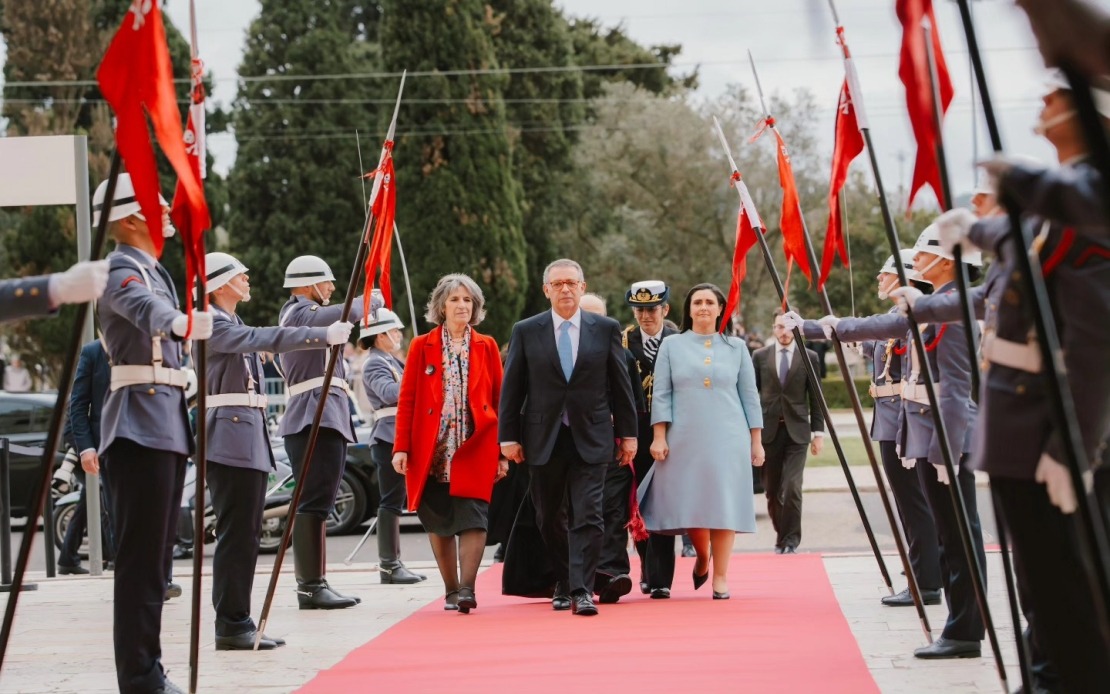
Portugal has formally prohibited face coverings in public spaces, following President Antonio Jose Seguro's signing of the controversial legislation on Tuesday. The law, which originated as a proposal from the right-wing Chega party, marks another significant moment in Europe's ongoing debate over religious expression and public integration policies. The presidential approval came after Parliament made adjustments to the original measure, changes that ultimately swayed Seguro to endorse the ban despite its contentious nature.
In his statement from Belem Palace, the Portuguese presidential seat in Lisbon, Seguro framed the legislation as addressing matters of "great social and cultural sensitivity." He emphasized that the modifications introduced during parliamentary deliberations had addressed his concerns sufficiently to justify his signature. The President's reasoning reflected deeper arguments about social cohesion and European values, positioning the ban not merely as a security measure but as a statement about how Portuguese society envisions itself.
The Portuguese government's justification for the ban centres on three principal arguments. First, officials contend that visible faces are essential to social integration and mutual recognition within Portuguese communities. Second, they argue the measure protects public security by ensuring identifiable citizens in shared spaces. Third, and perhaps most controversially, the government claims the ban upholds principles of gender equality and non-discrimination, citing European Court of Human Rights jurisprudence as supporting precedent.
Seguro's official position statement articulated a particular vision of Portuguese democracy. According to the presidential reasoning, an uncovered face serves as a foundational element of social trust and represents "a characteristic of Portuguese society." The statement stressed that daily coexistence depends on mutual recognition and the capacity for direct human connection. This framing reflects broader European anxieties about social fragmentation and the visibility of religious minorities in public life.
The gender equality argument has proven particularly contentious. Portuguese officials reasoned that requiring women exclusively to conceal their faces creates an unacceptable asymmetry contradicting principles of equal dignity and parity between men and women that they claim are central to European democracies. By reframing the face-covering ban as a gender equality measure, the government attempted to preempt criticism that the law discriminates against Muslim women.
However, Amnesty International Portugal has firmly rejected this reasoning, condemning the legislation as fundamentally discriminatory. The human rights organization argues that the ban threatens the autonomy and religious freedoms of Muslim women who have chosen to wear face coverings as expressions of their faith and identity. This perspective suggests that true gender equality involves respecting women's agency to make their own decisions about religious practice and bodily autonomy, rather than imposing restrictions ostensibly for their protection.
The Portuguese law represents part of a broader European trend toward restricting Islamic religious dress in public. France initiated this movement in 2011 with its burqa ban, followed by Belgium, Austria, Denmark, and the Netherlands implementing full or partial restrictions on face coverings. These countries have pursued similar justifications emphasizing social integration, security, and gender equality. The European landscape thus reflects competing visions of how diverse democracies should navigate religious expression in pluralistic societies.
For Southeast Asian readers, particularly in Malaysia with its significant Muslim population and constitutional protections for Islam, Portugal's approach offers a stark contrast. Malaysia's constitutional framework explicitly recognizes Islam's position and protects religious freedom, creating space for diverse dress practices without the restrictions now common across much of Europe. The Portuguese precedent illustrates how different democratic systems balance individual liberty, religious expression, and state interests in distinctly varied ways.
The law's implementation will likely generate ongoing disputes about enforcement and exceptions. Practical questions remain unresolved: will the ban apply only to facial coverings like niqabs and burqas, or extend to other religious or medical head coverings? How will authorities distinguish between religious expression and security concerns? These details will shape whether Portugal's ban achieves its stated objectives or primarily restricts the religious freedom of its Muslim citizens.
The Portuguese decision also reflects deeper anxieties within Europe about immigration, cultural identity, and the integration of Muslim communities. Rather than addressing underlying concerns through dialogue or social programs, several European governments have chosen legal restrictions on religious expression. Critics argue this approach alienates Muslim citizens, potentially driving marginalization rather than integration and contributing to social fragmentation rather than cohesion.
From a regional perspective, Portugal's face-covering ban highlights how Western democracies increasingly employ law to manage religious and cultural diversity. As Malaysia continues developing its own multicultural policies, the European experience offers cautionary lessons about the limits of legislative approaches to social integration and the importance of safeguarding religious freedom even within secular democratic frameworks.
The sustainability of such bans remains questionable given their vulnerability to European Court of Human Rights challenges and their potential contradictions with fundamental rights protections enshrined in EU law. Future judicial proceedings may ultimately determine whether Portugal's rationale withstands international human rights scrutiny, potentially reversing or modifying the current restrictions on face coverings in public spaces.

