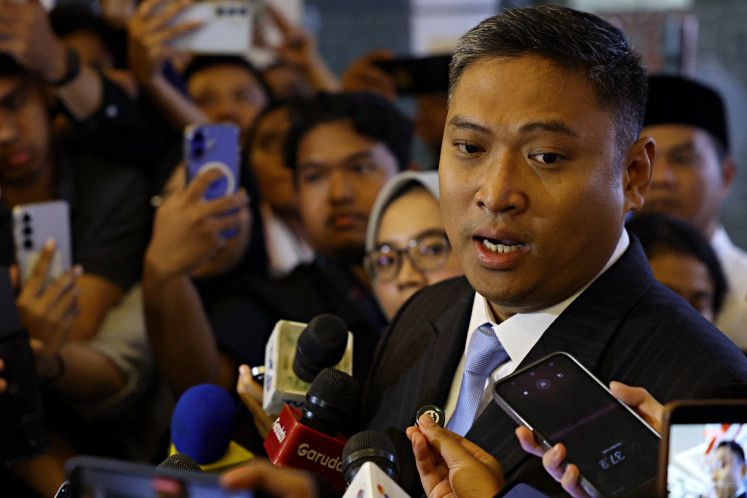
Indonesia's flagship free meals initiative has been rocked by another senior leadership departure, compounding governance troubles that have shadowed the programme since its 2025 rollout. Nanik Sudaryati Deyang, who took charge of the National Nutrition Agency (BGN) less than two months ago, stepped down this week citing urgent health concerns requiring overseas treatment. Her abrupt exit leaves the multitrillion-rupiah undertaking struggling to steady itself amid corruption allegations, operational mishaps and deepening public scepticism about institutional capacity.
Nanik's resignation announcement came via Facebook, where she detailed the emotional and physical toll of managing one of Prabowo Subianto's most high-profile campaign promises. Days earlier, she had disclosed that doctors had discovered an arterial blockage, attributing the condition partly to the overwhelming stress of overseeing the agency's massive budget allocation. In candid language that revealed the depth of institutional dysfunction, she described the responsibility of safeguarding public funds as akin to standing precariously on a cliff edge, where any misstep might prove catastrophic. The anxiety had become so acute that she found herself hesitant to authorise routine decisions independently, instead subjecting every policy proposal to repeated scrutiny—a paralysis born from fear of inadvertently triggering a financial or reputational disaster.
Nanik's appointment itself had been intended as a confidence-rebuilding measure following a damaging corruption scandal that consumed her predecessor. Dadan Hindayana, the former BGN chief, was arrested in early June alongside two deputies in connection with suspected procurement fraud and financial irregularities linked to the programme. Nanik, who had served as Dadan's deputy, was promoted as a replacement who could restore institutional credibility. Yet her tenure lasted mere weeks, highlighting how deeply fractured the agency's operational framework has become. The speed with which successive leaders have departed signals not merely individual failings but systemic breakdown—a programme conceived in political ambition but constructed on fragile administrative foundations.
Hours after accepting Nanik's resignation, Prabowo moved swiftly to fill the vacancy by appointing Sudaryono, the Deputy Agriculture Minister and a long-standing member of his Gerindra Party political apparatus. Sudaryono served as Prabowo's aide during the 2010s before his ministerial posting, embodying the pattern of deploying trusted loyalists to manage crisis situations. During his inauguration ceremony at the State Palace in Jakarta, Sudaryono acknowledged the agency's transparency shortcomings and committed to overhauling operational procedures. He pledged to eliminate clandestine decision-making, digitalise manual processes to create an auditable record, and restore public confidence through demonstrable accountability. Yet such promises, while rhetorically reassuring, arrive against a backdrop of scepticism about whether political appointees can genuinely transcend the systemic pressures that felled their predecessors.
The rationale for Sudaryono's selection reveals the administration's strategy: State Secretary Prasetyo Hadi explained that Sudaryono's involvement in the programme's development from inception positioned him to guide comprehensive institutional reforms. This reasoning, however, underscores a troubling reality—that the free meals initiative, despite being Prabowo's flagship policy, appears to have been launched without adequate technical groundwork or administrative scaffolding. A politician's familiarity with a project's origins does not automatically confer the expertise required to resolve endemic governance failures, particularly when those failures involve financial controls and organisational culture. The repeated recycling of party figures into emergency management roles suggests an administration more comfortable manipulating political variables than addressing structural defects.
The programme's operational difficulties extend far beyond leadership volatility. Since its initial rollout eighteen months ago, the scheme has contended with recurrent food safety crises, including multiple mass poisoning incidents scattered across the country. These incidents triggered widespread food quality concerns and sparked public debate about whether the programme prioritises coverage breadth over nutritional and hygenic standards. In response to mounting criticism, Nanik implemented a moratorium on establishing new kitchen facilities while the BGN reviewed approximately 28,000 existing operations nationwide. This defensive measure, though administratively sensible, provoked fierce backlash from thousands of prospective kitchen operators who had invested substantially in their facilities, expecting to participate in the expanded programme.
The government has responded to systemic pressures by substantially contracting the programme's ambitions. The BGN announced this week that the 2026 provisional budget has been slashed from the originally planned Rp268 trillion to Rp229 trillion, equivalent to approximately US$12.8 billion. The beneficiary target for the same year has similarly been reduced from 82.9 million to 62.7 million individuals, encompassing schoolchildren, toddlers and pregnant women. BGN deputy chief Agustina Arumsari characterised this recalibration as a strategic pivot toward quality rather than quantitative expansion. The language reflects a sophisticated retreat: rather than acknowledging the programme's inability to deliver both scope and standards, the administration frames contraction as a deliberate choice to prioritise service excellence. This rhetorical manoeuvre attempts to transform a forced retreat into a virtuous pivot, though it fundamentally contradicts Prabowo's original electoral promises of universal nutritional support.
Political analyst Wasisto Raharjo Jati has attributed the cascading governance crises to fundamental planning deficiencies rooted in political rather than technocratic considerations. The free meals programme, despite its political elevation as a cornerstone initiative, exhibits institutional characteristics typical of policies driven by electoral ambition rather than rigorous administrative preparation. This diagnosis suggests that successive leadership appointments, irrespective of the appointees' credentials or commitment, will struggle to resolve problems embedded in the programme's foundational design. The revolving-door senior management pattern—corruption arrests, health-induced departures, and emergency political replacements—indicates deeper organisational pathologies that reshuffle solutions cannot address.
For Southeast Asian observers and Malaysia's policymakers in particular, the Indonesian experience offers instructive lessons about the risks of launching ambitious social programmes without proportionate institutional capacity. Indonesia's free meals scheme represents one of the developing region's most expensive welfare undertakings, commanding billions in annual expenditure. Its implementation failures—combining financial mismanagement with operational breakdowns and food safety failures—demonstrate how political popularity and technical competence can diverge sharply, especially when administrative systems lack adequate oversight architecture. As Malaysia contemplates various social support expansions and targeted subsidy programmes, the cautionary Indonesian precedent merits serious consideration. Enthusiasm for ambitious social initiatives must be tempered by realistic assessment of institutional readiness, with adequate investment in systems design and accountability mechanisms preceding rather than following programme rollout.

