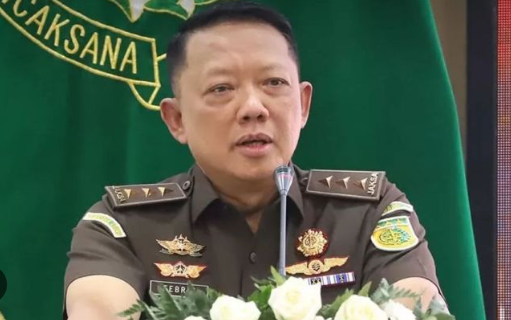
President Prabowo Subianto's arrival in office was marked by bold declarations about tackling corruption, with repeated calls for officials to reform themselves before formal law-enforcement intervention became necessary. Less than two years into his presidency, however, that resolute commitment faces a significant credibility challenge that threatens to undermine public confidence in Indonesia's anti-corruption infrastructure.
The investigation into Febrie Adriansyah has become a flashpoint in this broader struggle. Until recently serving as deputy attorney general overseeing special crimes prosecutions, Febrie occupied Indonesia's most senior anti-corruption enforcement position, wielding extraordinary influence over the nation's biggest financial crime investigations. Police seized approximately US$26 million in cash and gold bars from properties he owns and designated him a suspect in money-laundering cases, yet he remains free from detention despite these serious allegations.
What troubles legal observers most is not the investigation itself but the institutional choreography surrounding it. Police transferred three related cases to the Attorney General's Office shortly after the raids, creating an unusual arrangement where the very institution Febrie served for much of his career now leads the prosecution. This decision has become the most contested aspect of the entire proceedings, as it raises fundamental questions about whether prosecutors can impartially investigate their former colleague and superior.
Former Constitutional Court Chief Justice Mahfud MD has publicly questioned whether Indonesia's criminal procedure code even authorises such transfers, warning that the arrangement exposes the prosecution to potential pretrial challenges that could collapse the case entirely. Several lawmakers have established a monitoring committee, while some have called for the Attorney General's Office to establish a truly independent investigative team insulated from institutional pressures. The criticism reflects deep concern that political accommodation between agencies may be overriding legal procedure.
Anti-corruption scholar Zaenur Rohman from Gadjah Mada University characterised the transfer as fundamentally lawless, describing it as "a political settlement aimed at easing tensions" between competing institutions rather than one grounded in legal principle. He argues that Indonesia's Corruption Eradication Commission, which operates independently within the executive branch, would be far better positioned to conduct a credible investigation untainted by institutional conflicts of interest. The current arrangement creates an inherent bias that undermines the investigation's legitimacy regardless of its ultimate findings.
Coordinating Minister Yusril Ihza Mahendra defended the transfer as promoting investigative efficiency while simultaneously acknowledging the uncomfortable reality that it appears to constitute "oranges eating oranges" – the Indonesian idiom describing one institution protecting its own members. Yusril revealed that Prabowo had personally met with both the police chief and attorney general to provide directions on managing the transfer, suggesting high-level political involvement in what should theoretically be an independent legal process. Yet police and prosecutors continue insisting their coordination reflects standard institutional cooperation rather than any preferential treatment.
Febrie's prominence intensifies the sensitivity considerably. As head of the Attorney General's Office's Special Crimes Division, he personally directed investigations into Indonesia's largest corruption cases, overseeing probes affecting major state enterprises including Pertamina, Timah, and Garuda Indonesia, as well as high-profile figures like former Education Minister Nadiem Makarim. He also supervised investigations into Prabowo's signature free-meals programme, a central plank of the president's anti-poverty agenda. Few prosecutors have wielded comparable influence over Indonesia's legal landscape, making this case far more than a routine investigation.
The broader context involves an intensifying struggle for institutional supremacy among Indonesia's competing law-enforcement agencies. Police, prosecutors, and the Corruption Eradication Commission all claim overlapping jurisdictions in corruption cases, creating periodic tensions over visibility, control, and political influence. Recent military law revisions from 2025 have further complicated this landscape by allowing active-duty officers to serve in the Attorney General's Office without resigning, and by expanding prosecutors' authority to seek military protection – functions previously controlled exclusively by police. These shifts reshape Indonesia's institutional balance in ways that remain unstable and contested.
Since Prabowo's election, he has leveraged high-profile corruption investigations involving state-owned enterprises, former ministers, and his free-meals programme to project an image of decisive action against financial crime. Authorities have repeatedly staged televised press conferences showcasing seized cash, luxury vehicles, and gold bars, creating powerful symbolic demonstrations of institutional effectiveness. Yet these theatrical displays risk appearing hollow if the cases themselves reveal institutional partiality, as the Febrie investigation threatens to do.
Political lecturer Aditya Perdana from the University of Indonesia notes that while the sequence of recent events does not explicitly prove institutional conflict, it tells a suggestive story about how power is actually exercised. The timing of developments – raids on Febrie's residence, subsequent case transfers, and the naming of an active police brigadier general as a suspect in the free-meals investigation – suggests that turf wars and political calculations may influence case handling as much as legal principle.
Scholar Jacqui Baker from Murdoch University emphasises that successive Indonesian presidents have deliberately balanced law-enforcement institutions rather than allowing any single agency to dominate, recognising that investigative powers over corruption sit at the core of institutional political and economic authority. The 2025 military law changes reflect new calculations about how to distribute this crucial power, yet they also create fresh instability. Prabowo's balancing act remains unfinished, and the Febrie case will substantially determine whether his anti-corruption rhetoric translates into institutional credibility or merely masks the familiar patterns of institutional self-protection that have long compromised Indonesia's anti-corruption efforts.
As of mid-July, Febrie's whereabouts remained undisclosed, with immigration authorities imposing a 20-day ban on his departure at police request. He acknowledged owning raided properties but denied ownership of the seized assets. Public tensions eased after armed soldiers withdrew from his South Jakarta residence, with Prabowo calling for institutional "introspection" and the National Police chief appearing publicly with the attorney general to deny any rifts. Yet these gestures cannot resolve the fundamental question: whether Indonesia's anti-corruption architecture can function impartially when investigating its own most powerful members, or whether institutional self-preservation will continue limiting accountability.

