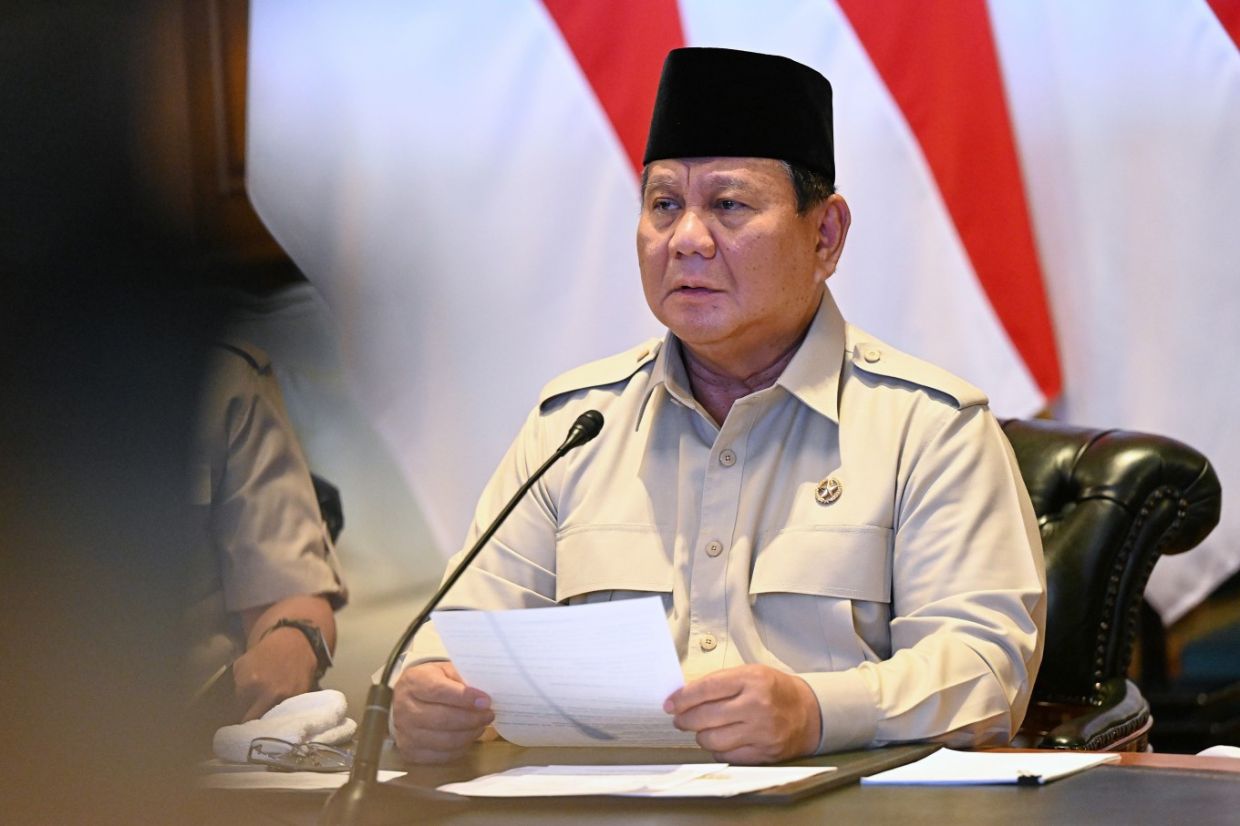
Indonesia's President Prabowo Subianto has experienced a dramatic reversal in public favour, with his approval rating plummeting from 81.2 percent in November 2025 to just 51.1 percent by July 2026. The collapse represents one of the sharpest nine-month declines for any major world leader in recent memory and signals that the extended honeymoon period enjoyed by Southeast Asia's largest economy now faces political reality. Survey data from Saiful Mujani Research and Consulting (SMRC) reveal that dissatisfaction has simultaneously surged from roughly 16 percent to 46.9 percent, a dramatic swing that suggests public patience with the administration has worn thin.
The durability of Prabowo's initial popularity was itself remarkable. Most newly elected presidents experience an early slide in support as campaign rhetoric confronts governing constraints, yet Prabowo defied this pattern throughout 2025. His predecessor, Joko "Jokowi" Widodo, never achieved comparable approval levels until deep into his second term, when SMRC recorded his highest rating at 81.7 percent in May 2023. By contrast, Prabowo's first term started near 62 percent and soared into the 70s and 80s—a trajectory that seemed almost immune to the conventional political gravity that governs democratic transitions elsewhere. The difference lay partly in electoral momentum, but largely in the aggressive deployment of social spending, most notably the free nutritious meal programme launched in January 2025, which generated genuine public enthusiasm and extended goodwill far beyond typical honeymoon duration.
This extended run of approval stands in sharp relief against global comparatives. Donald Trump began his second term in January 2025 with just 47 percent approval, historically low for a newly inaugurated American president, while Barack Obama and Joe Biden both experienced steep early declines from their opening highs. Even accounting for methodological differences between polling systems, Prabowo's 70-80 percent plateau represented exceptional political capital. That plateau now appears exhausted. The July 2026 SMRC survey, which involved 749 respondents polled between July 5-19, confirms that the goodwill accumulated through social programmes and initial economic optimism has dissipated as underlying conditions deteriorated.
Economic performance stands at the heart of the collapse. Prabowo campaigned on ambitious pledges to curb corruption and accelerate gross domestic product growth from the historical 5 percent to 8 percent—targets that seemed achievable during a favourable global environment. However, the rupiah has weakened considerably, equities remain sluggish, and concerns about unsustainable state spending and potential threats to central bank independence have surfaced among domestic and international investors. Public confidence in economic management has cratered accordingly. SMRC data show positive perceptions of the economy at only 15.7 percent in July 2026, a striking decline that fundamentally undermines any rhetorical message about progress. Citizens encounter economic deterioration through daily lived experience—prices at markets, exchange rates affecting imports, job prospects, and purchasing power—which no amount of presidential visibility can offset.
The survey also reveals significant damage in political and law enforcement perceptions. Positive assessments of the political environment fell sharply from 35.8 percent in November 2025 to 13.5 percent in July 2026, suggesting that public confidence in democratic institutions and governance itself has weakened. Law enforcement perception, at 26.4 percent, points to lingering concerns about corruption and judicial independence, areas where Prabowo's anti-corruption platform promised transformative change. These disparate declines across multiple governance domains suggest that the problem is not isolated to any single policy failure but rather reflects a broader sense that the administration has underdelivered on fundamental institutional reform.
Prabowo has not been a passive participant in his own decline. The President maintains a highly visible public profile through frequent televised addresses and a communications apparatus specifically designed to keep him prominent in national discourse. His readiness to directly confront critics and journalists has been characteristic of his approach to managing public perception. This strategy functioned adequately when underlying economic conditions remained sufficiently positive that rhetorical positioning could bridge the gap between campaign promises and administrative reality. However, the July figures suggest that a ceiling has been reached beyond which increased visibility produces diminishing returns. The public ultimately judges presidential performance through tangible experience—food prices, exchange rates, employment prospects, and whether flagship programmes such as the free meal initiative actually function as promised—rather than through how forcefully the president rebuts detractors on television.
Two independent polling organisations now converge on similar findings, substantially strengthening the credibility of these numbers. While critics have noted that SMRC founder Saiful Mujani has emerged as a government critic—a legitimate point that officials from Prabowo's Gerindra Party have raised—this observation does not constitute evidence of methodological flaws. SMRC maintains a long track record of rigorous survey work, including periods when its findings favoured the Jokowi administration. More compellingly, Indikator Politik Indonesia conducted an independent survey of 4,250 respondents between July 14-24 that discovered satisfaction at 49.5 percent, down from 68 percent in April 2026 and 81 percent in December 2025. This convergence across two separate organisations essentially eliminates claims that bias explains the results. When disparate polling operations independently reach similar conclusions, methodological credibility becomes very difficult to dismiss.
Historically, thirty-point declines across nine months are neither unprecedented nor necessarily catastrophic for sitting presidents, provided they recover sufficiently before electoral pressures intensify. However, the speed and magnitude of Prabowo's drop signal that the initial social spending advantage has been exhausted without corresponding gains in structural economic improvement or institutional reform. The free meal programme, which extended the honeymoon period through much of 2025, cannot indefinitely compensate for currency weakness, sluggish growth, or perceptions of corruption. Governments facing such situations must fundamentally shift strategy from distributing benefits to delivering systemic improvements that ordinary citizens recognise in their economic circumstances.
Responses within Prabowo's inner circle suggest recognition of the severity. The President has convened the National Economic Council (DEN) to evaluate policies in areas where public satisfaction has declined most sharply—economic management chief among them. According to government sources, discussions have focused on expanding social assistance programmes and addressing specific vulnerabilities such as weakening household purchasing power and rising food prices. Forecasts of an El Niño event have prompted additional concern that climate disruption could trigger broader economic turbulence, which the administration hopes to mitigate through decisions such as holding fuel prices unchanged. These adjustments indicate that the presidency understands the necessity of concrete economic action rather than continued rhetorical emphasis.
Simultaneously, Prabowo's advisers have consulted with pollsters involved in his successful 2024 presidential campaign, seeking diagnostic insight into recovery pathways. These consultants have reportedly urged the President to undertake two parallel initiatives: enhancing public communication strategies and conducting comprehensive reviews of government programmes that have experienced implementation difficulties. The free nutritious meal programme and the Red and White Cooperatives initiative have both faced delivery challenges that undermine their political benefit. One pollster involved in these discussions noted that "public approval could recover if improvements are made within the President's inner circle," a formulation suggesting that success depends less on expanded messaging than on actual operational improvements within government structures.
For Malaysian and Southeast Asian observers, Prabowo's trajectory carries important implications. Indonesia's political economy heavily influences regional stability and economic conditions, and sustained erosion of presidential legitimacy could eventually constrain policy coherence on trade, security, and cross-border issues. The mechanics of Prabowo's decline—campaign promises colliding with economic constraints, social spending providing temporary relief rather than systemic solutions, and public judgment ultimately resting on tangible experience rather than rhetoric—reflect patterns that apply across democratic systems in the region. The Indonesian case demonstrates that even unusually popular leaders cannot indefinitely substitute distributional programmes for structural economic management. For neighbouring governments, the lesson is sobering: honeymoons end when reality intrudes, and recovering public confidence requires genuine improvements, not merely more visible leadership.

