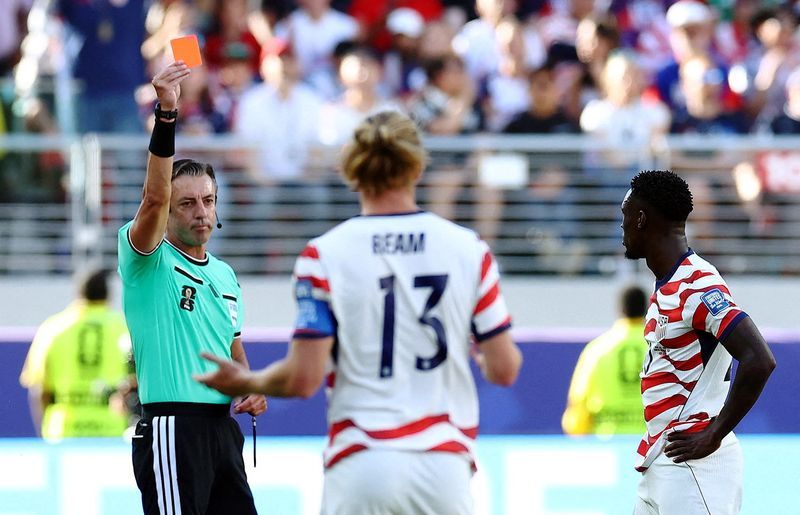
The Premier League's senior officiating and administrative figures are voicing alarm that the international football community's handling of Folarin Balogun's World Cup suspension has inflicted lasting damage on the credibility of football's disciplinary processes. Howard Webb, who oversees refereeing standards at Pro Ref, and chief executive Richard Masters both cautioned that the controversy surrounding the American forward's reinstatement risks poisoning public perception of match officials not only at the global tournament level but also extending into the domestic season beginning on Friday.
The Balogun case centred on FIFA's decision to lift a red card suspension after U.S. President Donald Trump publicly advocated for the player's reinstatement. The reversal occurred through a mechanism that observers deemed opaque and unprecedented, creating a narrative in which political pressure appeared to have overridden established sporting regulations. Webb articulated his deepest concerns not primarily about disagreement with the original dismissal decision itself, but rather with how the subsequent chain of events had unfolded and the implications this carries for football's integrity.
Web's discomfort runs deeper than the isolated incident. The controversy arrives at a moment when online discourse increasingly frames contentious refereeing decisions as evidence of systemic corruption, with social media platforms amplifying speculation untethered from factual grounding. Webb acknowledged that contemporary sports discourse has become saturated with unfounded allegations of misconduct, where observers attempt to reverse-engineer sinister motivations from decisions they dislike without substantive evidence. The Balogun episode, he suggested, furnishes ammunition to those predisposed to question official impartiality by appearing to validate conspiracies about behind-the-scenes influence on football's governance.
The timing compounds the concern. With the new Premier League campaign commencing, every significant refereeing decision and VAR intervention will face intense public scrutiny. Webb warned that the lingering fallout from the World Cup incident creates space for reasonable-minded viewers to harbour doubts about whether comparable political or commercial pressures might be operating within English football. He described the situation as particularly troubling precisely because it provides credibility to narratives he maintains are divorced from reality in his professional experience.
Masters approached the matter from a different angle, lamenting that discourse surrounding the World Cup has become overwhelmed by off-field controversies rather than the actual quality of football on display. He highlighted that while Spain's tactical dominance and England's heartbreaking semi-final exit deserved prominence in post-tournament analysis, these substantive sporting narratives have been overshadowed by administrative irregularities. This displacement of focus exemplifies how procedural controversies can erode the celebration of athletic achievement and sporting excellence.
The executive also identified systemic deficiencies in FIFA's regulatory architecture. Unlike many domestic competitions, FIFA's disciplinary framework lacks mechanisms to review and overturn red card decisions through established appeal channels. This regulatory gap meant that Balogun's restoration required extraordinary intervention outside normal procedures, generating the very perception of opacity and irregular process that has fuelled scepticism. Masters characterised this as a fundamental weakness in international football governance that the Balogun case has exposed with uncomfortable clarity.
The implications extend into tactical and professional territory. Webb confirmed that the Premier League will implement an expanded suite of regulatory amendments designed to accelerate match tempo and eliminate time-wasting tactics. Referees will demonstrate reduced tolerance for minor infringements, with more situations prosecuted rather than managed through warnings. This enforcement intensification, while aimed at improving spectacle quality, arrives against a backdrop of diminished public confidence in official decision-making.
The challenge Webb faces is genuinely consequential. As match officials navigate these tighter regulatory parameters throughout the season, fans and media commentary will inevitably dissect disputed calls with greater intensity. The Balogun controversy, having demonstrated that external political pressure can apparently circumvent established procedures, provides a template for questioning whether other forces might be influencing decisions on English football's biggest stage. Even unfounded suspicions, when sufficiently widespread, can erode the cooperative relationship between officials and the sporting public.
For Malaysian and Southeast Asian football observers, the episode carries instructive implications about institutional vulnerability in global sport. The case illustrates how geopolitical weight can be mobilised to challenge sporting governance, and how transparency deficits in international regulations create space for legitimacy crises even when individual decisions might ultimately prove defensible. It also underscores the dependence of professional football on maintaining public faith in impartial officiating—a faith that cannot be reconstructed quickly once damaged through perceived procedural irregularities.
The unfolding Premier League season will provide empirical testing ground for whether Webb's concerns materialise. If a pattern of contentious decisions emerges, the Balogun precedent could be invoked repeatedly as evidence of systemic bias. Conversely, a season of disciplinary consistency might gradually restore confidence. Yet the damage appears already substantial: the narrative that political pressure can override sporting rules has entered public consciousness, and no quantity of well-executed decisions may entirely dispel it. Webb's sombre assessment that the controversy "doesn't help" in restoring faith in officiating acknowledges a harsh reality about institutional reputation once compromised.

