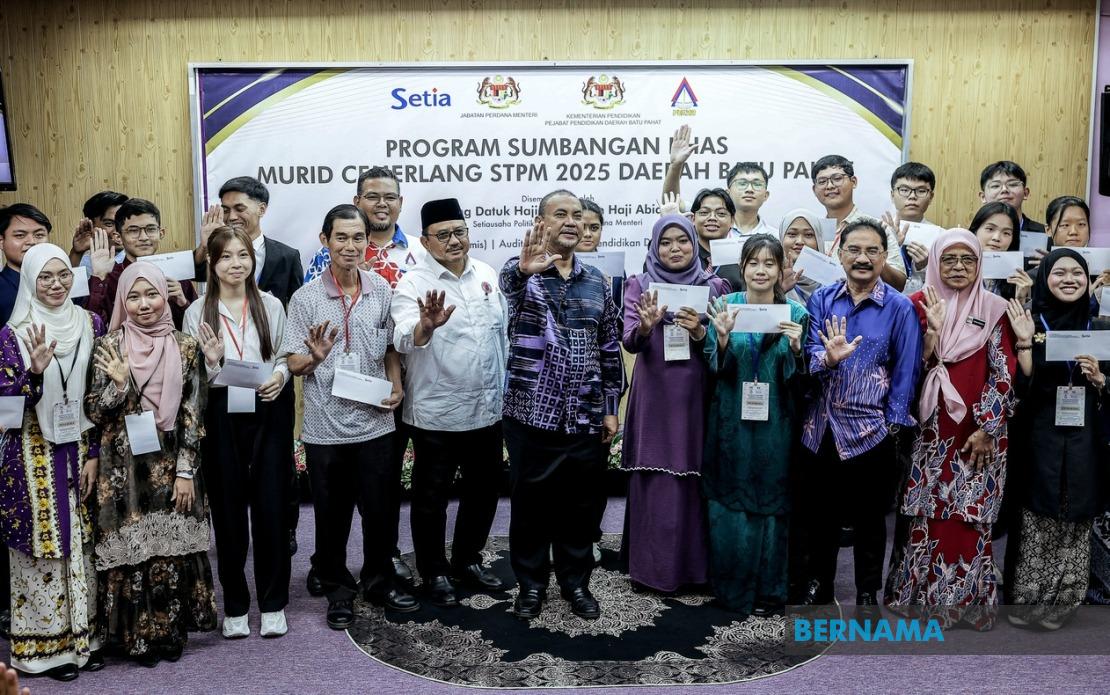
The Prime Minister's Office has recognised the outstanding academic achievements of 214 high-performing STPM students in Batu Pahat through a special contribution programme unveiled at a ceremony held at the district education office. The initiative, which honours graduates from 16 secondary schools across the district, represents a direct government investment in talent recognition and educational advancement at a critical juncture in students' academic journeys.
Datek Azman Abidin, who serves as Political Secretary to the Prime Minister, explained that the contribution scheme operates as both a recognition of merit and a practical support mechanism for talented students preparing for tertiary education. The programme underscores the government's commitment to identifying and nurturing high-achieving individuals who demonstrate the potential to contribute meaningfully to Malaysia's future workforce and society more broadly.
Speaking to reporters following the 2025 STPM Top Achievers Award Ceremony, Azman outlined the government's vision for the initiative's expansion. While the current distribution focuses on Batu Pahat, officials have signalled intentions to broaden the programme to other locations, contingent upon budget allocation and available resources. This phased approach reflects a deliberate strategy to scale successful education support initiatives across different regions, potentially benefiting a larger cohort of accomplished students nationwide.
The contribution scheme carries particular significance in the Malaysian education context, where disparities in access to higher education financing remain a persistent challenge for many families. For recipients who come from middle and lower-income backgrounds, such financial support can prove instrumental in reducing barriers to university enrolment and allowing students to focus on their studies rather than supplementary income generation. The initiative therefore extends beyond symbolic recognition to provide tangible assistance during a financially demanding transition period.
Among the recipients was Afida Auni Airulnizam, a 20-year-old graduate from Sekolah Menengah Kebangsaan Tun Sardon in Rengit, who articulated how the recognition resonated on both emotional and practical levels. As the younger of two siblings, Afida drew inspiration from her older brother's university experience and harboured ambitions to pursue sports science at the tertiary level. The contribution, she reflected, served as meaningful validation of her academic efforts while simultaneously easing concerns about funding constraints that might otherwise impede her educational progression.
The programme also resonated with Muhd Ammar Firdaus Mohd Fadzil, a 20-year-old former student of SMK Tun Ismail, who emphasised the financial burden inherent in preparing for higher education. Beyond tuition fees themselves, prospective university students face substantial costs encompassing application processes, accommodation searches, and initial living expenses. By providing targeted contributions to high achievers, the government effectively acknowledges these multifaceted financial pressures and demonstrates recognition that academic merit alone cannot overcome systemic barriers without adequate support infrastructure.
The timing of this recognition initiative carries broader implications for Malaysia's human capital development strategy. STPM qualification holders represent a cohort that has demonstrated sustained academic commitment and competitive performance within Malaysia's secondary education system. Investing in their transition to higher education yields multiplicative returns, as these individuals are likely to pursue professional qualifications and contribute to sectors demanding advanced expertise, from healthcare and engineering to research and technology.
Datek Azman's statements regarding ongoing support and potential geographic expansion indicate that policymakers view this as more than a one-off gesture. The conditional framing—that continuation depends on available funding—nonetheless reveals budgetary realities constraining ambitious expansion. This underscores the tension within education financing between aspirational policy objectives and fiscal constraints, a challenge confronting many governments across Southeast Asia grappling with competing spending priorities.
For secondary schools participating in the scheme, the recognition extends beyond individual recipients. Institutions whose students secure awards gain institutional validation and, potentially, enhanced reputational standing within their communities. This incentivises schools to maintain rigorous academic standards and provide quality teaching environments, contributing incrementally to systemic improvements in educational quality across districts like Batu Pahat.
The initiative also reflects evolving government attitudes toward talent recognition and meritocratic principles in education policy. By explicitly celebrating academic achievement at the secondary level, authorities send clear signals to younger cohorts that scholarly excellence attracts official recognition and material support. This can influence motivational dynamics within schools and encourage students to invest effort in academic pursuits, knowing that demonstrated competence carries tangible rewards.
Looking forward, the success of this programme in Batu Pahat will likely inform decisions about scaling similar initiatives elsewhere. If properly evaluated and documented, the scheme could provide valuable evidence regarding effective mechanisms for supporting high-achieving students' transition to tertiary education, contributing to broader policy development. Additionally, tracking recipient outcomes over time would illuminate whether such targeted support correlates with improved tertiary completion rates and subsequent career trajectories, information valuable for refining future iterations.
The recognition of these 214 students ultimately represents an investment in Malaysia's educational ecosystem and, by extension, in the nation's long-term competitiveness and development. While individual contributions provide immediate support, the broader significance lies in institutionalising recognition of merit and demonstrating governmental commitment to nurturing talent at critical educational transitions.

