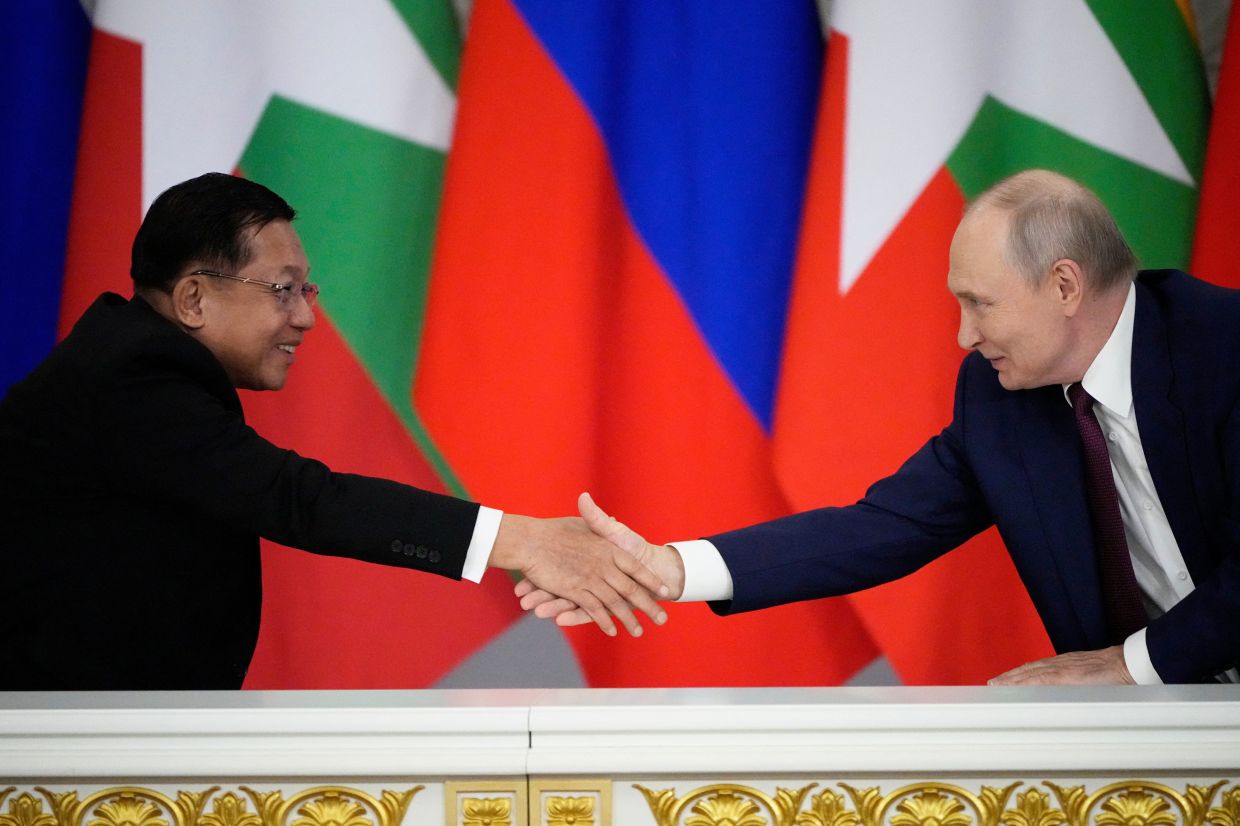
Russian President Vladimir Putin hosted Myanmar's Min Aung Hlaing in Moscow on Tuesday for talks that underscored the Kremlin's strengthening partnership with one of Asia's most isolated regimes. The meeting marked the Myanmar leader's first official visit to Russia since assuming the presidency in April following a controversial election, and came at a time when Min Aung Hlaing is actively seeking international legitimacy for his military-backed government after years of international condemnation.
Putin characterised the relationship between the two nations as "especially trusting" and highlighted the breadth of cooperation extending across military, economic and technological domains. The Russian leader's emphasis on this growing partnership reflects Moscow's strategy to cultivate allies in Southeast Asia at a moment when Western nations have largely frozen diplomatic and economic relations with Myanmar's military rulers. The presence of high-ranking officials from Russia's foreign ministry, finance sector, energy industry and defence establishment at the Kremlin talks illustrated the strategic importance both sides attach to the relationship.
Energy cooperation represents a cornerstone of Russia's engagement with Myanmar. Putin disclosed plans to construct a power plant and oil refinery in southern Myanmar, with Russia also seeking involvement in the country's geological surveys and hydrocarbon extraction operations. Beyond these immediate infrastructure ambitions, Moscow has expressed interest in participating in liquefied natural gas export projects, projects that could generate substantial long-term revenue for Myanmar's cash-strapped treasury and provide Russia with additional energy markets insulated from Western sanctions.
The nuclear dimension of the partnership underscores Moscow's technical reach in Myanmar. Myanmar is collaborating with Russia's Rosatom State Corporation to develop a small-scale nuclear power plant, a project framed as the foundation for broader applications of nuclear technology in healthcare, agriculture and industrial sectors. This cooperation places Myanmar among a select group of nations acquiring nuclear capabilities with Russian assistance, signalling deep technological integration between the two countries.
Military ties between Russia and Myanmar have solidified considerably since the February 2021 coup that ousted the civilian government of Aung San Suu Kyi. Russia has emerged as a primary weapons supplier to Myanmar's armed forces, with defence sales exceeding US$400 million since the coup according to a United Nations report from May 2023. Putin's explicit reference to "close military and military-technical cooperation" acknowledges this arms relationship, which has flourished precisely as Western nations imposed restrictions on military engagement with Myanmar.
The timing of this Moscow summit fits within a broader diplomatic offensive by Min Aung Hlaing to rehabilitate his government's international standing following the August 2023 election that was widely criticised by Western democracies and the UN as fundamentally flawed. The Myanmar president has undertaken an intensive schedule of regional visits, travelling to China, India, Laos and Thailand in recent months as he attempts to build a coalition of supportive nations. Notably, his administration has simultaneously pursued improved ties with the United States and sought greater integration with the Association of Southeast Asian Nations, even as it steadfastly refuses pressure to release Aung San Suu Kyi or move towards democratisation.
This is at minimum the fourth encounter between Min Aung Hlaing and Putin since Russia's invasion of Ukraine in February 2022, an invasion that prompted unprecedented Western sanctions against Moscow. The frequency of their meetings demonstrates the mutual utility of the relationship at a time when both nations face significant international isolation. For Myanmar, Russian support provides military capability and economic investment at a moment when Western capital flows have dried up. For Russia, Myanmar offers a foothold in a strategically important region and a willing partner unconstrained by Western pressure.
The Myanmar delegation that arrived in Moscow included multiple cabinet ministers and the head of the Myanmar Space Agency, indicating the comprehensive nature of the bilateral agenda. Beyond his meeting with Putin, Min Aung Hlaing held discussions with Prime Minister Mikhail Mishustin and Vyacheslav Volodin, speaker of Russia's lower house parliament. The itinerary included participation in a Myanmar-Russia Business Forum, suggesting efforts to expand commercial ties beyond traditional state-to-state channels.
For Southeast Asian observers, the deepening Russia-Myanmar relationship raises important questions about regional geopolitics and Myanmar's strategic orientation. As China simultaneously strengthens its influence in Myanmar through substantial investment and military support, Russia's expanding role creates a multipolar dynamic within the country. Myanmar's willingness to deepen ties with Moscow despite international isolation suggests the military leadership has adopted a strategy of strategic hedging, diversifying partnerships to reduce dependence on any single foreign power while maintaining access to military hardware and economic investment.
The Russian engagement with Myanmar also reflects broader geopolitical shifts in the Indo-Pacific region. With Western nations maintaining distance from Myanmar's military government, authoritarian-leaning powers including Russia and China have positioned themselves as alternative partners willing to provide unconditional support. This dynamic has implications for regional stability and for how Myanmar navigates the escalating competition between Russia-China and Western-aligned nations across Asia.
For Malaysia and other ASEAN members, Myanmar's gravitation towards Russia and China presents a diplomatic challenge. The bloc has struggled to maintain cohesion on Myanmar policy, with some members prioritising engagement over isolation and others advocating stronger pressure for democratic reforms. The Russia-Myanmar partnership signals that international isolation alone may be insufficient to alter the junta's behaviour, forcing regional governments to consider whether alternative diplomatic approaches might prove more effective in encouraging movement towards democratic restoration.

