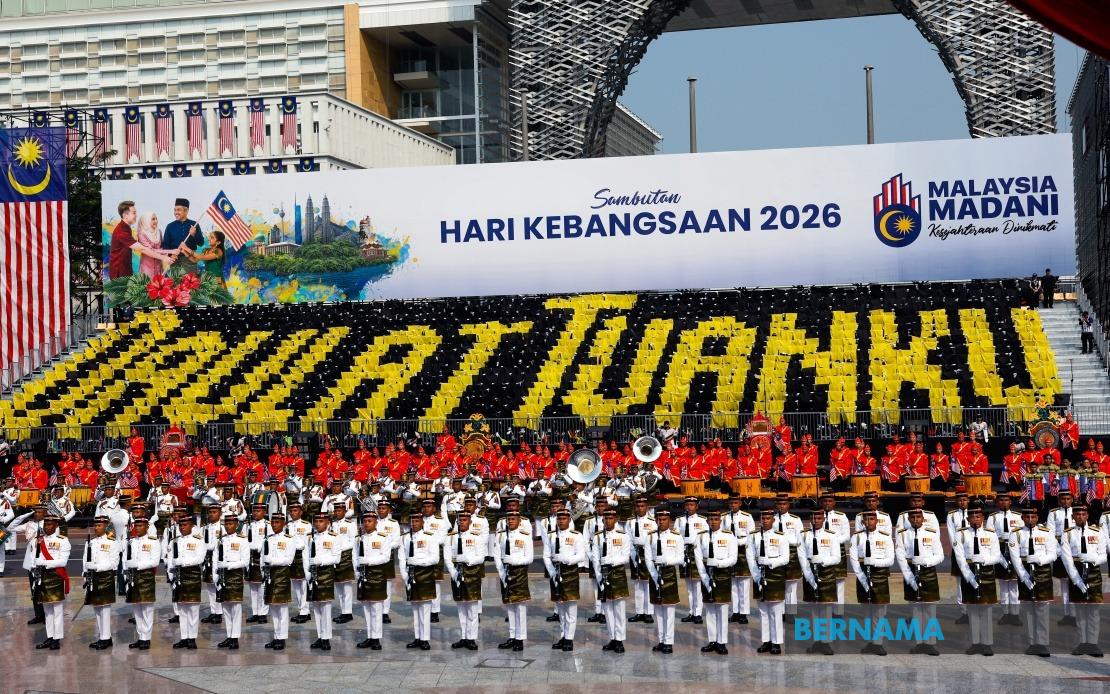
The nation's administrative heart will come alive tomorrow as Dataran Putrajaya hosts a sprawling 69th National Day celebration designed to crystallize Malaysia's contemporary identity around the Malaysia MADANI framework centring prosperity and well-being. The grand gathering, commencing at 8 a.m., will draw tens of thousands of spectators to witness a carefully orchestrated display of patriotism, national capability, and cultural richness that reflects the government's vision for a united, progressive Malaysia.
Royal patronage lends weight to the occasion, with His Majesty Sultan Ibrahim, King of Malaysia, and Her Majesty Raja Zarith Sofiah, Queen of Malaysia, attending the proceedings alongside Prime Minister Datuk Seri Anwar Ibrahim and Cabinet members. This high-level official presence underscores the ceremonial importance attached to the event, signalling both continuity of constitutional monarchy traditions and the administration's commitment to fostering civic pride during a period of social and economic recalibration.
The parade itself represents a mobilization of extraordinary logistical proportions. Organizers have marshalled 10,819 participants organized within 76 distinct contingents, supported by 22 marching bands, 11 float vehicles, and impressive arrays of military hardware encompassing 328 land, naval, and air assets. The inclusion of 112 working animals and 22 electric vehicles reflects conscious efforts to blend traditional ceremonial elements with contemporary sustainability messaging, particularly relevant to younger Malaysian audiences increasingly attuned to environmental concerns.
The opening spectacle, "Gema Inovasi MADANI," orchestrated by the National Department for Culture and Arts, deploys 700 traditional kompang frame drums and 150 additional percussion instruments to create a sonorous celebration of Malaysia's multicultural composition. This deliberate fusion of heritage instruments from the nation's principal ethnic communities transforms the opening minutes into a performative statement about cultural pluralism as foundational to national identity—a counternarrative to sectarian or communal fragmentation that occasionally surfaces in Malaysian public discourse.
Thematic components woven throughout the parade narrative encompass statehood, well-being, public order, and national security, each segment reinforcing specific dimensions of governmental legitimacy and social cohesion. The statehood contingent draws personnel from the National Resilience Leadership Academy and National Defence University of Malaysia, visibly connecting youth leadership development to national institutional structures. Military cadet participation sends symbolic messages about disciplined civic participation and the armed forces' role in contemporary society beyond purely defensive functions.
Athletic achievement receives particular emphasis through participation by national sportspeople and medallists returning from international competition, positioning sporting excellence as a manifestation of Malaysian prowess on global stages. This deliberate elevation of athletic representation reflects broader government strategies to harness sporting nationalism as a vehicle for inclusive patriotism—particularly important in a multiethnic democracy where sporting achievement can transcend communal boundaries through shared celebration of national representation.
Private sector integration throughout the parade represents a significant departure from purely state-centric ceremonialism. Participation by corporations including Munchy's Malaysia, ZUS Coffee, AirAsia, Malaysia Airlines, and Carsome Sdn Bhd embeds commercial enterprises within the patriotic narrative, effectively positioning business success as aligned with national advancement. This blending of commercial and civic spheres reflects the Malaysia MADANI emphasis on inclusive prosperity, though it simultaneously raises questions about corporate influence over state ceremony and the boundaries between commercial messaging and patriotic expression.
Public safety and welfare agencies feature prominently, including the Civil Defence Force, Road Transport Department, and Fire and Rescue Department, whose parade participation reminds spectators of institutional arrangements providing security and stability underpinning daily life. The Johor Military Force's inclusion as Malaysia's oldest military unit connects contemporary national pageantry to historical traditions of monarchical protection and institutional continuity, anchoring present celebrations within deeper historical narrative.
Tourism messaging permeates the celebration through elaborate floats showcasing Malaysia's regional diversity—flora, fauna, traditional costumes, and musical instruments representing different communities. Strategically positioned ahead of the 2026-2027 Visit Malaysia Year campaign, these displays function as subtle promotional content, utilizing national ceremony as platform for tourism marketing. This instrumentalization of patriotic occasions for economic purposes has become increasingly routine across Southeast Asian nations navigating competitive tourism markets.
Animation and youth-oriented programming through Upin and Ipin characters and synchronized formations by 1,500 students from 36 Selangor schools deliberately broadens the celebration's appeal beyond traditional state ceremony audiences. The human graphics component involving such substantial student participation creates participatory opportunities for younger Malaysians, potentially fostering direct emotional connections to national symbolic occasions through active involvement rather than passive spectatorship.
Military prowess receives dramatic finale through a Royal Malaysian Air Force display featuring fighter jets conducting aeronautical maneuvers above the administrative center. This aerial demonstration functions as both spectacle and assertion of national defense capability, projecting martial strength to both domestic audiences and international observers monitoring regional security balances. The symbolic geography of this air show—above the capital's administrative epicenter—reinforces associations between state institutions and territorial sovereignty.
Concluding performances include "Rentak MADANI, Paluan Tradisi" and the theme song "Aku Berjanji" composed by Faizal Tahir, embedding popular culture and contemporary music within patriotic frameworks. This cultural strategy attempts to contemporize national ceremony through association with recognizable entertainment personalities, making abstract governmental visions tangible through artistic expression.
Practical considerations reflecting current environmental challenges include distribution of N95 face masks to over 10,000 parade participants and public advisories regarding haze protection—a necessary adaptation to persistent Southeast Asian air quality challenges. Simultaneously, comprehensive road closures affecting five major bridges and surrounding routes necessitate careful transport planning by attendees, with authorities encouraging public transit utilization. These logistical realities underscore the massive operational footprint required to stage contemporary national celebrations, balancing spectacular presentation with urban management imperatives affecting hundreds of thousands of residents and commuters across the Klang Valley metropolitan region.

