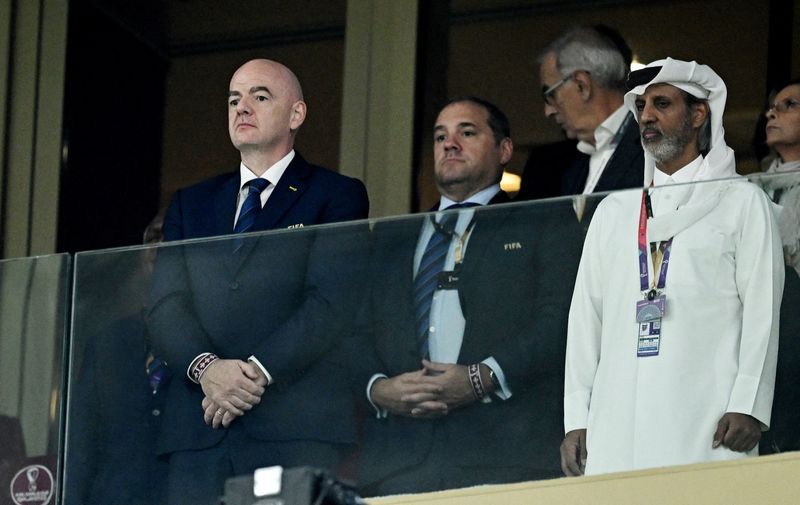
The Qatar Football Association has deepened its confrontation with the Asian Football Confederation over what it views as a breach of proper governance, refusing to accept the AFC's explanation for signing a joint letter condemning FIFA President Gianni Infantino without first seeking approval from member nations. In a third escalating correspondence that reveals rare public discord within one of world football's regional bodies, QFA President Hamad bin Khalifa Al-Thani rejected the AFC's defence of its conduct, arguing that his counterpart Sheikh Salman bin Ebrahim Al-Khalifa had overstepped his mandate by speaking unilaterally on behalf of Asia's 47 football associations.
Infantino, who is seeking reelection as FIFA president in the coming year, has faced unprecedented internal criticism following his failed push to secure private investment funding for future World Cup tournaments. The initiative, known as the FIFA Forward Enterprise proposal, triggered significant backlash from confederations, national associations, and senior football figures who argued that such a fundamental restructuring of world football's premier competition ought to have involved broader consultation. The joint letter from the AFC, UEFA, and CONCACAF challenged both Infantino's handling of the proposal and questioned his broader fitness to continue leading the global body.
What began as Qatar's initial complaint about the AFC's failure to consult its membership has evolved into a detailed institutional dispute over the limits of presidential authority within confederation governance structures. Al-Thani's latest letter, sent on Wednesday and reviewed by Reuters, focuses deliberately on a narrow but crucial procedural question: whether Sheikh Salman possessed the authority to commit the AFC to a public statement criticising Infantino without first obtaining formal endorsement from member associations or even the AFC's executive committee. In doing so, Qatar has shifted the debate away from the substance of FIFA's conduct toward the mechanics of how power operates within Asian football's governing hierarchy.
The AFC's response, delivered the previous day, saw Sheikh Salman robustly defend his actions, asserting that he held both the authority and responsibility to act decisively in defence of Asian football's interests. The Bahraini administrator further argued that waiting for consensus from 47 member associations on matters of such importance would have rendered the confederation unable to respond promptly to significant challenges facing the sport. He also pointed to historical precedent, noting that previous AFC statements on matters critical to Asian football—including public backing for Qatar's hosting of the 2022 World Cup amid international criticism—had been issued without seeking formal approval from every member association.
This procedural argument carries particular significance for Malaysian and Southeast Asian football governance, as it raises fundamental questions about how regional sporting bodies balance the need for swift institutional responses with the principle that major decisions ought to reflect member consensus. The AFC's position, essentially, is that confederation presidents must retain discretionary authority to make public pronouncements on behalf of their organisations, otherwise decision-making would become paralysed. Qatar's counter-argument insists that the limits of that authority must be defined clearly and respected scrupulously, particularly when statements might commit member nations to controversial positions affecting their relationship with FIFA.
Qatar's prominent position within this dispute reflects its somewhat unique status within Asian football. The country was among only six AFC members who declared early support for Infantino during the crisis triggered by the failed investment proposal, marking Qatar as part of a minority position within the confederation. This alignment with the FIFA president adds particular weight to Qatar's complaints about process and governance, as it allows the nation to frame its objections as technical rather than motivated by opposition to Infantino himself. By focusing on whether proper procedures were followed, rather than disagreeing with the letter's substance, Al-Thani effectively argues that his concerns transcend mere loyalty to the FIFA president.
The escalating correspondence between these two senior figures represents a striking departure from the AFC's traditional culture of conducting sensitive business behind closed doors. For decades, the confederation has cultivated an institutional preference for resolving disputes through private dialogue, with public statements typically reserved for ceremonial occasions or predetermined announcements. That Al-Thani and Sheikh Salman have now exchanged multiple letters that are being circulated to international media outlets suggests that internal negotiations have broken down entirely, and both sides now regard the dispute as sufficiently important to carry their argument to a broader audience.
Al-Thani's latest response reiterates that Sheikh Salman, regardless of his title or historical practice, cannot unilaterally exercise authority that properly belongs to the AFC's executive committee or membership as a whole. As a member of the FIFA Council who also sits on the AFC executive committee, Al-Thani possesses both the standing and knowledge to argue authoritatively about the confederation's governance structures. His contention that the AFC president's authority is defined and limited by executive committee decisions represents a direct challenge to Sheikh Salman's assertion of expansive presidential discretion.
Regarding the historical precedent that Sheikh Salman cited, Al-Thani offered a careful reframing. He acknowledged that the AFC had previously issued public statements supporting Qatar's World Cup hosting, but argued that those earlier statements reflected the confederation's own institutional interest in successfully staging a tournament in Asia. By contrast, the recent joint letter criticising Infantino does not serve any comparable institutional interest of the AFC itself; rather, it represents a position that individual member associations might or might not support, depending on their own bilateral relationships with the FIFA president. This distinction highlights the difference between statements serving the confederation's collective good and statements that impose a political position on members without their consent.
The entire dispute unfolds against a backdrop of broader tensions within FIFA and international football governance. The failed attempt to introduce private investment into World Cup financing has exposed fault lines between different regional confederations, wealthier national associations, and FIFA's executive leadership. Qatar's financial resources and hosting experience with the 2022 World Cup gave it particular leverage to influence how Asian football should position itself during this period of institutional upheaval. By objecting to the AFC's unilateral decision-making, Qatar signals that it intends to defend its voice and influence within confederation structures, refusing to be bound by decisions made without its participation.
Sheikh Salman has not yet responded publicly to Al-Thani's latest letter, and AFC officials have declined requests for comment. Their silence may reflect uncertainty about how to address the fundamental challenge to his authority without further escalating the dispute, or it might indicate that the confederation's leadership is consulting with other member associations about how to proceed. The situation remains unresolved and likely to generate continued tension within Asian football's institutional structures in the coming months. For Malaysian football administrators and fans watching these developments, the episode illustrates how disputes over procedural fairness and democratic governance can become just as significant as substantive disagreements over policy matters, particularly within organisations where tradition and protocol have always carried substantial weight.

