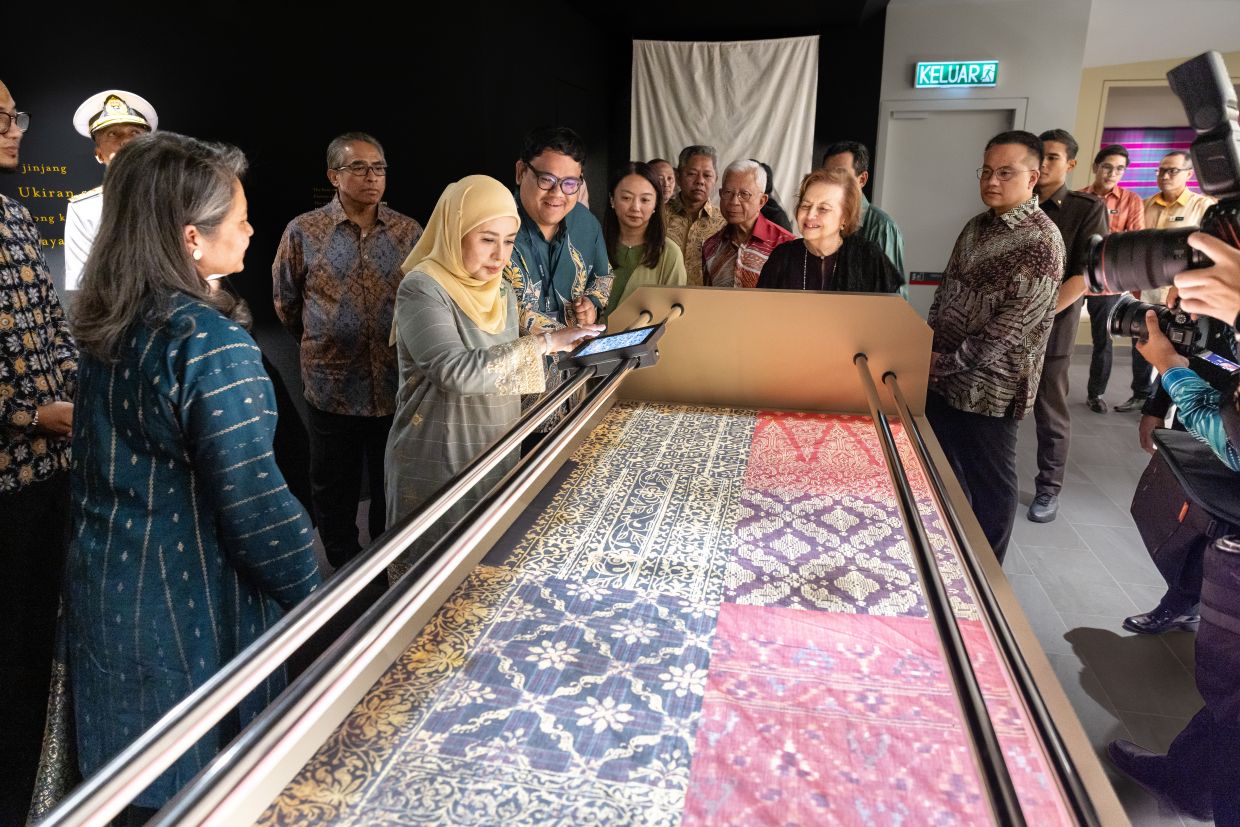
Her Majesty Raja Zarith Sofiah, Queen of Malaysia, officially opened the Merdeka Textile Museum yesterday within the Menara Merdeka Maybank complex in Kuala Lumpur, marking a significant moment in the nation's commitment to cultural preservation. The inaugural event underscores the royal family's investment in safeguarding Malaysia's artistic traditions at a time when many Southeast Asian societies grapple with the erosion of ancestral knowledge amid rapid modernisation.
PNB Merdeka Ventures Sdn Bhd, a wholly-owned subsidiary of the state-linked investment fund Permodalan Nasional Berhad (PNB), spearheaded the museum's establishment with an explicit mission to conserve and celebrate the textile legacy of the broader Malay world. Rather than adopting a purely archival approach, the institution combines historical scholarship with contemporary exhibition design and interactive cultural programming, reflecting an evolving understanding of how heritage institutions should engage audiences beyond traditional museum-going demographics.
In her remarks, Her Majesty emphasised the universal imperative for nations to recognise, protect, and transmit cultural inheritance across generational lines. She articulated a vision of textiles as vessels of national identity and societal values, positioning the museum not merely as a repository of objects but as an active pedagogical space for cultural transmission. This framing resonates particularly in Malaysia, where weaving traditions, songket production, and textile arts remain economically and spiritually significant practices across diverse communities.
Her Majesty expressed hope that the museum would function as a hub for intellectual engagement and discovery, serving as a catalyst for contemporary Malaysian women to reconnect with heritage traditions. She also stressed the necessity of cultivating appreciation among younger Malaysians for indigenous cultural practices, warning against the risk of irreversible cultural loss through indifference or neglect. These concerns reflect broader regional anxieties about cultural erosion in Southeast Asia as globalisation reshapes lifestyle choices and economic priorities.
The museum's core collection derives from the personal holdings of the late Sharifah Azah Syed Mohammed Alsagoff, known as Azah Aziz, whose family has deep connections to Malaysia's intellectual and financial circles. As the wife of the distinguished academic Ungku Abdul Aziz Abdul Hamid and mother of former Bank Negara Malaysia governor Tan Sri Dr Ungku Zeti Akhtar Aziz, Azah Aziz accumulated her collection with scholarly rigour and cultural sensitivity over decades. The Azah Aziz family's decision to donate these pieces to the public institution ensures their accessibility for research and public education rather than remaining confined to private ownership.
The collection encompasses 240 individual garments alongside 69 traditionally crafted jewellery items, including songket sarongs—the elaborately patterned silk wraps integral to Malay ceremonial dress—and Limar Baju Kurung, the traditional tunic worn across the Malay-speaking world. Tekat Emas pieces, featuring hand-embroidered gold thread work, represent the pinnacle of textile artistry and remain economically valuable artefacts. These items collectively document evolving aesthetic standards, weaving technologies, and social conventions spanning generations of Malay society.
The museum's intellectual framework extends beyond material objects, drawing substantive inspiration from Azah Aziz's pioneering research contributions to textile studies and cultural history. This scholarly foundation distinguishes the institution from purely decorative or commercial textile collections, positioning it as a research-oriented venue capable of producing new knowledge about production techniques, trade networks, and cultural symbolism. Malaysian and international scholars now possess access to a systematically catalogued primary collection for advancing textile historical understanding.
Physically distributed across eight distinct galleries, the museum integrates exhibition spaces with sophisticated scholarly infrastructure including a conservation laboratory equipped to arrest textile deterioration, a fabric library containing sample materials and technical documentation, and a textile knowledge centre facilitating comparative research. This multi-functional design reflects international best practices in cultural institution development, acknowledging that heritage preservation requires simultaneous attention to public interpretation, professional conservation, and academic investigation. The study centre's inclusion ensures the collection serves researchers, conservators, and educators rather than solely visitor audiences.
The opening ceremony attracted prominent government officials including Minister in the Prime Minister's Department (Federal Territories) Hannah Yeoh, Chief Secretary to the Government Tan Sri Shamsul Azri Abu Bakar, and PNB group chairman Raja Tan Sri Arshad Raja Tun Uda, reflecting the institution's stature within Malaysia's cultural governance framework. This high-level attendance signals sustained government commitment to cultural infrastructure investment despite competing budgetary priorities, and acknowledges PNB's role as a facilitator of nation-building initiatives beyond conventional fund management.
For Malaysian readers and regional observers, the Merdeka Textile Museum represents a vindication of textile-focused cultural scholarship too often marginalised within academic hierarchies that privilege literary and architectural heritage. The museum legitimises fabric arts as worthy subjects for institutional investment and intellectual rigour, potentially encouraging similar initiatives throughout Southeast Asia. Given Malaysia's position as a global centre for textile manufacturing and design, the institution may also catalyse connections between historical practices and contemporary creative industries, demonstrating how heritage knowledge informs future economic value creation in the cultural and creative sectors.

